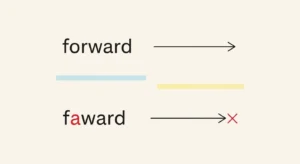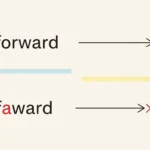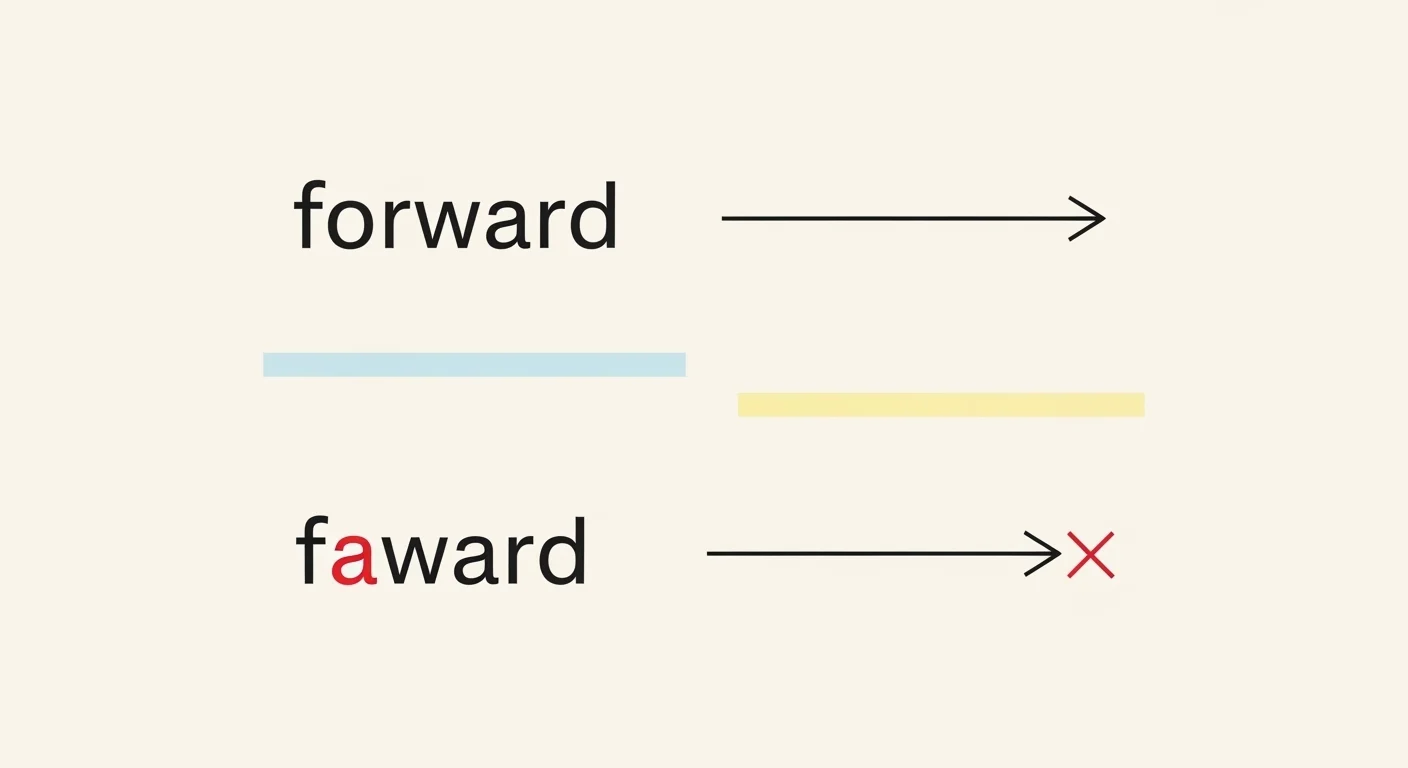
Many people feel confused about foward and forward because they look almost the same. When typing fast, it is very easy to miss one letter and not notice the mistake. This confusion is common for students, English learners, and even native speakers.
The good news is that this is a very simple problem to fix. Once you understand the correct spelling and see a few examples, you will never mix them up again.
Quick Answer
- Forward is the correct spelling
- Foward is a spelling mistake
- Always use forward in writing, speaking, and exams
Simple Background Explanation
The word forward has been used in English for many hundreds of years. It comes from old English words that mean “toward the front.”
Over time, the spelling became forward, and this is now the standard and accepted form everywhere.
The spelling foward is not part of English. It usually happens when someone forgets to include the letter r after “fo.”
Clear Explanation of the Difference
Forward
Forward is a real English word. It can be used in many ways:
- As an adverb: to describe movement
- Example: She walked forward.
- As an adjective: to describe position or direction
- Example: The forward door is open.
- As a verb: to send something to another person
- Example: Please forward this email.
Foward
Foward is not a real word in English.
- It is a spelling error
- It has no meaning
- It should never be used in correct writing
Comparison Table
| Feature | Forward | Foward |
| Correct word | Yes | No |
| Meaning | Direction or movement | No meaning |
| Usage | Common and correct | Always incorrect |
| Found in books | Yes | No |
| Should you use it | Yes | No |
Which One to Use and When
You should always use “forward.”
Here are common situations where “forward” is used:
1. Talking about movement
- Move forward slowly
- Step forward please
2. Talking about progress
- We are moving forward in life
- The project is going forward
3. Sending messages
- I will forward the email
- She forwarded the message
4. In sports
- He plays as a forward (position in games like football)
Important Tip
If you ever write foward, stop and check your spelling. The correct form is always forward.
Common Mistakes People Make
Here are some common mistakes and why they happen:
1. Missing the letter “r”
- Wrong: foward
- Correct: forward
This happens because people type too fast or do not notice the missing letter.
2. Not checking spelling
Some people do not use spell check or ignore it.
3. Confusing pronunciation
Sometimes people say the word quickly, and it sounds like “foward,” but the correct spelling still includes the “r.”
4. Copying incorrect text
If someone sees the wrong spelling online, they may copy it without thinking.
Everyday Real Life Examples
Let’s look at how forward is used in daily life.
In Emails
- Please forward this message to your manager.
- I will forward the report tomorrow.
In School
- Step forward when your name is called.
- Move forward in the line.
In News
- The country is moving forward with new plans.
- The team pushed forward to win the game.
On Social Media
- Looking forward to the weekend
- Let’s move forward and stay positive
In Daily Conversations
- Come forward and speak
- We need to go forward, not backward
Short Learning Section for Students and Beginners
Here is an easy way to remember:
Memory Trick
Forward has “for” and “ward”
Think of it like:
- For + ward = forward
This may help you remember the correct spelling.
Practice Exercise
Fill in the blank with the correct word:
- Please ______ this email to me.
- She stepped ______ to speak.
- We are moving ______ in life.
Answers:
- forward
- forward
- forward
Quick Check Rule
Ask yourself:
- Does this word look complete?
- Did I include the letter “r”?
If yes, you probably wrote it correctly.
FAQ Section
1. Is “foward” ever correct?
No, “foward” is always incorrect. It is a spelling mistake.
2. Why do people write “foward”?
Because they forget to type the letter “r” or type too quickly.
3. What does “forward” mean?
It means moving ahead, sending something, or facing the front.
4. Can “forward” be used as a verb?
Yes. Example: Please forward the message.
5. Is “forward” used in exams?
Yes. It is a common and correct English word.
6. How can I remember the correct spelling?
Remember that “forward” has two “r” sounds: one after “fo” and one at the end.
7. Is “forward” used in speaking and writing?
Yes. It is used in both daily speaking and formal writing.
8. What should I do if I keep making this mistake?
Practice writing the word and always double-check your spelling.
Conclusion
The difference between foward and forward is very simple.
- Forward is the correct word and should always be used
- Foward is just a spelling mistake and should be avoided
This is an easy mistake to fix. Once you remember to include the missing r, you will never get confused again.
Keep practicing, check your writing, and you will improve step by step.