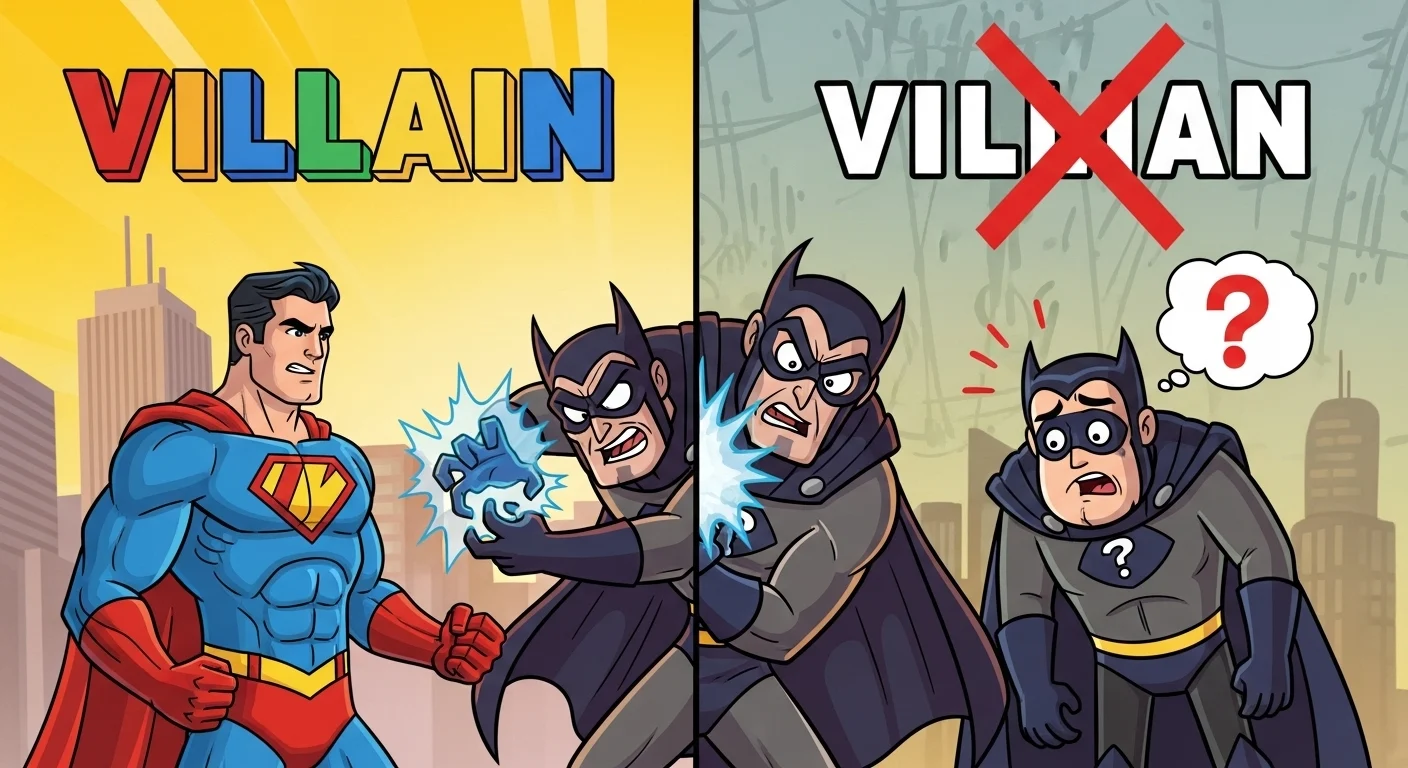
Many learners feel confused when they see the words villain and villian. They look almost the same. The spelling is very close, so it is easy to make a mistake while writing.
This confusion is very common among students, ESL learners, and even native speakers. The good news is that the answer is simple. Once you understand it, you will never mix them up again.
Let’s make it very clear step by step.
Quick Answer
- Villain is the correct spelling
- Villian is incorrect and not a real word
- Always use villain when talking about a bad person in a story or real life
- Avoid using villian in writing because it is a spelling mistake
Simple Origin and Background
The word villain comes from old languages like Old French and Latin. Long ago, it meant a person who worked on land or a farm. Over time, the meaning changed.
Later, people started using villain to describe someone who behaves badly. In stories, it became the word for the “bad character.”
The incorrect spelling villian likely comes from confusion. People often mix up the position of the letters “a” and “i” because they sound similar when spoken quickly.
Clear Explanation of the Difference
Let’s make it very simple.
Villain
Villain is a real English word. It is used to describe:
- A bad person in a story
- Someone who does harmful or evil actions
- The opposite of a hero
Example:
- The villain in the movie tried to destroy the city.
Villian
Villian is not a correct word in English.
It is just a spelling mistake of “villain.” It has no meaning and should not be used in writing.
Example:
- Incorrect: The villian was caught by the police.
- Correct: The villain was caught by the police.
Comparison Table
| Feature | Villain | Villian |
| Is it correct? | Yes | No |
| Meaning | Bad or evil person | No meaning |
| Usage | Stories, movies, real life | Not used |
| Spelling | V I L L A I N | V I L L I A N (wrong) |
| Dictionary | Found in dictionaries | Not found |
Which One to Use and When
You should always use “villain.”
Use it when you talk about:
- Movies
- Books
- Stories
- Real people who do bad things
Examples:
- The villain in the story was very clever.
- Every superhero needs a strong villain.
- He acted like a villain in that situation.
Never use villian, even in casual writing.
Common Mistakes People Make
Here are some common mistakes and why they happen:
1. Mixing the letters “a” and “i”
People often write villian because they are not sure where the “a” goes.
Tip:
Remember this pattern:
vill + ain = villain
2. Writing quickly without checking
When typing fast, small spelling mistakes happen.
Tip:
Always check your spelling, especially for common words.
3. Relying only on sound
Both words may sound similar when spoken. But English spelling is not always based on sound.
Tip:
Focus on correct spelling, not just pronunciation.
4. Copying incorrect spelling from others
Sometimes people learn the wrong spelling from social media or messages.
Tip:
Trust correct sources like books and dictionaries.
Everyday Real Life Examples
Let’s see how the correct word is used in daily life.
In Emails
- The villain in your story is very interesting.
- Please make the villain stronger in the next chapter.
In News Style Writing
- The villain in the film represents corruption and greed.
- The story shows how the villain was defeated.
On Social Media
- That movie had the best villain ever
- I love stories where the villain is smarter than the hero
In Daily Conversation
- Who is the villain in this drama
- The villain made the story exciting
Incorrect Usage to Avoid
- The villian was scary
- That villian is very powerful
Always correct these to villain.
Short Learning Section for Students and Beginners
Here is an easy way to remember:
Memory Trick
Think of this:
A villain is a pain
The word pain helps you remember the letters A I N at the end.
So:
- vill + ain = villain
Practice Sentences
Fill in the blank:
- The _______ tried to stop the hero.
- Every story needs a strong _______.
- The _______ lost in the end.
Answers:
- villain
- villain
- villain
Quick Tip
If you see villian, it is always wrong. Replace it with villain.
FAQ Section
1. Is villian a real word?
No, villian is not a real English word. It is a spelling mistake.
2. What does villain mean?
A villain is a bad person, usually in a story, movie, or real situation.
3. Why do people write villian?
People confuse the letter order, especially “a” and “i.”
4. Is villain used only in stories?
No, it can also describe real people who behave badly.
5. How can I remember the correct spelling?
Use the trick: vill + ain = villain
6. Is villain a noun?
Yes, villain is a noun. It names a person.
7. Can I use villian in informal writing?
No, you should never use villian, even in casual writing.
8. What is the opposite of villain?
The opposite of a villain is a hero.
Conclusion
The difference between villain and villian is very simple.
- Villain is the correct spelling and a real word
- Villian is always incorrect
If you remember just one thing, remember this:
Only “villain” is right. “Villian” is a mistake.With a little practice, you will never confuse them again. Keep learning, keep practicing, and your English will become stronger every day.