Many English learners mistakenly write ment when they mean meant. Because the word is often pronounced quickly in conversation, the correct spelling can be difficult to remember.
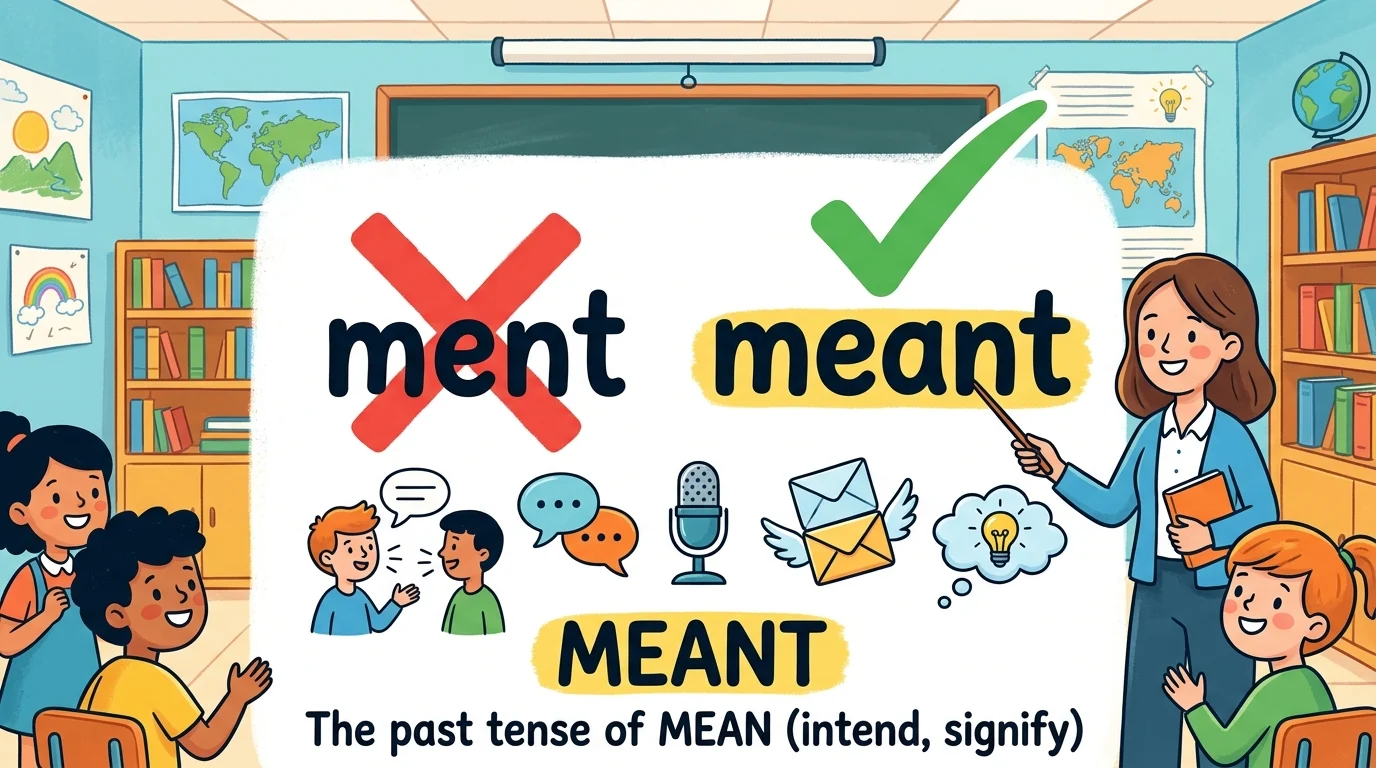
The simple answer is that meant is the correct spelling, while ment is usually a spelling mistake.
If you’re talking about intending, meaning, or referring to something, you should use meant.
Quick Answer
- Meant is the correct spelling.
- Ment is generally incorrect in standard English.
- Meant is the past tense and past participle of mean.
- Always use meant in formal and informal writing.
The Basic Difference
| Word | Correct? | Meaning |
|---|---|---|
| Ment | ❌ No | Misspelling (in most contexts) |
| Meant | ✅ Yes | Past tense of mean |
Examples
- I meant to call you yesterday.
- What did you mean?
- She meant no harm.
- That’s not what I meant.
What Does “Meant” Mean?
Meant is the past tense and past participle of the verb mean.
It can mean:
- intended
- referred to
- signified
- had in mind
Examples
- I meant to send the email earlier.
- He meant every word he said.
- She meant well.
- What exactly did you mean?
Why Is “Ment” Incorrect?
Ment is not the standard spelling of the past tense of mean.
Many people write it because:
- it sounds similar to meant
- English spelling can be confusing
- the pronunciation doesn’t clearly reveal the correct spelling
However, dictionaries recognize meant, not ment, as the correct form.
Comparison Table
| Feature | Ment | Meant |
|---|---|---|
| Correct Standard English | No | Yes |
| Dictionary Word | Generally No | Yes |
| Past Tense of Mean | No | Yes |
| Formal Writing | Incorrect | Correct |
| Everyday Usage | Misspelling | Standard |
How to Use “Meant” Correctly
To Express Intention
Examples:
- I meant to help.
- We meant to arrive earlier.
- She meant to finish the project.
To Express Meaning
Examples:
- What did you mean by that?
- The sign meant danger.
- His words meant a lot to me.
To Show Purpose
Examples:
- This gift was meant for you.
- The book was meant to educate readers.
- The message was meant as a joke.
Common Mistakes People Make
Writing “Ment” Instead of “Meant”
Incorrect:
- I ment to call you.
Correct:
- I meant to call you.
Forgetting the Silent Letters
The spelling meant includes letters that are not strongly pronounced, which leads to errors.
Confusing Pronunciation and Spelling
English often contains silent or unexpected letter combinations, and meant is one example.
Everyday Examples
In Conversations
- That’s not what I meant.
- I meant to tell you earlier.
In Emails
- I meant to attach the file.
- Sorry, I meant Wednesday, not Thursday.
At School
- What did the author mean?
- The teacher meant that as advice.
At Work
- I meant to send the report yesterday.
- The manager meant the deadline was flexible.
Easy Memory Trick
Think of these related words:
- mean
- meaning
- meaningful
- meant
All of them begin with mean.
So:
mean → meant
Not:
mean → ment
This makes the correct spelling easier to remember.
Practice Sentences
Choose the correct spelling.
- I _____ to reply earlier.
- What did you _____?
- She _____ no harm.
- The message _____ a lot to us.
Answers
- meant
- mean
- meant
- meant
Frequently Asked Questions
Is “ment” a real word?
Not as the past tense of mean.
In standard English, it is considered a misspelling in this context.
Is “meant” correct?
Yes.
It is the proper past tense and past participle of mean.
What does “meant” mean?
It can mean intended, signified, referred to, or had in mind.
Why do people write “ment”?
Because the pronunciation can make the correct spelling difficult to hear.
Can I use “ment” in formal writing?
No.
Use meant.
How do I remember the correct spelling?
Think:
mean → meant
The word keeps the mean spelling pattern.
Common Expressions with “Meant”
- meant to be
- meant well
- meant no harm
- what I meant was
- wasn’t meant for you
- meant a lot to me
Examples
- Maybe it was meant to be.
- She meant well, even if she made a mistake.
- I meant no harm.
- Your support meant a lot to me.
Conclusion
The difference between meant and ment is straightforward.
- Meant is the correct spelling.
- Ment is usually a spelling mistake.
- Use meant whenever you’re talking about intention, purpose, or meaning.
- Remember that meant comes from mean, which helps explain its spelling.
A simple rule to remember is:
If you’re writing the past tense of “mean,” always use “meant,” never “ment.”