Many learners feel confused about plural and possessive forms in English. The words often look very similar, and the only difference can be a small apostrophe. Because of this, it is easy to make mistakes.
But once you understand one simple idea, everything becomes clear. This guide will explain it step by step in very easy English.
Quick Answer
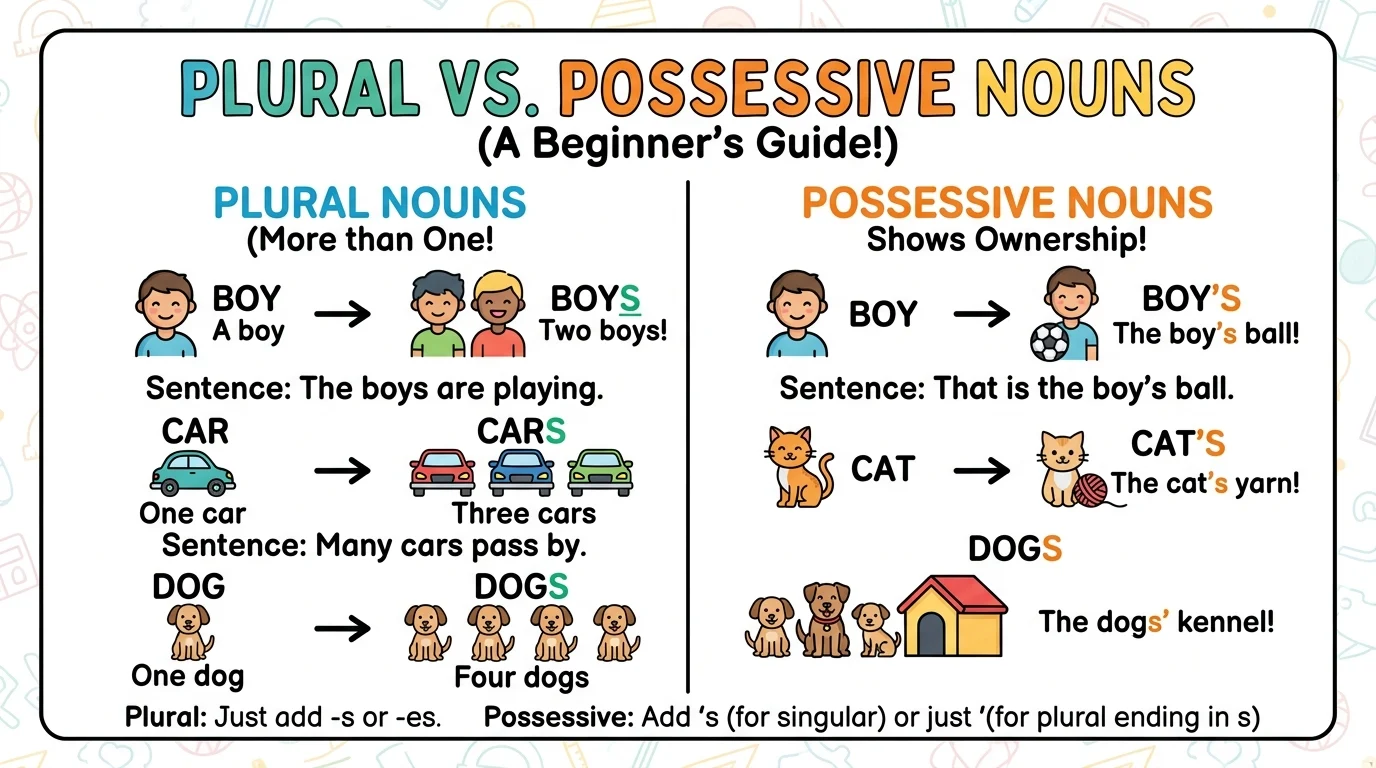
- Plural means more than one
- Possessive shows ownership or belonging
- Plural usually adds s
- Possessive uses apostrophe + s or just an apostrophe
Simple Origin or Background
English uses simple rules to show number and ownership.
- To show more than one, we add s or change the word
- To show ownership, we use an apostrophe
Examples:
- book → books (plural)
- boy → boy’s (possessive)
Some words are different, like:
- man → men (plural)
- men → men’s (possessive)
Clear Explanation of the Difference
What is plural
Plural means more than one person, place, or thing.
Examples:
- one cat → two cats
- one boy → three boys
- one apple → many apples
No apostrophe is used.
What is possessive
Possessive shows that something belongs to someone or something.
Examples:
- The boy’s bag
- The cat’s food
- The teacher’s book
The apostrophe tells us that something belongs to someone.
Comparison Table
| Feature | Plural | Possessive |
|---|---|---|
| Meaning | More than one | Shows ownership |
| Apostrophe | No | Yes |
| Example | boys | boy’s |
| Question | How many | Who does it belong to |
Which One to Use and When
Use plural when:
- You talk about more than one thing
- There is no ownership
Examples:
- The boys are playing
- The dogs are barking
Use possessive when:
- You show something belongs to someone
Examples:
- The boy’s toy is broken
- The dog’s tail is long
Common Mistakes People Make
1. Using apostrophe for plural
Wrong:
- The cat’s are sleeping
Correct:
- The cats are sleeping
2. Forgetting apostrophe for possession
Wrong:
- The boys bag is here
Correct:
- The boy’s bag is here
3. Confusing plural possessive
Plural possessive means something belongs to many people.
Example:
- The boys’ classroom
Here:
- boys = plural
- boys’ = something belongs to many boys
4. Irregular plural confusion
Wrong:
- The mens shoes
Correct:
- The men’s shoes
Everyday Real Life Examples
In Emails
- The students are ready
- The student’s assignment is attached
In News
- The players are training
- The player’s performance was amazing
On Social Media
- The dogs are cute
- The dog’s photo is funny
In Daily Conversations
- The kids are outside
- The kid’s bike is new
Short Learning Section for Students and Beginners
1. Ask a simple question
- More than one → plural
- Belongs to someone → possessive
2. Look for ownership
If something belongs to someone, use apostrophe.
3. Remember the pattern
- boy → boys
- boy → boy’s
4. Practice daily
Write simple sentences:
- The girls are singing
- The girl’s dress is blue
FAQ Section
1. What is the main difference
Plural means more than one. Possessive shows ownership.
2. Do plural words use apostrophes
No, plural words do not use apostrophes.
3. When do I use apostrophe
Use it when showing something belongs to someone.
4. What is plural possessive
It shows something belongs to many people.
Example:
- The teachers’ room
5. Is “cats’s” correct
No, the correct form is cats’.
6. Why is this confusing
Because the difference is small but important.
7. Is this rule important
Yes, it helps your writing be clear and correct.
8. How can I improve
Practice and check your writing carefully.
Conclusion
Understanding plural and possessive is very important in English.
- Plural means more than one
- Possessive shows ownership
Remember:
No apostrophe for plural
Use apostrophe for possession
With practice, you will use both forms correctly and confidently.