“To bad” and “too bad” are often confused because they sound exactly the same in speech. When people write quickly, they may choose the wrong spelling without noticing.
But in standard English, only one form is correct in almost all situations.
Let’s make this very clear and easy so you never make this mistake again.
Quick Answer
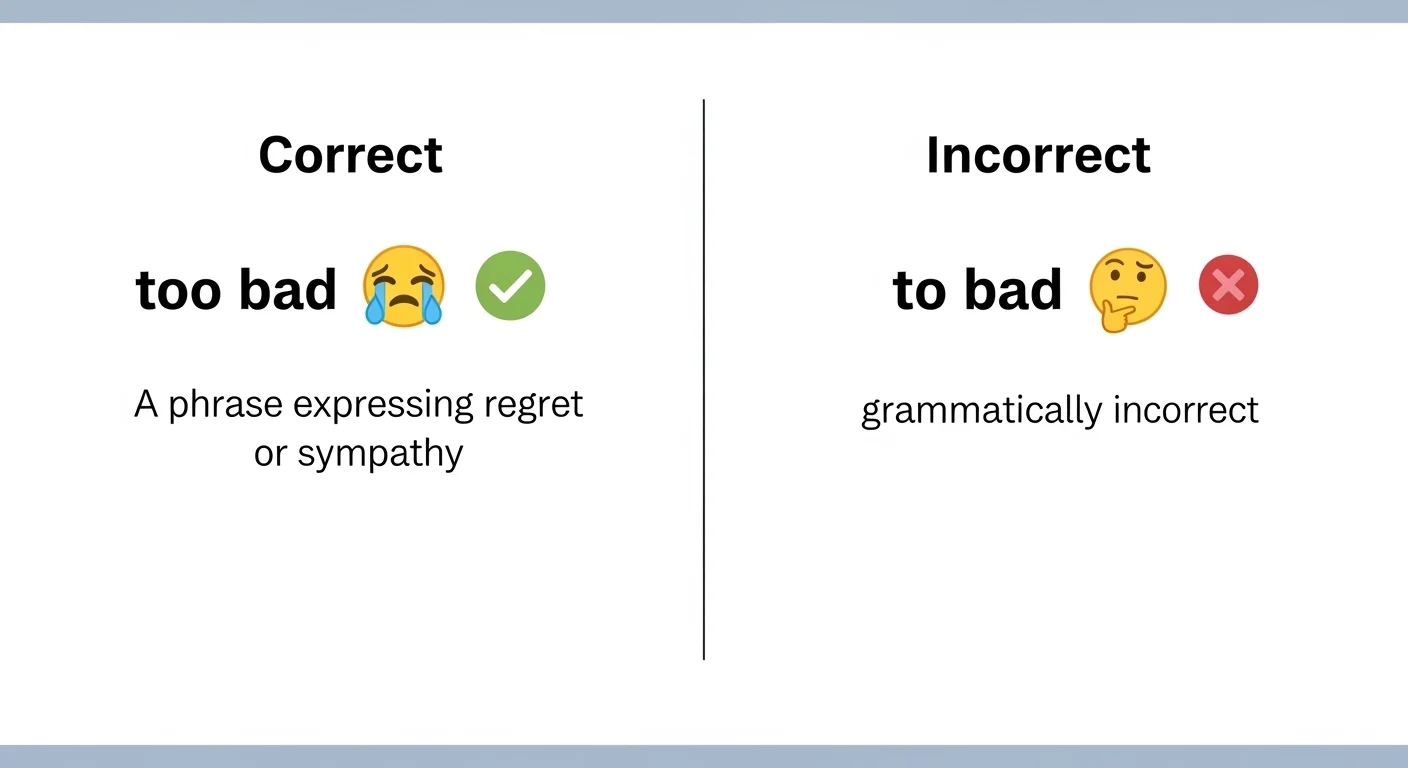
- “Too bad” is the correct phrase
- “To bad” is incorrect in this context
- “Too” means “very” or “more than enough”
- Always use “too bad” when expressing regret or disappointment
Simple Background Explanation
The word “too” means “very” or “more than needed.”
The word “to” is usually used for direction, purpose, or before a verb.
In the phrase “too bad,” the meaning is “very bad” or “unfortunate,” so we use “too,” not “to.”
Clear Explanation of the Difference
Let’s make it simple.
“Too bad”
This is correct. It is used to show disappointment, regret, or sympathy.
Examples:
- That’s too bad.
- It’s too bad you missed the event.
“To bad”
This is incorrect in this situation.
Example:
- That’s to bad ❌ wrong
So the difference is about correct word choice.
Comparison Table
| Phrase | Correct or Not | Meaning | Should You Use It |
|---|---|---|---|
| Too bad | Correct | Very bad or unfortunate | Yes |
| To bad | Incorrect | No correct meaning here | No |
What “Too Bad” Means
“Too bad” is used to express:
- Disappointment
- Regret
- Sympathy
Examples:
- It’s too bad you couldn’t come.
- That’s too bad about your result.
- It’s too bad the shop is closed.
It can be serious or casual depending on tone.
When to Use “Too Bad”
Use “too bad” when:
- Something did not go well
- You feel sorry about a situation
- You express mild disappointment
Examples:
- That’s too bad you lost your phone.
- It’s too bad the weather changed.
- Too bad we missed the train.
- It’s too bad he is not here.
Why People Make This Mistake
Here are the main reasons:
Same pronunciation
“To” and “too” sound the same.
Fast typing
People do not check spelling.
Simple confusion
Both words are very common.
Lack of awareness
Many learners do not know the rule.
Simple tip:
Remember:
“Too” = very
So “too bad” = very bad
Common Mistakes to Avoid
Here are mistakes to watch for:
Writing “to bad”
This is incorrect.
Mixing “to” and “too”
They have different meanings.
Not checking writing
Always review your sentences.
Correct vs incorrect examples:
- That’s too bad ✔️
- That’s to bad ❌
- It’s too bad you missed it ✔️
- It’s to bad you missed it ❌
Everyday Real Life Examples
Here are simple examples from daily life.
In conversation:
- That’s too bad.
- It’s too bad you are busy.
In school:
- It’s too bad you missed the class.
- That’s too bad about your result.
At work:
- It’s too bad the meeting was canceled.
- That’s too bad we lost the client.
On social media:
- Too bad I missed the event
- It’s too bad the video ended early
Easy Learning Section for Beginners
Here is a simple trick:
“Too” means “very”
Memory tip:
too bad = very bad
Practice sentences:
- That’s too bad
- It’s too bad you missed it
- Too bad we were late
Mini exercise:
Fill in the blanks:
- That’s ______ bad
Answer: too - It’s ______ bad you missed the event
Answer: too - ______ bad we couldn’t go
Answer: too
Never use “to bad”
Frequently Asked Questions
1. Is “to bad” ever correct
No, not in this meaning.
2. What is the correct phrase
The correct phrase is “too bad.”
3. What does “too bad” mean
It means very bad or unfortunate.
4. Why do people write “to bad”
Because “to” and “too” sound the same.
5. Can I use “to bad” informally
No, it is incorrect.
6. Is this mistake common
Yes, very common.
7. How can I remember the correct form
Remember “too” means “very.”
8. Will this mistake affect my writing
Yes, it can make your writing look incorrect.
Conclusion
The difference between “to bad” and “too bad” is simple.
“Too bad” is the correct phrase and should always be used when expressing regret or disappointment.
“To bad” is incorrect and should be avoided.
Just remember:
“Too” means “very,” so “too bad” means “very bad.”
With this simple rule, you can use the correct phrase every time.