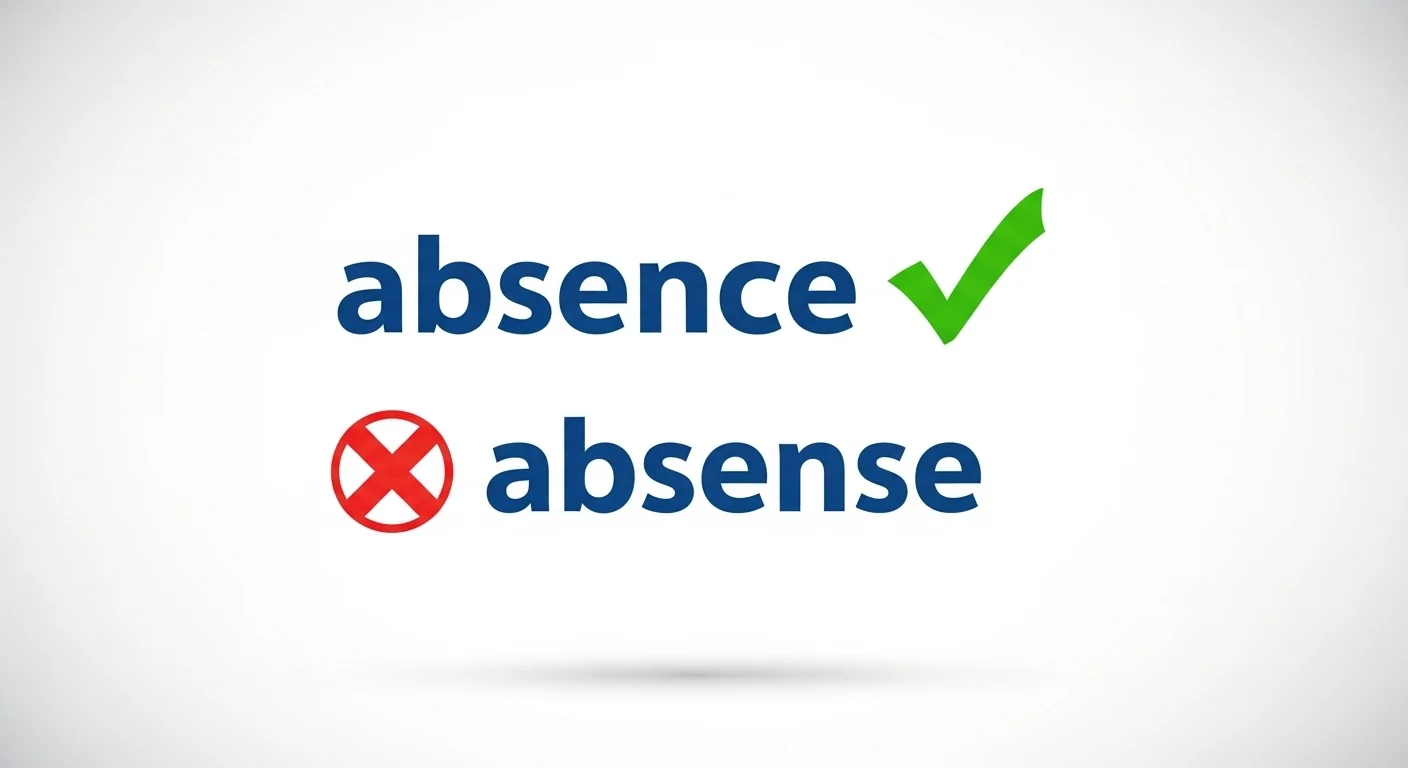
Many English learners feel confused when they see the words “absence” and “absense.” These two words look very similar, and they sound almost the same when spoken. Because of this, it is easy to think both are correct.
But in real English, only one of these words is correct. The other is a common spelling mistake. This article will help you understand the difference in a very simple way so you can use the correct word with confidence.
Quick Answer
- “Absence” is the correct spelling
- “Absense” is incorrect and should not be used
- “Absence” means not being present or not being there
- Always use “absence” in writing, exams, and daily communication
Simple Origin or Background
The word “absence” comes from a very old language called Latin. It comes from the word “absentia,” which means “being away” or “not present.”
Over time, this word became “absence” in English.
Because English spelling can sometimes be tricky, many learners write “absense” by mistake. This happens because the ending “-sence” sounds like “-sense.” But in this case, the correct spelling is “-sence” with a “c,” not an “s.”
So, the confusion is mainly about spelling, not meaning.
Clear Explanation of the Difference
Let’s understand this in the simplest way.
What does “absence” mean
“Absence” is a noun. It means that someone or something is not present.
Examples:
- Her absence from school was noticed.
- There was an absence of noise in the room.
- He explained his absence to the teacher.
It can be used for people, things, or even feelings.
What does “absense” mean
“Absense” is not a correct word in English.
It is just a spelling mistake of “absence.”
Wrong example:
- His absense made everyone worried.
Correct version:
- His absence made everyone worried.
So, there is no real meaning for “absense” because it is not a valid word.
Comparison Table
| Word | Correct or Not | Meaning | Use in English | Example |
| Absence | Correct | Not being present | Yes | Her absence was noticed |
| Absense | Incorrect | No meaning | No | ❌ His absense was strange |
Which One to Use and When
This is very simple.
Always use “absence”
Use “absence” in all situations when you want to talk about someone or something not being present.
Examples:
- I was marked absent due to my absence.
- The absence of light made the room dark.
- She wrote a letter to explain her absence.
Never use “absense”
“Absense” should never be used in:
- Exams
- School writing
- Emails
- Social media
- Any formal or informal communication
Simple Tip
If you are unsure, remember this:
- “Absence” has a “c”
- Think of the word “absent” which also has a “c” sound
This can help you remember the correct spelling.
Common Mistakes People Make
Here are some common mistakes and how to avoid them.
Mistake 1: Writing “absense” instead of “absence”
Wrong:
- My absense from class was long.
Correct:
- My absence from class was long.
Mistake 2: Confusing sound with spelling
The word sounds like “ab-sense,” so learners write it with an “s.”
Correct spelling:
- absence (with “c”)
Mistake 3: Not checking spelling in exams
Small spelling mistakes like this can reduce marks.
Tip:
- Always double-check words like “absence.”
Mistake 4: Mixing it with similar words
Some learners confuse “absence” with “absent.”
- “Absent” is an adjective
- “Absence” is a noun
Example:
- He is absent today.
- His absence was noted.
Everyday Real-Life Examples
Let’s see how “absence” is used in real life.
In Emails
- I am writing to explain my absence from the meeting.
- Please accept my absence due to illness.
In School or College
- The teacher asked about her absence.
- Too many absences can affect your grades.
In News
- The absence of strong leadership caused problems.
- His absence from the event was surprising.
On Social Media
- Sorry for my absence, I was very busy.
- Long absence, but I am back now.
In Daily Conversations
- Why was there an absence of water?
- His absence made the team weaker.
Short Learning Section for Students and Beginners
Here is a simple way to remember everything.
Rule 1
“Absence” is the correct word.
Rule 2
“Absense” is always wrong.
Rule 3
Think of “absent” to remember the spelling.
- Absent
- Absence
Both have a “c” sound.
Practice Sentences
Fill in the blanks:
- Her ______ from school was noticed.
- His ______ made everyone sad.
- The ______ of sound was strange.
Answers:
- absence
- absence
- absence
FAQ Section
1. Is “absense” a real word
No, “absense” is not a real word. It is a spelling mistake.
2. What is the correct spelling
The correct spelling is “absence.”
3. What does “absence” mean
It means not being present or not being there.
4. Why do people write “absense”
Because it sounds like “sense,” so they spell it with an “s” by mistake.
5. Can I use “absense” in exams
No, you should never use “absense.” It will be marked as incorrect.
6. Is “absence” a noun or verb
“Absence” is a noun.
7. What is the difference between “absent” and “absence”
- “Absent” describes a person
- “Absence” is the state of not being present
8. How can I remember the correct spelling
Think of the word “absent.” Both words are related and spelled with a “c.”
Conclusion
The difference between “absence” and “absense” is very simple.
“Absence” is the correct spelling and should always be used. It means not being present.
“Absense” is incorrect and should never be used in any situation.
If you remember the connection between “absent” and “absence,” you will not make this mistake again.
With regular practice, you will feel more confident using the correct spelling in your writing and speaking.