“Awhile” and “a while” often confuse learners because they look almost the same. The only difference is a space, but that small change affects how the words work in a sentence.
Many people are unsure when to use one word or two words.
The good news is that the rule is simple once you understand it.
Quick Answer
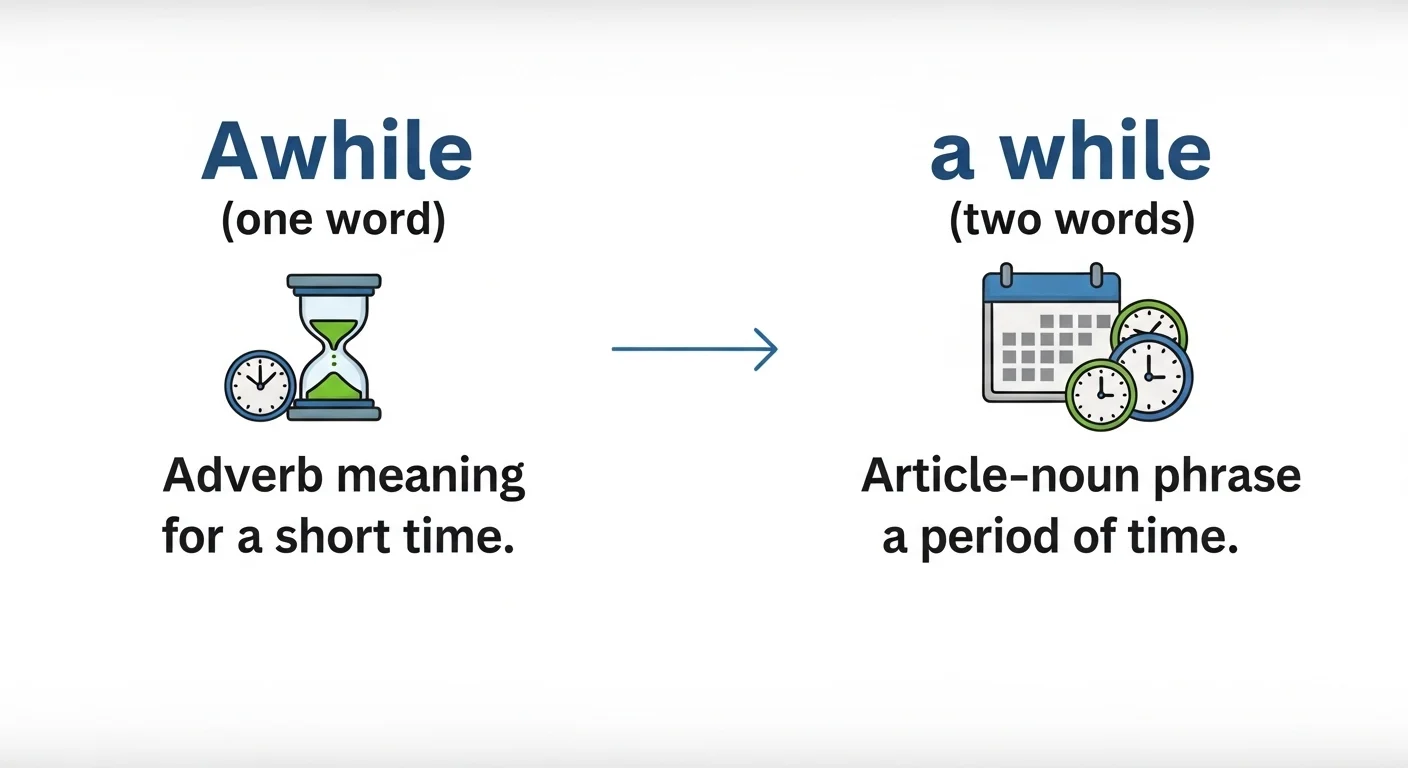
- “Awhile” is an adverb
- “A while” is a noun phrase
- Use “awhile” without a preposition
- Use “a while” after a preposition like for or after
Simple Background Explanation
Both forms come from the same idea of time.
Over time:
- “A while” stayed as a noun phrase meaning “a short time”
- “Awhile” became an adverb meaning “for a short time”
So both are correct, but used differently.
Clear Explanation of the Difference
Let’s make it very simple.
“Awhile”
This is an adverb. It means “for a short time.”
Examples:
- Sit awhile.
- Stay awhile.
“A while”
This is a noun phrase. It usually follows a preposition.
Examples:
- Sit for a while.
- I will stay here for a while.
So the difference is about grammar use.
Comparison Table
| Form | Type | Meaning | When to Use |
|---|---|---|---|
| Awhile | Adverb | For a short time | Without preposition |
| A while | Noun phrase | A short period | After preposition |
What “Awhile” Means
“Awhile” means “for a short time” and does not need extra words.
Examples:
- Come and rest awhile.
- Sit awhile and relax.
- Stay awhile with us.
What “A While” Means
“A while” means “a short period of time.”
It is often used after words like “for” or “after.”
Examples:
- Wait for a while.
- I will call you after a while.
- It has been a while.
Which One to Use and When
Use “awhile” when:
- You do not use “for”
- You want a shorter form
Examples:
- Sit awhile.
- Stay awhile.
Use “a while” when:
- You use a preposition like “for”
- You want to show a time period
Examples:
- Sit for a while.
- Wait for a while.
Easy Trick to Remember
Here is a simple rule:
If you can add “for,” use “a while”
If not, use “awhile”
Memory tip:
“for a while” is correct
“for awhile” is wrong
Why People Get Confused
Here are the main reasons:
Similar spelling
Only a space changes meaning.
Same meaning idea
Both refer to time.
Fast writing
People forget the rule.
Grammar confusion
Adverb vs noun phrase.
Common Mistakes to Avoid
Here are mistakes to watch for:
Using “for awhile”
- Wait for awhile ❌
Using “a while” without preposition
- Sit a while ❌
Correct vs incorrect examples:
- Wait for a while ✔️
- Wait for awhile ❌
- Sit awhile ✔️
- Sit a while ❌
Everyday Real Life Examples
Here are simple examples from daily life.
In conversation:
- Sit awhile and relax
- Wait for a while
At home:
- Stay awhile
- I will be back in a while
In daily life:
- Come here awhile
- It has been a while
In messaging:
- Talk to you in a while
- Stay awhile
Easy Learning Section for Beginners
Here is a simple trick:
Check for “for”
Memory tip:
for = a while
Practice sentences:
- Sit awhile
- Wait for a while
- Stay awhile
Mini exercise:
Fill in the blanks:
- Sit ______
Answer: awhile - Wait for ______
Answer: a while - Stay ______
Answer: awhile
Frequently Asked Questions
1. What is the difference between “awhile” and “a while”
“Awhile” is an adverb, while “a while” is a noun phrase.
2. Can I use them interchangeably
No, they follow different grammar rules.
3. When do I use “a while”
After prepositions like “for.”
4. When do I use “awhile”
Without prepositions.
5. Is “for awhile” correct
No, it is incorrect.
6. Why are they confusing
Because they look similar.
7. Is this mistake common
Yes, very common.
8. How can I remember the difference
Check if “for” is used.
Conclusion
The difference between “awhile” and “a while” is simple once you know the rule.
“Awhile” is used without a preposition.
“A while” is used after a preposition like “for.”
Just remember:
for = a while
With this simple rule, you can use both forms correctly and confidently.