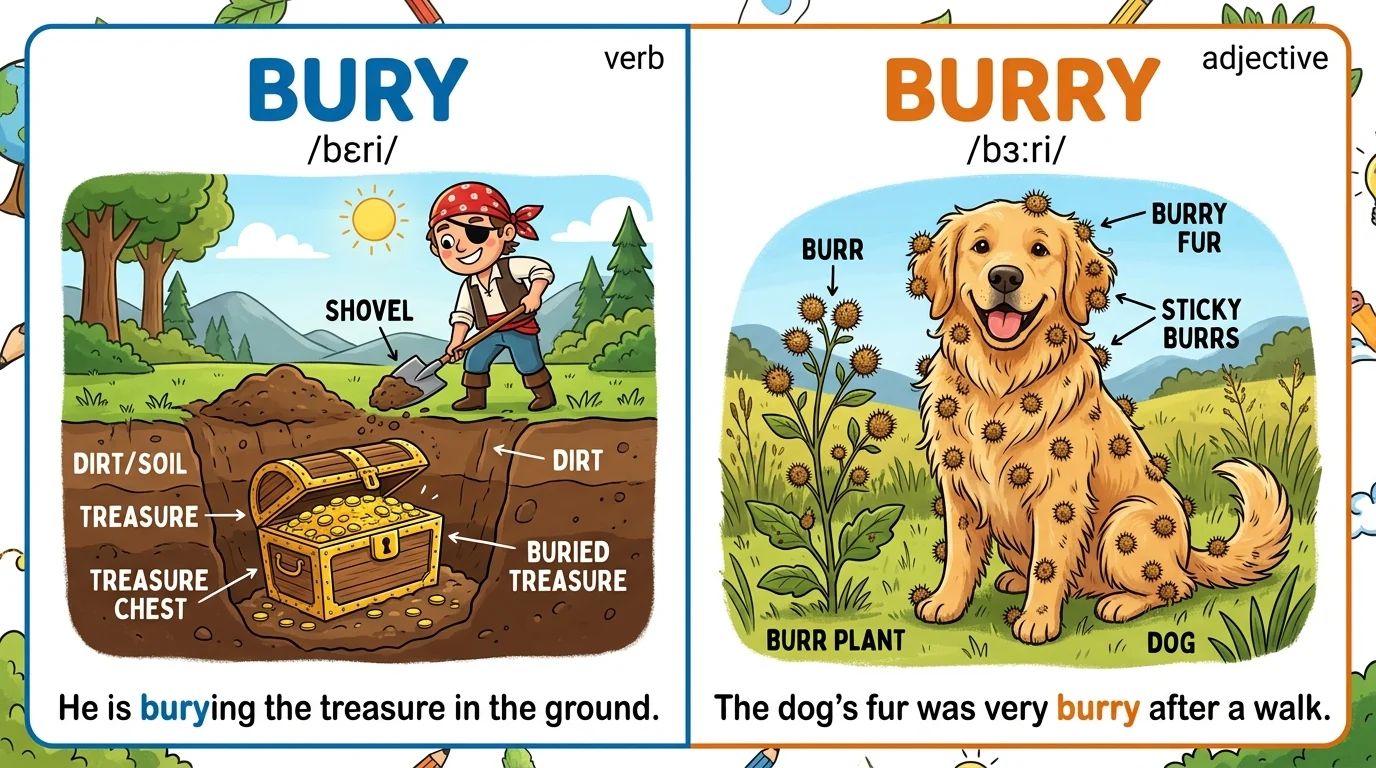
Many English learners confuse bury and burry because the words look very similar. The pronunciation of bury can also make the spelling harder to remember.
The good news is simple: bury is a common English word, while burry is a much less common word with a completely different meaning.
Understanding the difference will help you avoid spelling mistakes and use the right word in the right situation.
Quick Answer
- Bury means to put something underground or hide it.
- Burry is a real word, but it is rare and usually means covered with burrs or rough seed cases.
- Most of the time, people mean bury.
- If you are talking about hiding, covering, or placing something in the ground, use bury.
Simple Origin or Background
The word bury comes from Old English and has been used for centuries to mean:
- placing something in the ground
- hiding something
- covering something completely
The word burry comes from burr, which refers to a rough seed case that sticks to clothing or animal fur.
Because the words look alike, many learners accidentally add an extra r and write burry when they mean bury.
Clear Explanation of the Difference
What Does “Bury” Mean?
Bury is a verb.
It means:
- to place something underground
- to hide something
- to cover something completely
Examples:
- They will bury the treasure in the garden.
- The dog tried to bury a bone.
- She buried her face in her hands.
- Snow buried the road overnight.
This is the word most people need in everyday English.
What Does “Burry” Mean?
Burry is an adjective.
It means:
- covered with burrs
- having rough, prickly seed coverings
Examples:
- The dog’s fur became burry after the walk.
- The plant has burry seeds.
- His socks were covered in burry weeds.
This word is uncommon and rarely used in daily conversation.
Comparison Table
| Feature | Bury | Burry |
|---|---|---|
| Part of Speech | Verb | Adjective |
| Meaning | Put underground or hide | Covered with burrs |
| Common Usage | Very common | Rare |
| Used in Daily English | Yes | Seldom |
| Example | Bury the treasure | Burry plant seeds |
Which One to Use and When
Use “Bury” When
You are talking about:
- putting something in the ground
- hiding something
- covering something completely
Examples:
- Bury the time capsule.
- They buried the evidence.
- The leaves buried the path.
Use “Burry” When
You are describing:
- burr covered plants
- burr covered fur
- prickly seed coverings
Examples:
- The dog’s coat became burry.
- We removed the burry seeds from our clothes.
For most learners, bury is the word you will use far more often.
Common Mistakes People Make
Adding an Extra “R”
Wrong:
- I will burry the treasure.
Correct:
- I will bury the treasure.
Thinking “Burry” Is Another Spelling of “Bury”
These words are not alternative spellings.
They have different meanings.
Using “Burry” in Everyday Situations
Most situations involving hiding or placing something underground require bury, not burry.
Confusing Pronunciation and Spelling
The pronunciation of bury does not clearly show its spelling, which causes mistakes.
Everyday Real Life Examples
In Emails
- Please bury the cable underground.
- The garden became covered with burry weeds.
In News
- Workers buried the damaged pipe.
- Farmers removed burry plants from fields.
On Social Media
- My dog loves to bury toys.
- My socks are full of burry seeds after hiking.
In Daily Conversations
- Let’s bury the box in the backyard.
- That plant leaves burry seeds everywhere.
Short Learning Section for Students and Beginners
Easy Rule
If you mean:
- hide
- cover
- put underground
Use bury.
If you mean:
- covered with burrs
Use burry.
Practice Sentences
- Bury the treasure.
- Bury the cable.
- The dog’s fur is burry.
- The field contains burry plants.
Memory Trick
Think:
- bury = underground
- burry = burrs
The extra r in burry can remind you of burr.
FAQ Section
Is “burry” a real word?
Yes, but it is uncommon.
Is “bury” the correct word for putting something underground?
Yes.
Which word is more common?
Bury is much more common.
Can “burry” mean hide?
No.
What part of speech is “bury”?
It is usually a verb.
What part of speech is “burry”?
It is usually an adjective.
Why do people confuse these words?
Because they look very similar.
How can I remember the difference?
Remember:
- bury = hide or place underground
- burry = covered with burrs
Conclusion
The difference between bury and burry is easy once you know their meanings.
- Bury means to hide, cover, or place something underground.
- Burry means covered with burrs or prickly seed cases.
- Bury is the word used in most everyday situations.
- Burry is a rare descriptive word.
A simple memory trick is that burry comes from burr, while bury is the word used when something goes into the ground.