Many learners get confused between flair and flare because they sound exactly the same. When two words sound alike but have different meanings, it is easy to mix them up, especially in writing.
The good news is that these words are not complicated. Once you understand their meanings and uses, you can choose the correct one without any confusion.
Quick Answer
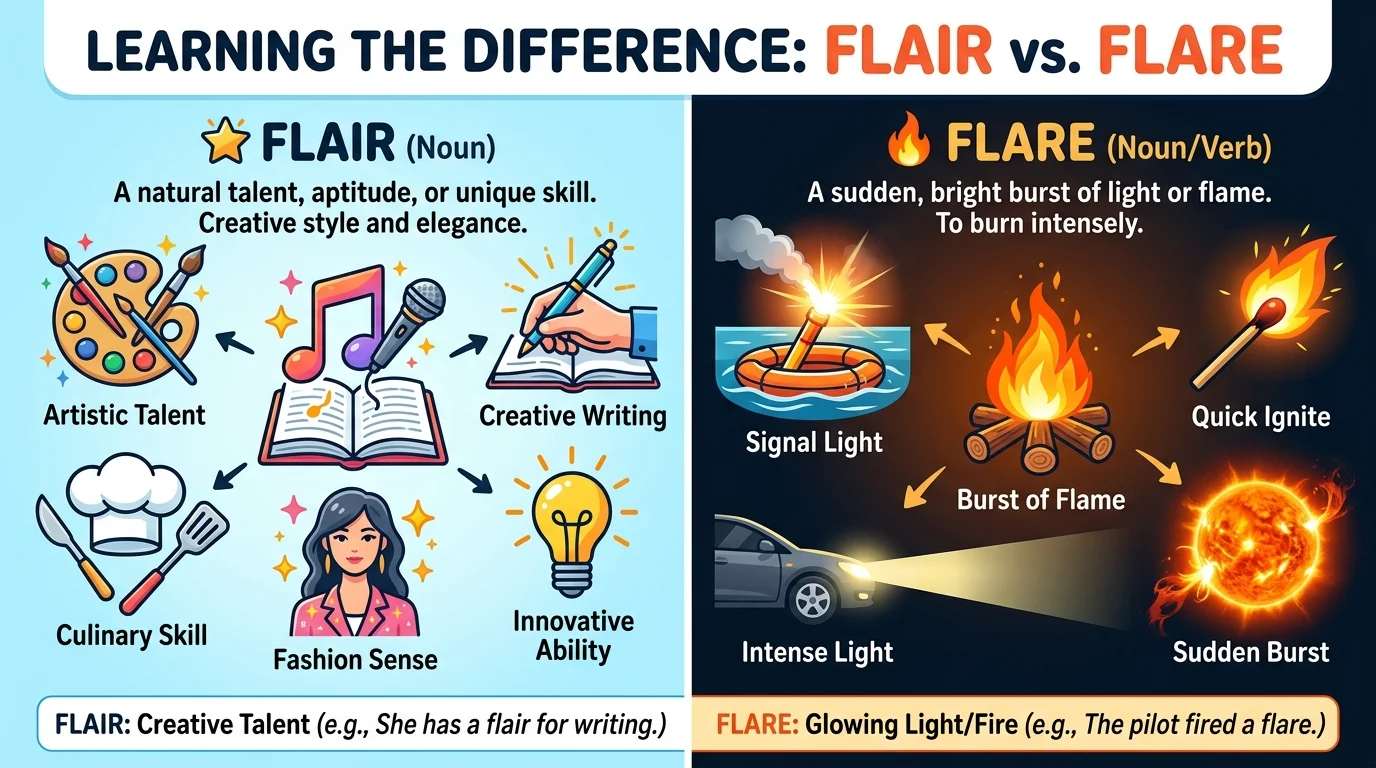
- Flair = natural talent or style
→ Example: She has a flair for music - Flare = a bright light or sudden burst
→ Example: A flare lit up the sky
Easy tip:
- Skill or style → flair
- Light or sudden action → flare
Simple Background
Flair and flare are homophones. This means they sound the same but have different meanings and spellings.
- Flair comes from an old word meaning smell or instinct
- Flare comes from a word meaning to shine or burn brightly
Over time, their meanings changed, but their pronunciation stayed the same. That is why people often confuse them.
Clear Explanation of the Difference
What is “flair”?
Flair is a noun. It talks about talent, style, or natural ability.
You use it when someone:
- Is naturally good at something
- Has a special style
- Shows creativity
Examples:
- She has a flair for painting
- He writes with flair
- The chef cooks with great flair
What is “flare”?
Flare can be a noun or a verb. It usually relates to light, fire, or something sudden.
As a noun:
- A bright light or signal
As a verb:
- To burn suddenly
- To grow quickly or become stronger
Examples:
- The flare was visible at night
- The fire began to flare
- His anger started to flare
Comparison Table
| Feature | Flair | Flare |
|---|---|---|
| Meaning | Talent or style | Light or sudden burst |
| Part of speech | Noun | Noun and verb |
| Use | Ability or creativity | Fire, light, emotion |
| Example | She has a flair for art | The flames flare up |
| Memory tip | Skill | Shine or burst |
Which One to Use and When
Use “flair” when:
- You talk about talent or ability
- You describe style or creativity
Examples:
- She has a flair for design
- He speaks with flair
- The artist shows great flair
Use “flare” when:
- You talk about light or fire
- You describe something sudden or strong
Examples:
- A flare lit the dark sky
- The pain began to flare
- The flames flared quickly
Common Mistakes People Make
Mistake 1: Using “flare” for talent
❌ She has a flare for singing
✔ She has a flair for singing
Mistake 2: Using “flair” for light
❌ The flair was very bright
✔ The flare was very bright
Mistake 3: Guessing based on sound
Both words sound the same, so always think about meaning:
- Talent → flair
- Light or sudden action → flare
Everyday Real Life Examples
In daily conversation
- He has a flair for storytelling
- The fire started to flare
In school or learning
- She shows flair in writing
- The experiment caused a small flare
In emails
- Your work shows great flair
- The issue may flare again soon
On social media
- She has a flair for fashion
- His anger flared during the match
Short Learning Section for Students and Beginners
Here is a simple way to remember.
Step 1: Ask yourself
Is it about skill or light?
- Skill → flair
- Light or sudden change → flare
Step 2: Practice
Fill in the blanks:
- She has a ___ for art
Answer: flair - The flames ___ up quickly
Answer: flare - He writes with ___
Answer: flair - A bright ___ lit the sky
Answer: flare
Step 3: Speak aloud
- Flair for music
- Fire will flare
This helps fix the meaning in your mind.
FAQ Section
1. Are “flair” and “flare” the same?
No. They sound the same but have different meanings.
2. What does “flair” mean?
It means natural talent, style, or ability.
3. What does “flare” mean?
It means a bright light or a sudden increase in something like fire or emotion.
4. Can “flare” be a verb?
Yes. It can mean to burn or increase suddenly.
5. Is “flair” ever a verb?
No. It is only a noun.
6. Why do people confuse these words?
Because they sound exactly the same.
7. How can I remember the difference?
Think:
- Flair → skill
- Flare → fire
8. Can “flare” be used for emotions?
Yes. For example: His anger flared quickly.
Conclusion
The difference between flair and flare is easy when you focus on meaning.
- Flair is about talent and style
- Flare is about light, fire, or something sudden
If you remember this simple idea, you will always choose the correct word with confidence.