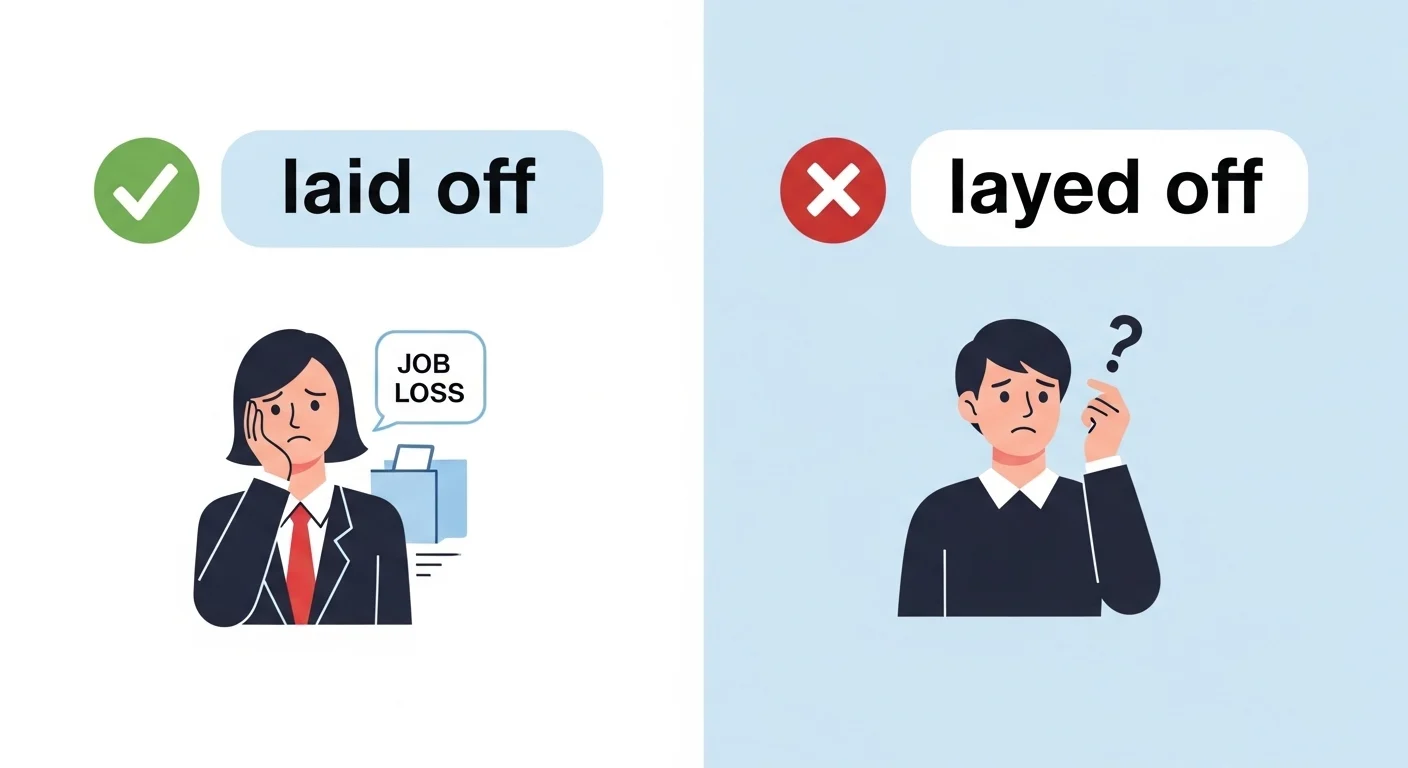
“Layed off” and “laid off” are often confused, especially when people talk about jobs and employment. The words sound similar, so it feels natural to add “ed” and write “layed.”
But English does not always follow simple patterns.
In this case, only one phrase is correct in standard English. The other is a common mistake.
Let’s make this very clear and easy so you never get confused again.
Quick Answer
- “Laid off” is the correct phrase
- “Layed off” is incorrect
- Always use “laid off” when talking about job loss
- “Layed off” is just a spelling mistake
Simple Background Explanation
The phrase “laid off” comes from the verb “lay.”
“Lay” is an irregular verb. This means it does not follow the normal rule of adding “ed.”
Instead:
- Present: lay
- Past: laid
So when we talk about the past, we must use “laid,” not “layed.”
That is why the correct phrase is “laid off.”
Clear Explanation of the Difference
Let’s make it simple.
“Laid off”
This is correct. It means someone lost their job, usually because the company reduced staff.
Examples:
- He was laid off last month.
- Many workers were laid off during the crisis.
“Layed off”
This is incorrect. It is not used in proper English.
Example:
- He was layed off ❌ wrong
So the difference is about correct grammar.
Comparison Table
| Phrase | Correct or Not | Meaning | Should You Use It |
| Laid off | Correct | Lost a job (usually not personal fault) | Yes |
| Layed off | Incorrect | No correct meaning | No |
What Does “Laid Off” Mean
“Laid off” is used when a person loses their job because of business reasons, not because of their performance.
Common reasons:
- Company problems
- Budget cuts
- Fewer customers
- Company restructuring
Examples:
- She was laid off due to company losses.
- Many employees were laid off last year.
When to Use “Laid Off”
Use “laid off” when:
- Talking about job loss
- Writing about business or news
- Explaining employment situations
Examples:
- He was laid off after five years at the company.
- The factory laid off many workers.
- She got laid off but found a new job soon.
There is never a correct situation to use “layed off.”
Why People Make This Mistake
Here are the main reasons:
Regular verb habit
People think “lay” becomes “layed.”
Sound similarity
“Layed” sounds natural, but it is wrong.
Confusion with other verbs
English has many irregular verbs.
Lack of practice
Irregular forms need memorization.
Simple tip:
Remember:
lay → laid
laid off is always correct
Common Mistakes to Avoid
Here are mistakes to watch for:
Adding “ed” to “lay”
- layed off ❌
Mixing forms
Do not use “layed” anywhere.
Not checking writing
Always review your sentence.
Correct vs incorrect examples:
- He was laid off ✔️
- He was layed off ❌
- Workers were laid off ✔️
- Workers were layed off ❌
Everyday Real Life Examples
Here are simple real life examples.
In news:
- Hundreds of workers were laid off.
- The company laid off staff due to losses.
In office talk:
- He was laid off last week.
- Some employees were laid off recently.
In conversations:
- She got laid off but stayed positive.
- I heard he was laid off.
In social media:
- Many people were laid off this year.
- He shared that he was laid off.
Easy Learning Section for Beginners
Here is a simple way to remember:
The verb “lay” is irregular
So it becomes “laid,” not “layed”
Memory trick:
lay → laid → laid off
Practice sentences:
- He was laid off
- She was laid off
- They were laid off
Mini exercise:
Fill in the blanks:
- He was ______ last month
Answer: laid off - Many workers were ______
Answer: laid off - She got ______ from her job
Answer: laid off
Never use “layed off”
Frequently Asked Questions
1. Is “layed off” ever correct
No, it is always incorrect.
2. What is the correct phrase
The correct phrase is “laid off.”
3. What does “laid off” mean
It means losing a job due to business reasons.
4. Why do people say “layed off”
Because they think “lay” follows the “ed” rule.
5. Is “laid” an irregular verb form
Yes, it is the past form of “lay.”
6. Is this mistake common
Yes, many learners make it.
7. Can I use “layed off” informally
No, it is still wrong.
8. Will this mistake affect my writing
Yes, it makes your writing incorrect.
Conclusion
The difference between “layed off” and “laid off” is simple but very important.
“Laid off” is the correct phrase and should always be used when talking about job loss.
“Layed off” is a spelling mistake and should be avoided.
Just remember:
“Lay” becomes “laid,” not “layed.”
With this simple rule, you can use the correct phrase every time with confidence.