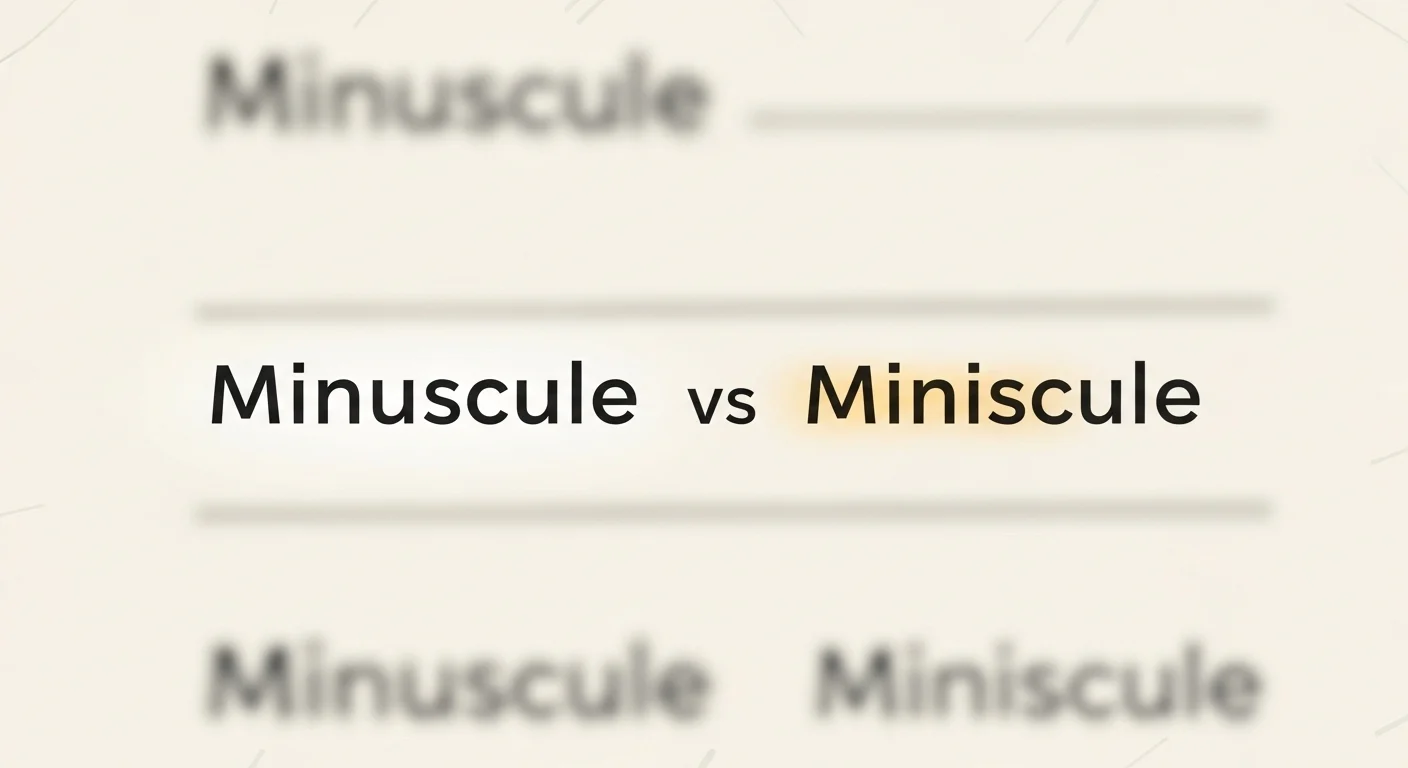
Many people feel confused when they see the words minuscule and miniscule. Both words look almost the same, and they sound very similar when spoken. Because of this, many students, writers, and even native English speakers mix them up.
The confusion usually happens because the spelling difference is very small. One word has “us” in the middle, while the other has “is.” At first glance, it is easy to think both spellings are correct.
In this guide, we will explain everything in very simple English. By the end of the article, you will clearly understand which word is correct, why the confusion happens, and how to remember the right spelling every time.
Quick Answer
Here is the simple truth.
• Minuscule is the correct and standard spelling in English.
• Miniscule is a common spelling mistake.
• The word minuscule means very small or tiny.
• Many people write miniscule by mistake because it sounds similar when spoken.
• In formal writing, school work, and professional communication, always use minuscule.
Example:
Correct: The chances of rain are minuscule today.
Incorrect: The chances of rain are miniscule today.
Simple Origin and Background
To understand why minuscule is the correct spelling, it helps to look at its origin.
The word minuscule comes from Latin. It comes from the word “minusculus,” which means very small or somewhat smaller.
Later, the word entered English through French. Over time, English speakers used minuscule to describe something extremely small.
Originally, the word was also used when talking about handwriting. In old writing styles, minuscule letters were the small lowercase letters.
For example:
a, b, c, d
These are minuscule letters.
Because the word came from Latin and French spelling traditions, the correct spelling stayed minuscule, not miniscule.
Clear Explanation of the Difference
Now let’s explain the difference in the simplest way.
Minuscule
Minuscule is the correct English word.
It means:
• Very tiny
• Extremely small
• Almost too small to notice
Examples:
The insect was minuscule.
The error in the report was minuscule.
The difference between the two colors was minuscule.
In modern English, this word is often used to describe something that is almost unnoticeable.
Miniscule
Miniscule is usually considered a spelling mistake.
Many people write miniscule because they think the word contains “mini.”
Since mini means small, it feels natural to spell it that way. But historically, the word did not come from mini.
Because of this misunderstanding, the incorrect spelling became very common in everyday writing.
However, in school writing, professional writing, and formal documents, miniscule should be avoided.
Comparison Table
| Feature | Minuscule | Miniscule |
| Correct spelling | Yes | No |
| Meaning | Very small or tiny | Intended to mean very small |
| Standard English | Yes | No |
| Used in formal writing | Yes | No |
| Common mistake | No | Yes |
This table makes it simple to remember: Minuscule is correct. Miniscule is incorrect.
Which One Should You Use
You should always use minuscule in writing.
Use it when you want to describe something extremely small or unimportant.
Examples:
• The difference in price was minuscule.
• The bug on the leaf was minuscule.
• The chances of failure were minuscule.
Avoid using miniscule, especially in:
• School essays
• Work emails
• Reports
• Articles
• Professional communication
If you remember only one thing from this article, remember this:
Minuscule is the correct spelling.
Common Mistakes People Make
Many people make similar mistakes with this word. Here are the most common ones.
1. Thinking the word comes from “mini”
People see mini and assume the spelling must be miniscule. This is incorrect.
The word actually comes from minusculus, not mini.
2. Spelling it the way it sounds
When people hear the word spoken, the middle part may sound like “ni.” This leads them to write miniscule.
English spelling does not always match pronunciation.
3. Copying incorrect spelling online
Because many people write miniscule, the mistake spreads easily on social media and blogs.
Always double check the spelling in reliable dictionaries.
4. Mixing it up with “mini”
Words like:
mini car
mini dress
mini vacation
make people think the spelling must include mini, which leads to confusion.
Everyday Real Life Examples
Let’s see how minuscule appears in daily life.
In Emails
“The error in the spreadsheet is minuscule, so it will not affect the final result.”
In News
“The difference in votes between the candidates was minuscule.”
On Social Media
“The scratch on my phone screen is minuscule, but it still annoys me.”
In School
“The teacher said the mistake in my answer was minuscule.”
In Daily Conversations
“The price increase is minuscule, only a few cents.”
These examples show how the word describes something extremely small or minor.
A Short Learning Section for Students
Here is an easy way for students and beginners to remember the correct spelling.
Memory Trick
Look at this part of the word:
minus
The word minuscule begins with something that looks like minus, which means less or smaller.
So you can remember:
Minus → smaller → minuscule
Practice Sentences
Fill in the blank with the correct word.
- The difference between the two numbers is _______.
- The insect on the wall was _______.
- The chances of making a mistake are _______.
Correct answer for all three:
minuscule
Practice writing the word a few times so the spelling becomes familiar.
Frequently Asked Questions
Is miniscule ever correct?
In most standard English writing, miniscule is considered incorrect. The correct spelling is minuscule.
Why do so many people write miniscule?
Many people think the word comes from mini, which means small. This leads them to spell it incorrectly.
What does minuscule mean?
Minuscule means extremely small, tiny, or almost unnoticeable.
Example: The crack in the glass was minuscule.
Is minuscule used in everyday English?
Yes. People use it when describing very small differences, sizes, or chances.
How do you pronounce minuscule?
It is usually pronounced like:
MIN uh skyool
The pronunciation may vary slightly depending on accent.
Can minuscule describe importance?
Yes. It can describe something that is very small in importance.
Example: The problem is minuscule and easy to fix.
Is minuscule a formal word?
It can be used in both formal and informal writing. It appears in essays, articles, emails, and everyday speech.
What is the opposite of minuscule?
Common opposites include:
• huge
• enormous
• massive
• large
Conclusion
The confusion between minuscule and miniscule happens because the two words look and sound very similar. Many people assume the spelling should include mini, which leads to the incorrect form miniscule.
However, the correct and standard spelling is minuscule. The word comes from Latin and means very small or tiny.
To remember the correct spelling:
Think of minus, which means smaller. This will help you remember minuscule.
Whenever you write essays, emails, or reports, always choose minuscule. Using the correct spelling will make your writing clearer and more accurate.