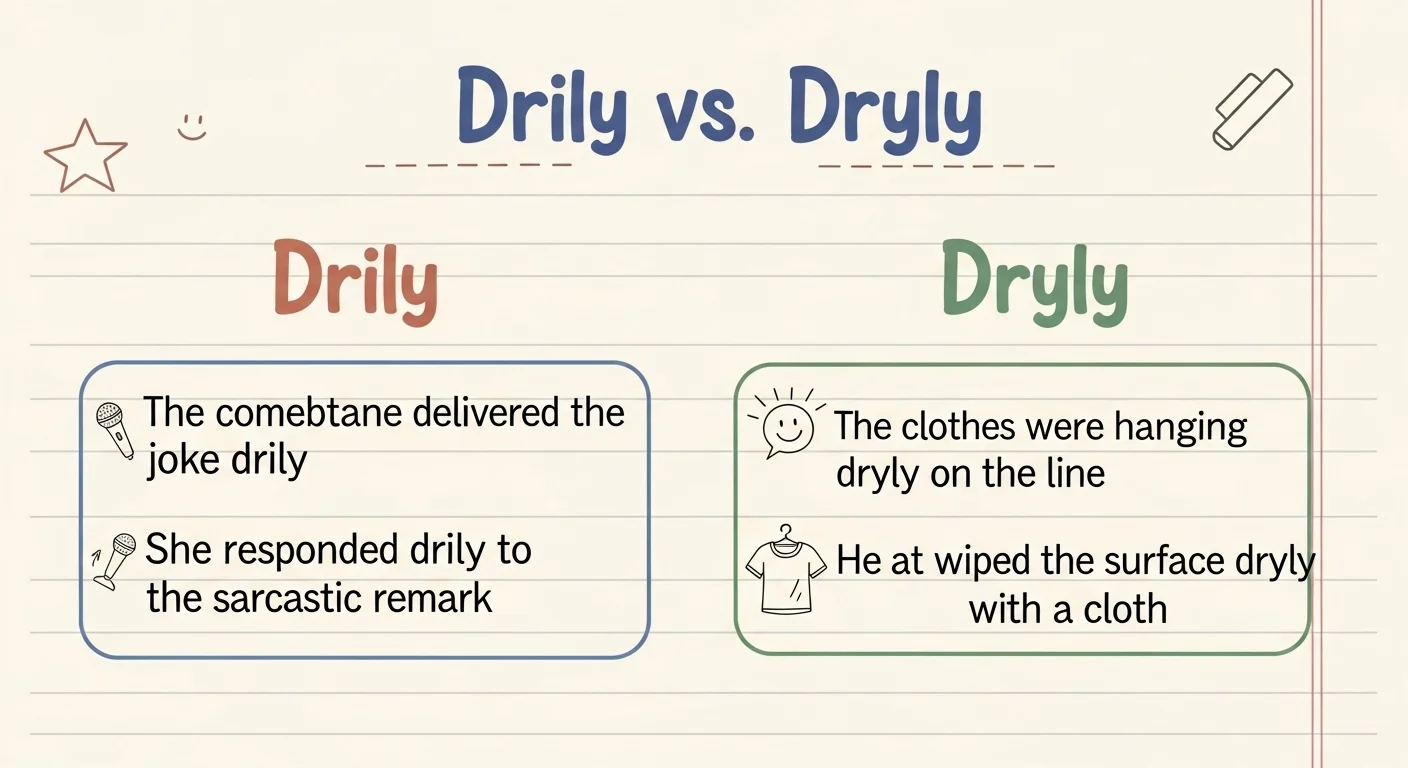
Many learners feel confused when they see drily and dryly. Both words look almost the same, and both come from the word dry. So it is natural to wonder which one is correct and when to use each one.
The good news is that this confusion is easy to fix. Once you understand the small difference between these two spellings, you will feel confident using them in writing and speaking.
This guide will explain everything in very simple English so you can understand it quickly and remember it easily.
Quick Answer
- Drily and dryly have the same meaning
- Both are correct spellings
- They are adverbs of the word dry
- They mean “in a dry way” or “without emotion or humor”
- Dryly is more common in modern English
- Drily is less common but still correct
Simple Background
Both drily and dryly come from the adjective dry.
The word dry can have two meanings:
- Not wet
- Not emotional or not funny
When we change dry into an adverb, we add ly at the end. This gives us dryly.
But English spelling is not always simple. Some words change a little when we add ly. That is how drily also came into use.
Over time, both forms became accepted, even though they look different.
Clear Explanation of the Difference
Now let’s make it very simple.
Meaning
There is no difference in meaning between drily and dryly.
Both can mean:
- In a dry manner
- Without emotion
- In a serious or slightly sarcastic way
Spelling Style
The real difference is only in spelling:
- Dryly follows the normal rule
- Drily is a shorter, less common version
Usage Preference
- Dryly is used more often today
- Drily is still correct but less common
So, if you are not sure, it is safer to use dryly.
Comparison Table
| Feature | Drily | Dryly |
| Meaning | Same | Same |
| Correct spelling | Yes | Yes |
| Common usage | Less common | More common |
| Style | Slightly older or formal | Modern and widely used |
| Easy for beginners | Slightly confusing | Easier to remember |
Which One to Use and When
Here is a simple guide to help you choose.
Use Dryly when:
- You want to use modern English
- You are writing emails or messages
- You want to be safe and clear
- You are a beginner learner
Example:
She replied dryly to the question.
Use Drily when:
- You like a more traditional spelling
- You see it in books and want to copy the style
- You understand that it is less common
Example:
He smiled drily at the joke.
Easy Tip
If you are confused, just use dryly. You will almost always be correct.
Common Mistakes People Make
Here are some mistakes learners often make.
1. Thinking one is wrong
Many people think drily is incorrect. This is not true. Both spellings are correct.
2. Mixing meanings
Some learners think the words have different meanings. They do not. The meaning is the same.
3. Spelling confusion
Because dry ends in y, learners are unsure how to add ly.
Remember:
- dry + ly = dryly
- drily is also accepted
4. Overthinking the choice
You do not need to worry too much. Choose dryly if unsure.
5. Using in wrong context
Both words often describe tone, not physical dryness.
Correct:
She answered dryly.
Incorrect:
The towel dried dryly.
Everyday Real Life Examples
Let’s look at how these words are used in daily life.
In Emails
- She wrote dryly, “Please read the instructions again.”
- He replied drily, “I already told you that yesterday.”
In Conversations
- He said dryly, “That was not very helpful.”
- She smiled drily and walked away.
In News or Reports
- The speaker dryly noted that the plan had failed.
- The reporter drily commented on the situation.
On Social Media
- “Oh great,” she said dryly.
- He posted drily, “Another long meeting today.”
In Daily Use
- My teacher dryly said, “This is not your best work.”
- My friend drily joked about the weather.
Short Learning Section for Students and Beginners
Let’s make learning simple and clear.
Step 1: Understand the base word
Dry means:
- Not wet
- Not emotional
Step 2: Learn the adverb form
Adverbs describe how something happens.
Dryly and drily both describe how someone speaks or acts.
Step 3: Practice simple sentences
Try writing your own:
- She answered dryly.
- He laughed drily.
Step 4: Remember the easy rule
- Use dryly most of the time
- Do not worry about drily, it is also correct
Step 5: Read and notice
When you read books or articles, look for these words. This helps you learn naturally.
FAQ Section
1. Are drily and dryly the same?
Yes, they have the same meaning. Only the spelling is different.
2. Which one is correct?
Both are correct. But dryly is more common today.
3. Which one should beginners use?
Beginners should use dryly because it is easier and more common.
4. Is drily old or outdated?
No, it is not wrong or outdated. It is just less common.
5. Do they sound different?
No, they are pronounced the same way.
6. Can I use them in formal writing?
Yes, both can be used in formal writing. But dryly is usually preferred.
7. Do they mean “not wet”?
Sometimes yes, but often they describe a tone that is serious or not emotional.
8. Is it wrong to use both in the same text?
It is better to choose one style and stay consistent.
Conclusion
The confusion between drily and dryly is very common, but the answer is simple.
Both words are correct and have the same meaning. They describe something done in a dry or unemotional way. The only real difference is spelling.
In modern English, dryly is more popular and easier to use. That is why it is the best choice for most learners and everyday writing.
If you remember just one thing, remember this:
Use dryly when you are unsure, and you will be right almost every time.
With a little practice, this confusion will disappear, and you will use these words naturally and confidently.