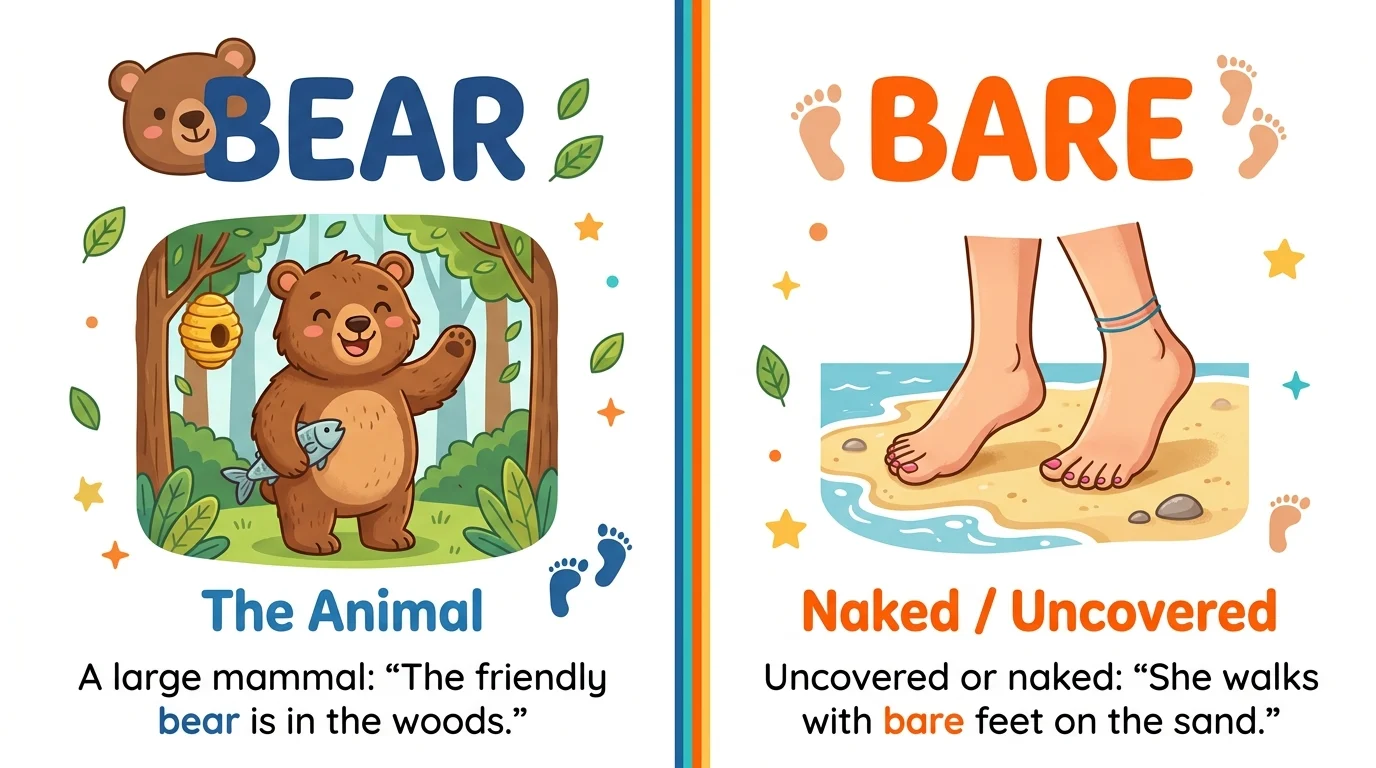
Many English learners confuse bear and bare because they sound exactly the same when spoken. These words are called homophones, which means they have the same pronunciation but different spellings and meanings.
Because they sound alike, people often use the wrong word in writing. However, once you understand their meanings, choosing the correct one becomes much easier.
This guide explains the difference between bear and bare in very simple English with clear examples and beginner friendly tips.
Quick Answer
- Bear usually means to carry, support, endure, or refers to the animal.
- Bare means uncovered, exposed, or without something.
- The words sound the same but have different meanings.
- Use bear for carrying, tolerating, or the animal.
- Use bare for something uncovered or empty.
Simple Origin or Background
Although bear and bare sound alike today, they come from different old English words.
Over time, their pronunciation became similar, but their meanings remained different.
That is why many learners confuse them in writing.
Clear Explanation of the Difference
What Does “Bear” Mean?
Bear can be a noun or a verb.
As a noun, it refers to the large furry animal.
Examples:
- We saw a bear in the forest.
- The bear searched for food.
As a verb, it can mean:
- carry
- support
- endure
- tolerate
Examples:
- I cannot bear the noise.
- She bears responsibility for the project.
- The bridge can bear heavy weight.
What Does “Bare” Mean?
Bare is usually an adjective.
It means:
- uncovered
- exposed
- empty
- without something
Examples:
- He walked with bare feet.
- The walls were bare.
- The tree had bare branches.
It can also be a verb meaning to reveal or uncover.
Examples:
- She bared her teeth.
- He bared the truth.
Comparison Table
| Feature | Bear | Bare |
|---|---|---|
| Meaning | Carry, endure, support, animal | Uncovered, exposed, empty |
| Part of Speech | Noun or verb | Adjective or verb |
| Related To | Weight, responsibility, animals | Exposure or lack of covering |
| Example | I cannot bear the pain | She has bare feet |
Which One to Use and When
Use “Bear” When
You mean:
- carry
- support
- tolerate
- endure
- the animal
Examples:
- I cannot bear the heat.
- The shelf can bear the weight.
- We saw a bear at the zoo.
Use “Bare” When
You mean:
- uncovered
- exposed
- empty
- reveal
Examples:
- He stood on the bare floor.
- The room looked bare.
- She bared her shoulders.
Common Mistakes People Make
Writing “Bare” Instead of “Bear”
Incorrect:
- I can’t bare the pain.
Correct:
- I can’t bear the pain.
Writing “Bear” Instead of “Bare”
Incorrect:
- He walked with bear feet.
Correct:
- He walked with bare feet.
Forgetting the Different Meanings
Even though the words sound alike, their meanings are completely different.
Choosing Based on Sound
Because they are homophones, pronunciation will not help you choose the correct spelling.
Everyday Real Life Examples
In Emails
- We must bear the additional costs.
- The report left several details bare.
In News
- A bear was spotted near the village.
- The investigation bared new evidence.
On Social Media
- I can’t bear waiting any longer.
- Walking on the beach with bare feet feels amazing.
In Daily Conversations
- Can this chair bear my weight?
- The walls look bare without pictures.
Short Learning Section for Students and Beginners
Easy Rule
Use bear for:
- carrying
- supporting
- enduring
- the animal
Use bare for:
- uncovered
- exposed
- without covering
Practice Sentences
- I cannot bear the noise.
- The bridge can bear heavy traffic.
- She walked with bare feet.
- The room looked bare.
Memory Trick
Think:
- Bear has an animal meaning.
- Bare means without covering.
If you can imagine a furry animal, choose bear.
If you can imagine something uncovered, choose bare.
FAQ Section
Is “bear” the animal?
Yes.
Can “bear” mean tolerate?
Yes.
Example:
- I cannot bear the pain.
What does “bare” mean?
It means uncovered or exposed.
Is “bare feet” correct?
Yes.
Is “bear feet” correct?
No.
Unless you are talking about the feet of an actual bear.
Why do people confuse these words?
Because they sound exactly the same.
Can “bare” be a verb?
Yes.
It can mean to reveal or uncover.
How can I remember the difference?
Remember:
- bear = animal, carry, endure
- bare = uncovered
Conclusion
The difference between bear and bare is simple once you learn their meanings.
- Bear means to carry, support, endure, or refers to the animal.
- Bare means uncovered, exposed, or without covering.
- The words sound the same but are used in different situations.
A simple memory trick is to connect bear with the furry animal and bare with something uncovered.
Once you remember that, choosing the correct word becomes much easier.