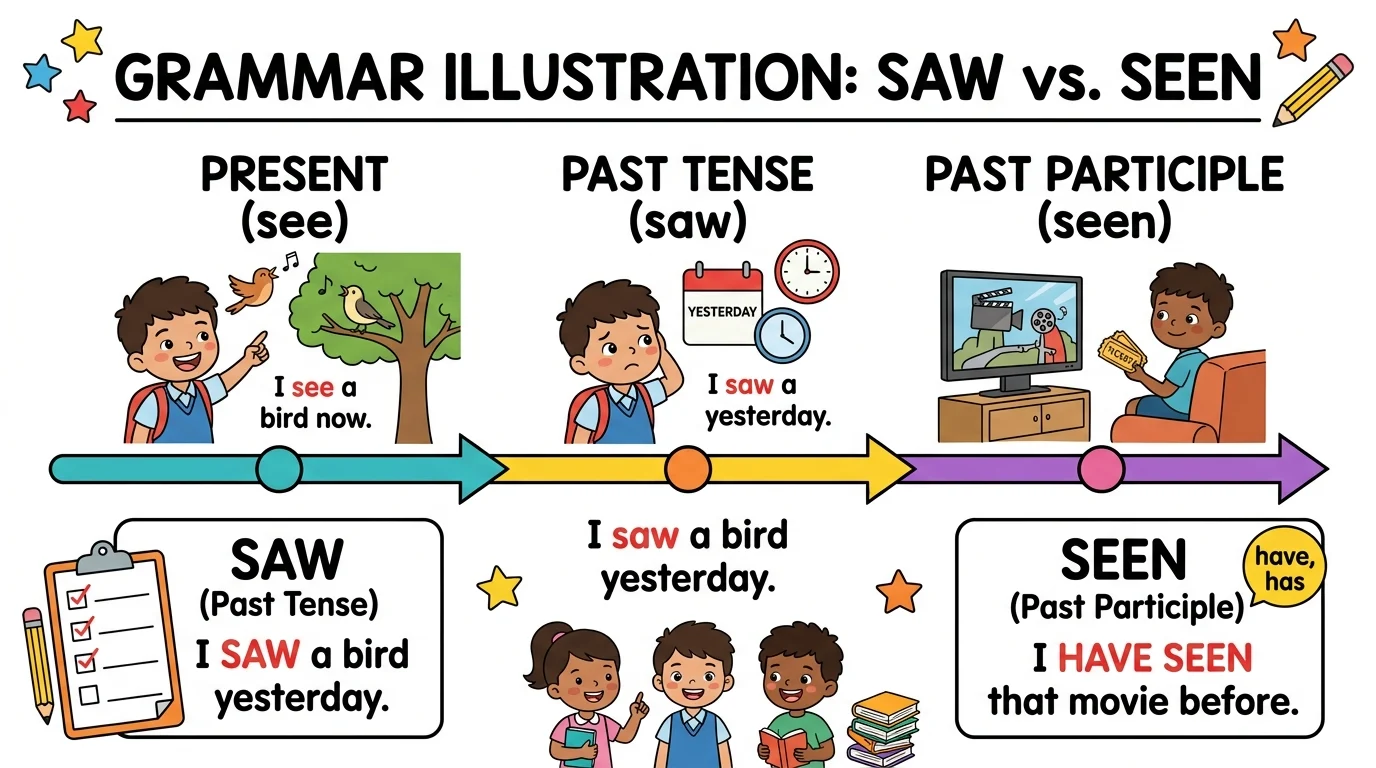
Many English learners struggle with seen and saw because both words come from the verb see. Since they refer to the past, it’s easy to mix them up.
The simple answer is this:
- Saw is the simple past tense of see.
- Seen is the past participle and usually needs a helping verb such as have, has, had, was, or been.
Understanding this rule will help you avoid one of the most common English grammar mistakes.
Quick Answer
✅ I saw the movie yesterday.
✅ I have seen the movie before.
❌ I seen the movie yesterday.
❌ I have saw the movie before.
The Basic Difference
| Word | Grammar Role | Example |
|---|---|---|
| Saw | Simple past tense | I saw a bird. |
| Seen | Past participle | I have seen a bird. |
Think of it this way:
- Saw can usually stand alone.
- Seen usually needs a helping verb.
What Does “Saw” Mean?
Saw is the simple past tense of see.
Use it when talking about something you viewed or noticed in the past.
Examples:
- I saw a rainbow this morning.
- She saw her friend at the mall.
- We saw a great movie last night.
- They saw a deer in the forest.
In all of these sentences, saw works by itself.
What Does “Seen” Mean?
Seen is the past participle form of see.
It is usually used with helping verbs such as:
- have
- has
- had
- been
Examples:
- I have seen that movie.
- She has seen the report.
- We had seen the warning signs.
- They have seen better days.
Notice that seen is not standing alone.
Comparison Table
| Feature | Saw | Seen |
|---|---|---|
| Correct Alone | Yes | Usually No |
| Simple Past Tense | Yes | No |
| Past Participle | No | Yes |
| Needs Helping Verb | No | Usually Yes |
| Example | I saw it. | I have seen it. |
When to Use “Saw”
Use saw when describing a completed action in the past.
Examples:
- I saw him yesterday.
- She saw the accident.
- We saw the sunset.
- They saw the new building.
A good clue is a past-time expression such as:
- yesterday
- last week
- last year
- this morning
Examples
- I saw her yesterday.
- We saw the game last night.
- He saw the email this morning.
When to Use “Seen”
Use seen with helping verbs.
Examples:
- I have seen this show before.
- She has seen the results.
- We had seen the problem earlier.
- They have seen the new design.
Common Helping Verbs
- have seen
- has seen
- had seen
- been seen
Common Mistakes People Make
Mistake 1: Using Seen Without a Helping Verb
Incorrect:
- I seen that movie.
Correct:
- I saw that movie.
- I have seen that movie.
Mistake 2: Using Saw After Have
Incorrect:
- I have saw that movie.
Correct:
- I have seen that movie.
Mistake 3: Mixing Up the Forms
Incorrect:
- She seen him yesterday.
Correct:
- She saw him yesterday.
Everyday Examples
In Conversations
- I saw your brother at school.
- Have you seen my keys?
In Emails
- I saw your message this morning.
- I have seen the updated document.
On Social Media
- I saw that video yesterday.
- I’ve seen it already.
At Work
- We saw an increase in sales.
- We have seen strong growth this year.
Easy Memory Trick
Remember this pattern:
See → Saw → Seen
Just like:
Go → Went → Gone
Examples:
- I saw it yesterday.
- I have seen it before.
If there is have, has, or had, you usually need seen.
Practice Sentences
Choose the correct word:
- I _____ her yesterday.
- We have _____ that movie before.
- She _____ the accident last week.
- They had _____ the report earlier.
Answers:
- saw
- seen
- saw
- seen
FAQ
Is “I seen it” correct?
No. Standard English requires:
- I saw it.
- I have seen it.
Is “I have saw it” correct?
No.
Correct:
- I have seen it.
Which word is the past tense of see?
Saw.
Which word is the past participle of see?
Seen.
Can seen be used alone?
Usually no.
It normally needs a helping verb.
How do I remember the difference?
Think:
- Yesterday = saw
- Have/has/had = seen
Conclusion
The difference between seen and saw is a grammar rule that becomes easy once you remember the verb forms.
- Saw is the simple past tense.
- Seen is the past participle.
- Use saw by itself for past actions.
- Use seen with helping verbs like have, has, and had.
A simple rule to remember is:
If you see “have,” “has,” or “had,” use “seen.” Otherwise, use “saw” for a completed action in the past.