Many English learners confuse win and loose because they are often mistakenly used as opposites online. People sometimes write “loose” when they actually mean lose.
However, win and loose do not have opposite meanings.
The correct opposite of win is usually:
- lose
The word loose has a completely different meaning related to something not tight.
This guide explains the difference in very simple English with clear examples and beginner friendly tips.
Quick Answer
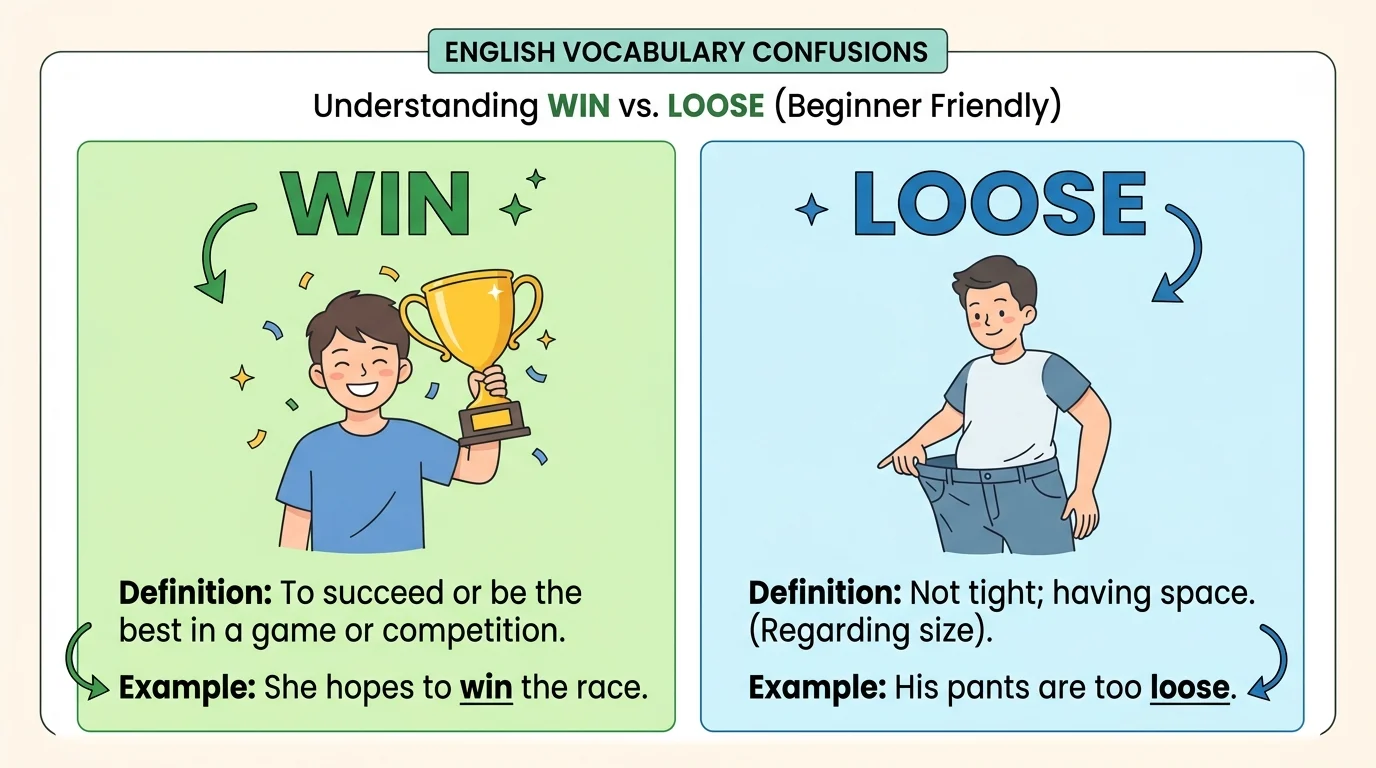
- Win means to succeed or get victory
- Loose means not tight or free
- Win and loose are not opposites
- The opposite of win is usually lose
Simple Origin or Background
The word win comes from old English words meaning:
- gain success
- achieve victory
The word loose comes from words meaning:
- not tight
- free from holding
Because:
- lose
and - loose
look very similar, many learners accidentally confuse them while writing.
Clear Explanation of the Difference
What does “win” mean
Win is a verb.
It means:
- to succeed
- to get victory
- to receive a prize or reward
Examples:
- Our team will win the match
- She hopes to win the competition
- He won first place
This word is connected to success and victory.
What does “loose” mean
Loose is usually an adjective.
It means:
- not tight
- free
- not fixed firmly
Examples:
- My shirt feels loose
- The dog escaped because the gate was loose
- She wore loose clothing
This word is connected to physical looseness, not losing.
Comparison Table
| Feature | Win | Loose |
|---|---|---|
| Meaning | Succeed or get victory | Not tight |
| Grammar type | Usually verb | Usually adjective |
| Related to | Success or competition | Physical condition |
| Example | Win the game | Loose shoes |
Which One to Use and When
Use win when:
- Talking about success
- Discussing games or competitions
- Referring to achievements
Examples:
- We want to win today
- She won a gold medal
Use loose when:
- Talking about something not tight
- Describing clothing, objects, or parts
Examples:
- These pants are loose
- The wheel feels loose
Common Mistakes People Make
1. Using “loose” instead of “lose”
Wrong:
- We might loose the game
Correct:
- We might lose the game
2. Thinking “loose” is the opposite of “win”
Correct opposite:
- win ↔ lose
3. Forgetting pronunciation differences
- lose sounds like “looz”
- loose sounds like “loos”
4. Spelling confusion
Many learners add an extra “o” by mistake.
Everyday Real Life Examples
In Emails
- I hope we win the contract
- The handle feels loose
In News
- The team won the championship
- A loose wire caused problems
On Social Media
- We finally win sometimes
- I love wearing loose sweaters
In Daily Conversations
- Did your team win
- My shoes are too loose
Short Learning Section for Students and Beginners
1. Learn the simple meanings
- win = victory
- loose = not tight
2. Remember the true opposite
- win ↔ lose
not:
- loose
3. Practice simple examples
- We win together
- My jacket is loose
4. Use memory tricks
- loose has extra “o” because it feels more open and loose
FAQ Section
1. Does “win” mean success
Yes.
2. Does “loose” mean defeat
No.
3. What is the opposite of “win”
Lose.
4. What does “loose” mean
It means not tight.
5. Is “We loose the game” correct
No.
Correct sentence:
- We lose the game.
6. Can “loose” describe clothing
Yes.
Example:
- loose jeans.
7. Why do learners confuse these words
Because lose and loose look very similar.
8. How can I remember the difference
Remember:
- win ↔ lose
- loose = not tight
Conclusion
The difference between win and loose becomes simple once you understand their meanings.
- Win means success or victory
- Loose means not tight
A very important reminder:
- the opposite of win is lose, not loose
A simple memory trick:
- loose has an extra “o” because loose things have extra space
With practice and clear examples, you can avoid this very common English mistake.