Commas and semicolons are both punctuation marks, but they are not used the same way. Many learners either overuse commas or avoid semicolons completely because they seem confusing.
The truth? The difference is simple once you understand their purpose.
Let’s make it clear and practical.
Quick Answer
- A comma (,) separates small parts of a sentence
- A semicolon (;) connects closely related complete sentences
- Commas are more common
- Semicolons are stronger than commas but weaker than full stops
Simple Background Explanation
Think of punctuation like traffic signals:
- Comma = short pause
- Semicolon = medium pause
- Full stop = complete stop
That’s the easiest way to understand their roles.
Clear Explanation of the Difference
Let’s make it very simple.
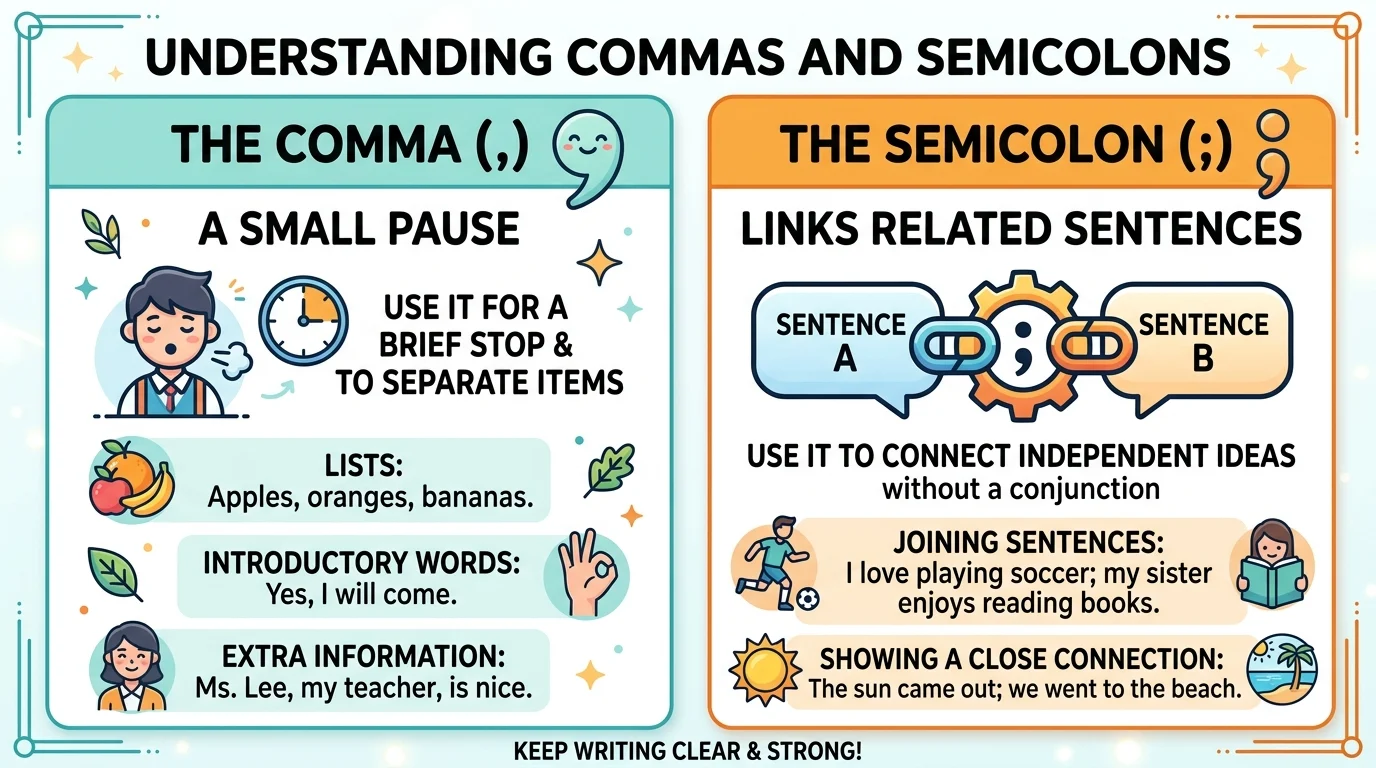
Comma ( , )
Used for short pauses and separating parts of a sentence.
Examples:
- I bought apples, oranges, and bananas.
- After lunch, we went home.
Semicolon ( ; )
Used to connect two complete sentences that are closely related.
Examples:
- I was tired; I went to bed.
- She loves reading; he prefers movies.
So the difference is small separation vs linking full ideas.
Comparison Table
| Punctuation | Function | Strength | Example |
|---|---|---|---|
| Comma (,) | Separates parts of a sentence | Weak pause | I ate apples, oranges, and bananas |
| Semicolon (;) | Links related sentences | Medium pause | I was tired; I slept |
What a Comma Does
A comma is used for:
- Lists
- I bought milk, bread, and eggs.
- Introductory phrases
- After dinner, we watched TV.
- Joining with conjunctions (and, but, so)
- I was tired, so I slept.
Commas are used very often in everyday writing.
What a Semicolon Does
A semicolon is used for:
- Connecting related sentences
- It was raining; we stayed inside.
- Before linking words (however, therefore, etc.)
- I wanted to go; however, I was busy.
It shows a stronger connection than a comma.
Which One to Use and When
Use a comma when:
- Listing items
- Adding extra information
- Using conjunctions
Examples:
- I like tea, coffee, and juice.
- I was tired, so I slept.
Use a semicolon when:
- Connecting two full sentences
- Showing a close relationship
Examples:
- I was tired; I went to bed.
- She studies hard; she wants to succeed.
Easy Trick to Remember
Here is a simple rule:
Comma = small pause
Semicolon = join two sentences
Memory tip:
Semicolon = “semi stop” (not full stop, but stronger than comma)
Why People Get Confused
Here are the main reasons:
Overusing commas
Trying to connect full sentences incorrectly.
Avoiding semicolons
Not understanding how to use them.
Similar appearance
Both are small punctuation marks.
Grammar confusion
Not knowing sentence structure.
Common Mistakes to Avoid
Here are mistakes to watch for:
Using a comma instead of semicolon
- I was tired, I went to bed ❌
Using semicolon incorrectly
- I like apples; and bananas ❌
Correct vs incorrect examples:
- I was tired; I went to bed ✔️
- I was tired, I went to bed ❌
- I like apples, bananas, and oranges ✔️
- I like apples; bananas; and oranges ❌
Everyday Real Life Examples
Here are simple examples from daily life.
In writing:
- I bought milk, bread, and eggs.
- It was late; we went home.
At school:
- After class, we left.
- She studied hard; she passed the exam.
In conversation writing:
- I am tired, so I will rest.
- He was busy; he couldn’t come.
Easy Learning Section for Beginners
Here is a simple trick:
Ask yourself:
Is it one sentence or two?
Memory tip:
One sentence = comma
Two sentences = semicolon
Practice sentences:
- I like tea, coffee, and juice
- I was tired; I slept
- After lunch, we left
Mini exercise:
Fill in the blanks:
- I bought apples, oranges ___ bananas
Answer: , - I was tired ___ I went to bed
Answer: ; - After school ___ we went home
Answer: ,
Frequently Asked Questions
1. What is the difference between a comma and a semicolon
A comma separates parts of a sentence, while a semicolon connects full sentences.
2. Can I use them interchangeably
No, they have different functions.
3. When should I use a semicolon
When joining two related sentences.
4. When should I use a comma
For lists and short pauses.
5. Why is the semicolon confusing
Because many people do not learn it well.
6. Is this mistake common
Yes, very common.
7. How can I remember the difference
Think small pause vs sentence link.
8. Will this affect my writing
Yes, it improves clarity.
Conclusion
The difference between a comma and a semicolon is simple.
A comma separates small parts of a sentence.
A semicolon connects two related sentences.
Just remember:
Comma = small pause
Semicolon = link sentences
With this simple rule, you can write clearly and confidently.