“Cord” and “chord” sound exactly the same, so many learners confuse them when writing. Even though they sound alike, their meanings are very different.
A small spelling change can completely change your sentence.
Let’s make it simple and clear so you can use them correctly every time.
Quick Answer
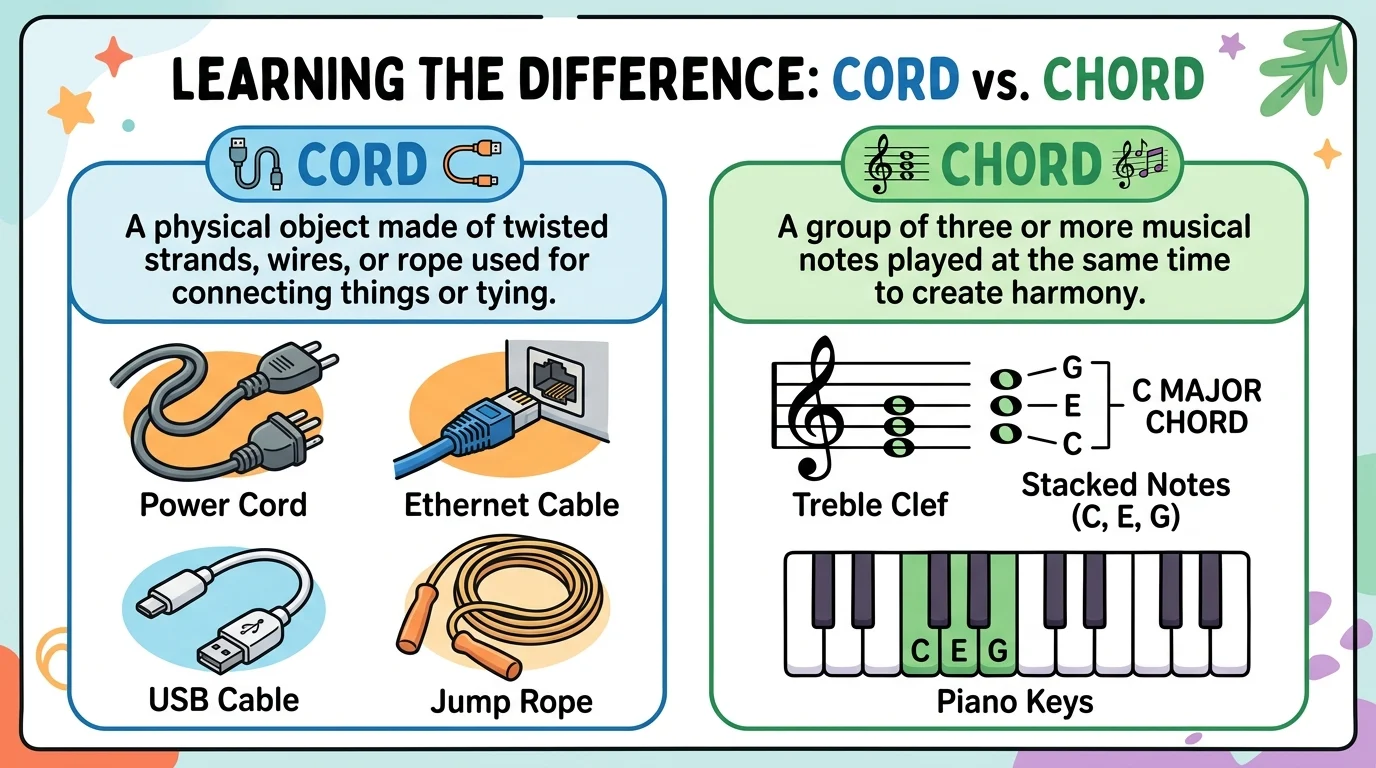
- “Cord” means a rope, wire, or string
- “Chord” is used in music or geometry
- They are not interchangeable
- Always check the meaning in your sentence
Simple Background Explanation
These two words come from different ideas:
- “Cord” comes from words related to rope or string
- “Chord” comes from music and math
Even though they sound the same, their meanings are not related.
Clear Explanation of the Difference
Let’s make it very simple.
“Cord”
This refers to a physical object like a rope or cable.
Examples:
- The power cord is broken.
- Tie it with a cord.
“Chord”
This has two main meanings:
- Music: a group of notes played together
- Geometry: a line joining two points on a circle
Examples:
- He played a chord on the guitar.
- Draw a chord in the circle.
So the difference is object vs music or math.
Comparison Table
| Word | Meaning | Type | When to Use |
|---|---|---|---|
| Cord | Rope, wire, or cable | Noun | Physical objects |
| Chord | Musical notes or a line in a circle | Noun | Music or math |
What “Cord” Means
“Cord” is used for something physical like a rope or wire.
Examples:
- The phone cord is long.
- He used a cord to tie the box.
- The power cord is unplugged.
It is common in daily life.
What “Chord” Means
“Chord” is used in music and math.
In music:
- He played a chord on the piano.
- This song uses simple chords.
In math:
- A chord connects two points on a circle.
Which One to Use and When
Use “cord” when:
- Talking about wires, ropes, or cables
- Referring to physical objects
Examples:
- Plug in the cord.
- Use a cord to tie it.
Use “chord” when:
- Talking about music
- Talking about geometry
Examples:
- Play a chord on the guitar.
- Draw a chord in the circle.
Easy Trick to Remember
Here is a simple rule:
Cord = cable
Chord = music
Memory tip:
Chord has “h” like “harmony”
Why People Get Confused
Here are the main reasons:
Same pronunciation
They sound identical.
Similar spelling
Only one extra letter.
Different meanings
Used in different fields.
Fast writing
Mistakes happen easily.
Common Mistakes to Avoid
Here are mistakes to watch for:
Using “cord” for music
- He played a cord ❌
Using “chord” for cables
- The power chord is broken ❌
Correct vs incorrect examples:
- He played a chord ✔️
- He played a cord ❌
- The power cord is broken ✔️
- The power chord is broken ❌
Everyday Real Life Examples
Here are simple examples from daily life.
At home:
- The power cord is unplugged.
- I need a longer cord.
In music:
- He played a chord.
- Learn basic chords first.
In school:
- Draw a chord in the circle.
- Use a cord to tie it.
Easy Learning Section for Beginners
Here is a simple trick:
Ask yourself:
Is it a physical object or music?
Memory tip:
Cable = cord
Music = chord
Practice sentences:
- The cord is broken
- He played a chord
- Use a cord to tie it
Mini exercise:
Fill in the blanks:
- The power ______ is broken
Answer: cord - He played a ______ on the guitar
Answer: chord - Draw a ______ in the circle
Answer: chord
Frequently Asked Questions
1. What is the difference between “cord” and “chord”
“Cord” is a rope or cable, while “chord” is used in music or math.
2. Can I use them interchangeably
No, they have different meanings.
3. What does “cord” mean
It means a rope or wire.
4. What does “chord” mean
It means musical notes or a line in a circle.
5. Why are they confusing
Because they sound the same.
6. Is this mistake common
Yes, very common.
7. How can I remember the difference
Think cable vs music.
8. Will this mistake affect my writing
Yes, it can change meaning.
Conclusion
The difference between “cord” and “chord” is simple.
“Cord” is used for ropes or cables.
“Chord” is used in music or geometry.
Just remember:
Cord = cable
Chord = music
With this simple rule, you can use both words correctly and confidently.