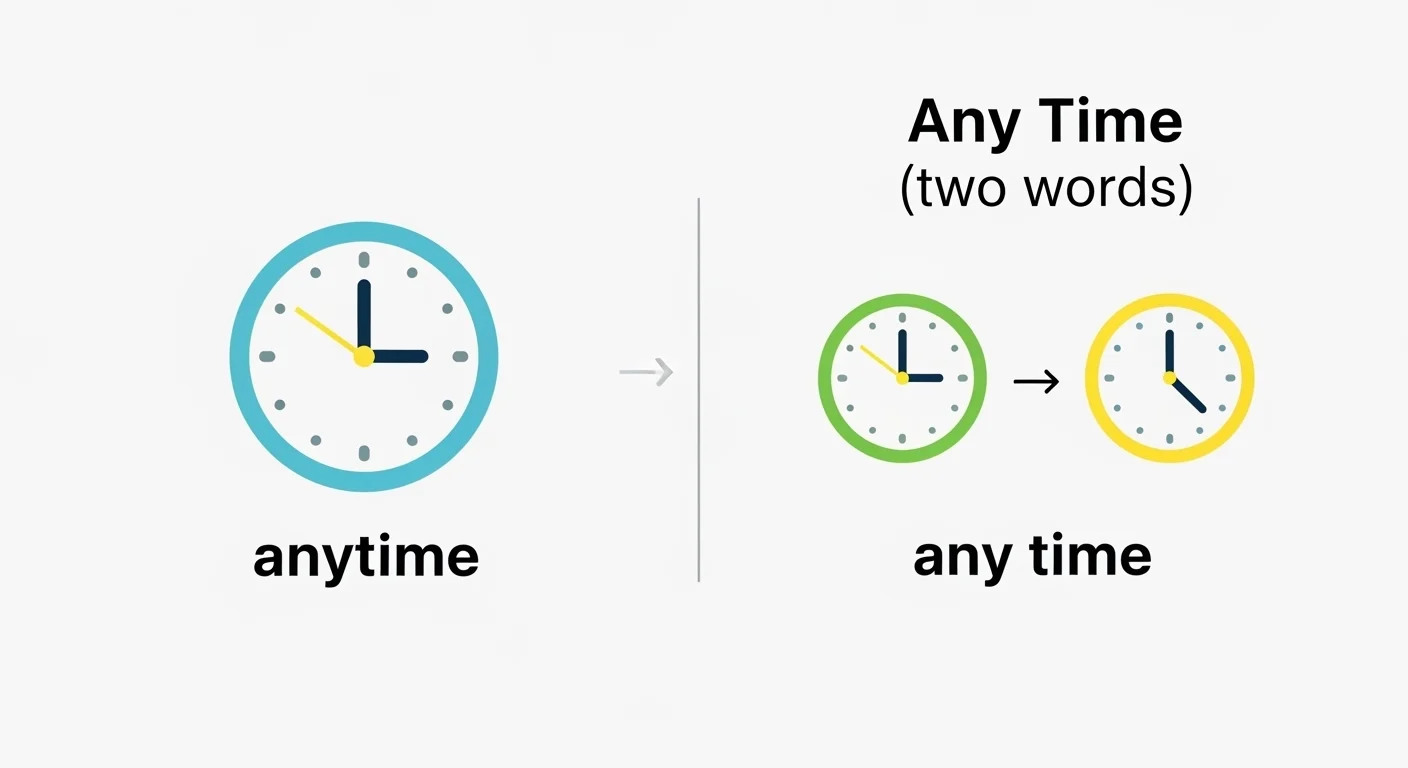
“Any time” and “anytime” often confuse English learners because they look almost the same. The only difference is a space, but that small change affects how they are used in a sentence.
Many people use them incorrectly because both relate to time.
The good news is that the rule is very simple once you understand it.
Quick Answer
- “Anytime” is an adverb
- “Any time” is a noun phrase
- Use “anytime” to mean whenever
- Use “any time” when talking about an amount of time
Simple Background Explanation
Both forms come from the same idea of referring to time.
Over time:
- “Any time” remained as a two word noun phrase
- “Anytime” became a single word used as an adverb
This is why both are correct, but they work differently.
Clear Explanation of the Difference
Let’s make it very simple.
“Anytime”
This is one word. It means “whenever.”
Examples:
- You can call me anytime.
- Visit anytime.
“Any time”
This is two words. It refers to an amount of time.
Examples:
- Do you have any time today?
- I do not have any time to rest.
So the difference is about whenever vs amount of time.
Comparison Table
| Form | Type | Meaning | When to Use |
|---|---|---|---|
| Anytime | Adverb | Whenever | Action or invitation |
| Any time | Noun phrase | Some amount of time | Talking about time available |
What “Anytime” Means
“Anytime” means “whenever” or “at any moment.”
Examples:
- You can visit anytime.
- Call me anytime.
- Come anytime you want.
It usually gives permission or flexibility.
What “Any Time” Means
“Any time” means some amount of time.
Examples:
- Do you have any time to talk?
- I do not have any time today.
- She barely had any time to prepare.
It is used when discussing available time.
Which One to Use and When
Use “anytime” when:
- You mean whenever
- Giving open permission
Examples:
- You can message me anytime.
- Stop by anytime.
Use “any time” when:
- Talking about available time
- Asking about time amount
Examples:
- Do you have any time later?
- I do not have any time now.
Easy Trick to Remember
Here is a simple rule:
Whenever = anytime
Amount of time = any time
Memory tip:
If you can replace it with “whenever,” use “anytime.”
Why People Get Confused
Here are the main reasons:
Similar spelling
Only a space changes meaning.
Same general idea
Both relate to time.
Fast writing
People often skip spaces.
Grammar confusion
Different sentence roles.
Common Mistakes to Avoid
Here are mistakes to watch for:
Using “anytime” for time amount
- I do not have anytime ❌
Using “any time” for whenever
- Call me any time tonight ❌ (less natural in modern usage)
Correct vs incorrect examples:
- Call me anytime ✔️
- Call me any time ❌
- I do not have any time ✔️
- I do not have anytime ✔️ (accepted informally but less preferred)
The clearer standard choice is “any time” for amount.
Everyday Real Life Examples
Here are simple examples from daily life.
In conversation:
- Call me anytime.
- Do you have any time today?
At work:
- You can email anytime.
- I do not have any time for extra tasks.
At school:
- Ask for help anytime.
- She did not have any time to study.
In texting:
- Message me anytime
- Got any time later?
Easy Learning Section for Beginners
Here is a simple trick:
Ask yourself:
Does it mean “whenever”?
If yes → anytime
If no → any time
Memory tip:
Whenever = one word
Practice sentences:
- Call me anytime
- Do you have any time
- Visit anytime
Mini exercise:
Fill in the blanks:
- You can call me ______
Answer: anytime - Do you have ______ today?
Answer: any time - Visit us ______
Answer: anytime
Frequently Asked Questions
1. What is the difference between “anytime” and “any time”
“Anytime” means whenever, while “any time” means an amount of time.
2. Are both correct
Yes, both are correct.
3. Which one means whenever
“Anytime.”
4. Which one refers to available time
“Any time.”
5. Why are they confusing
Because they look almost the same.
6. Is this mistake common
Yes, very common.
7. How can I remember the difference
Replace with “whenever.”
8. Will this mistake affect my writing
Yes, it can make your meaning unclear.
Conclusion
The difference between “any time” and “anytime” is simple once you know the rule.
“Anytime” means whenever.
“Any time” refers to an amount of time.
Just remember:
Whenever = anytime
Amount = any time
With this simple rule, you can use both forms correctly and confidently.