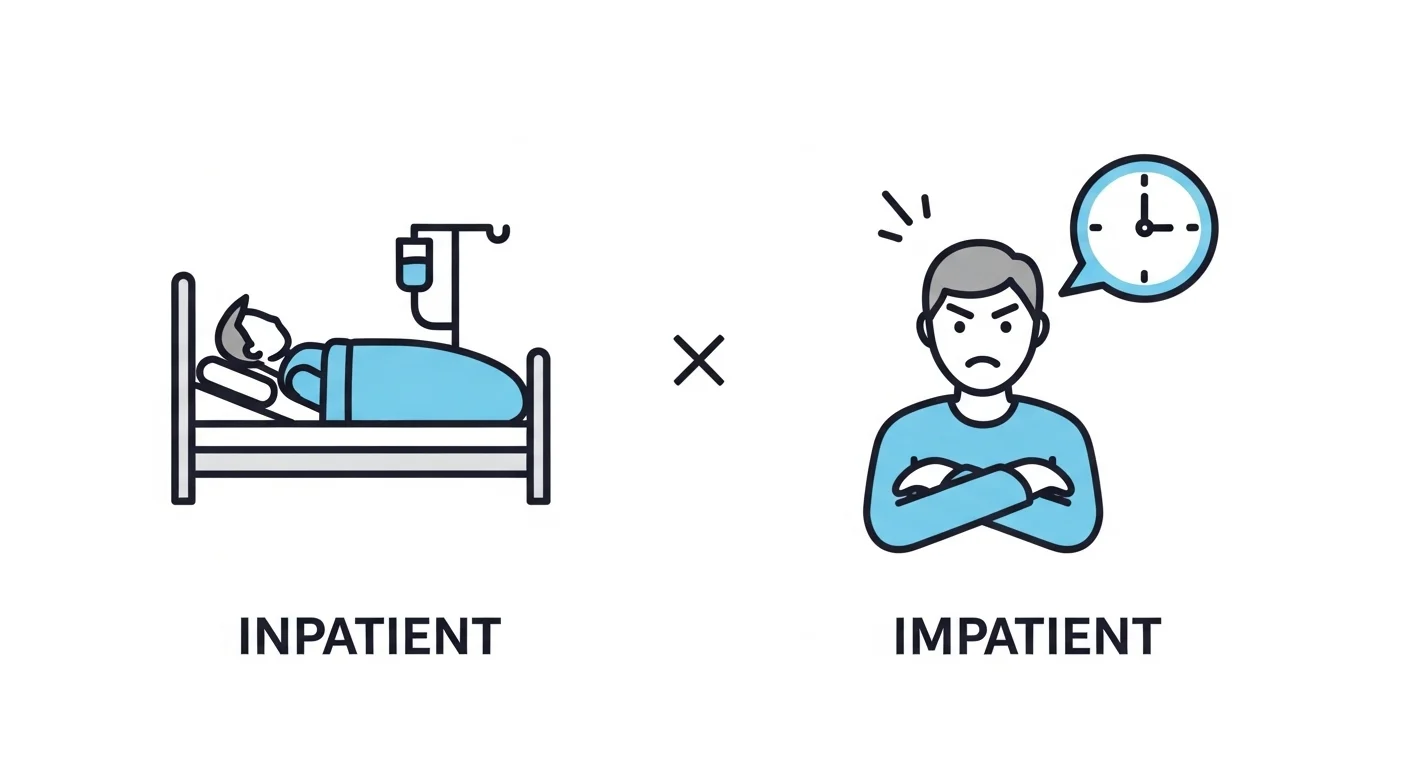
“Inpatient” and “impatient” look very similar, but they have completely different meanings. Just one letter changes, and that can confuse many learners.
If you mix them up, your sentence may sound strange or even funny.
Let’s make the difference simple and clear.
Quick Answer
- “Inpatient” is a noun (a person staying in a hospital)
- “Impatient” is an adjective (not willing to wait)
- They are not interchangeable
- Always check the context
Simple Background Explanation
These words come from different roots:
- “Inpatient” combines “in” and “patient” (a person receiving care)
- “Impatient” adds “im” to “patient,” meaning “not patient”
So one is about hospitals, and the other is about behavior.
Clear Explanation of the Difference
Let’s make it very simple.
“Inpatient”
This is a noun. It means a person who stays in a hospital for treatment.
Examples:
- The inpatient is recovering.
- She was admitted as an inpatient.
“Impatient”
This is an adjective. It means not willing to wait or easily annoyed.
Examples:
- He is impatient in long lines.
- She became impatient quickly.
So the difference is about hospital vs behavior.
Comparison Table
| Word | Type | Meaning | When to Use |
|---|---|---|---|
| Inpatient | Noun | Person staying in hospital | Medical context |
| Impatient | Adjective | Not willing to wait | Behavior or feeling |
What “Inpatient” Means
“Inpatient” is used in medical situations.
Meaning:
- A person admitted to a hospital
Examples:
- The inpatient stayed overnight.
- Doctors treated the inpatient carefully.
- She is now an inpatient.
What “Impatient” Means
“Impatient” describes a person’s behavior or feeling.
Meaning:
- Not calm when waiting
- Easily annoyed
Examples:
- He is impatient during delays.
- She felt impatient in traffic.
- Children can be impatient.
Which One to Use and When
Use “inpatient” when:
- Talking about hospitals
- Referring to a patient staying inside
Examples:
- The inpatient needs rest.
- He became an inpatient after surgery.
Use “impatient” when:
- Talking about behavior
- Talking about feelings
Examples:
- I am impatient today.
- She is impatient with slow service.
Easy Trick to Remember
Here is a simple rule:
Inpatient = in hospital
Impatient = not patient
Memory tip:
“Im” means “not”
Why People Get Confused
Here are the main reasons:
Similar spelling
Only one letter difference.
Same root word
Both include “patient.”
Fast reading
People miss small details.
Different meanings
But look very similar.
Common Mistakes to Avoid
Here are mistakes to watch for:
Using “inpatient” for behavior
- He is inpatient ❌
Using “impatient” for hospital
- She is an impatient in the hospital ❌
Correct vs incorrect examples:
- He is impatient ✔️
- He is inpatient ❌
- She is an inpatient ✔️
- She is an impatient ✔️ (but different meaning)
Everyday Real Life Examples
Here are simple examples from daily life.
In hospital:
- The inpatient is stable.
- Doctors visited the inpatient.
In daily life:
- I am impatient when waiting.
- She is impatient in traffic.
In conversation:
- He is impatient
- She is an inpatient
Easy Learning Section for Beginners
Here is a simple trick:
Ask yourself:
Is it about hospital or behavior?
Memory tip:
In = inside hospital
Im = not
Practice sentences:
- The inpatient is resting
- I am impatient
- She is impatient today
Mini exercise:
Fill in the blanks:
- The ______ is resting in the hospital
Answer: inpatient - I feel ______ waiting in line
Answer: impatient - She became ______ quickly
Answer: impatient
Frequently Asked Questions
1. What is the difference between “inpatient” and “impatient”
“Inpatient” is a hospital patient, while “impatient” means not willing to wait.
2. Can I use them interchangeably
No, they have different meanings.
3. What does “inpatient” mean
A person staying in a hospital.
4. What does “impatient” mean
Not willing to wait.
5. Why are they confusing
Because they look very similar.
6. Is this mistake common
Yes, very common.
7. How can I remember the difference
In = inside hospital, Im = not.
8. Will this mistake affect my writing
Yes, it can change meaning.
Conclusion
The difference between “inpatient” and “impatient” is simple once you understand it.
“Inpatient” is used for someone in a hospital.
“Impatient” is used to describe behavior.
Just remember:
Inpatient = hospital
Impatient = not patient
With this simple rule, you can use both words correctly and confidently.