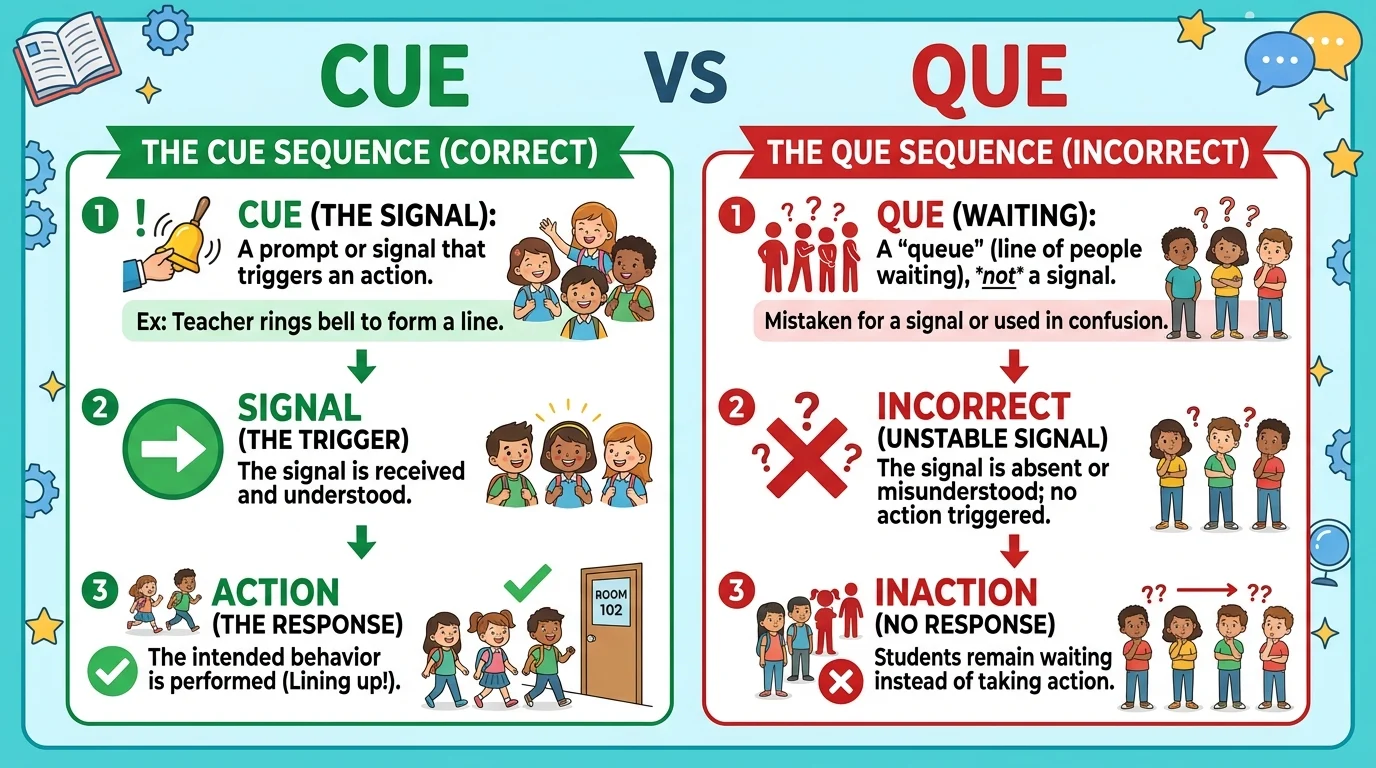
“Cue” and “que” often confuse learners because they look similar and may sound alike in some accents. But in standard English, only one of these is commonly correct.
The difference is simple once you understand it.
Let’s make it clear so you never mix them up again.
Quick Answer
- “Cue” is a correct English word
- “Que” is usually incorrect in English (except in special cases)
- “Cue” means a signal, prompt, or line in a queue (like billiards cue stick or acting signal)
- Use “cue” in normal English writing
Simple Background Explanation
“Cue” comes from theater and music, where it meant a signal to act or speak.
“Que” comes from other languages like Spanish and French, where it means “that” or “what.” It is not normally used in English sentences.
Clear Explanation of the Difference
Let’s make it very simple.
“Cue”
This is a real English word. It has several meanings:
- A signal to act
- A hint or prompt
- A stick used in games like billiards
Examples:
- That was my cue to speak.
- She waited for her cue.
“Que”
This is not a standard English word.
Example:
- That was my que ❌ wrong
So the difference is correct English word vs incorrect usage.
Comparison Table
| Word | Correct or Not | Meaning | Should You Use It |
|---|---|---|---|
| Cue | Correct | Signal, prompt, or hint | Yes |
| Que | Incorrect | Not standard in English | No |
What “Cue” Means
“Cue” is used in different ways.
Meaning:
- A signal to do something
- A hint or prompt
Examples:
- That was my cue to leave.
- He gave me a cue to start.
- She waited for her cue on stage.
It is common in daily speech and writing.
Special Note About “Queue”
Another similar word is “queue,” which means a line of people.
Examples:
- I stood in a queue.
Do not confuse “cue” with “queue.”
When “Que” Is Used
“Que” may appear in:
- Spanish or French sentences
- Names or quotes
Examples:
- ¿Qué haces? (Spanish)
But in normal English writing, avoid using “que.”
Which One to Use and When
Use “cue” when:
- Talking about signals or prompts
- Talking about timing or actions
Examples:
- That was my cue.
- She followed the cue.
Do not use “que” in English sentences.
Easy Trick to Remember
Here is a simple rule:
Cue = correct
Que = not English
Memory tip:
Cue has “u” like “you act now”
Why People Get Confused
Here are the main reasons:
Similar spelling
They look alike.
Foreign language influence
“Que” is common in other languages.
Sound confusion
They may sound similar.
Typing errors
Quick mistakes happen.
Common Mistakes to Avoid
Here are mistakes to watch for:
Using “que” instead of “cue”
- That was my que ❌
Confusing with “queue”
- I waited for my cue (if meaning line) ❌
Correct vs incorrect examples:
- That was my cue ✔️
- That was my que ❌
- I stood in a queue ✔️
- I stood in a cue ❌
Everyday Real Life Examples
Here are simple examples from daily life.
In conversation:
- That was my cue to speak.
- He gave me a cue.
At work:
- Wait for your cue.
- Follow the cue.
In daily life:
- That was my cue to leave
- She missed her cue
Easy Learning Section for Beginners
Here is a simple trick:
Ask yourself:
Is it a signal or prompt?
Memory tip:
Signal = cue
Practice sentences:
- That was my cue
- She waited for her cue
- He gave a cue
Mini exercise:
Fill in the blanks:
- That was my ______ to speak
Answer: cue - She waited for her ______
Answer: cue - He gave a ______
Answer: cue
Frequently Asked Questions
1. Is “que” correct in English
No, not in standard English.
2. What is the correct word
The correct word is “cue.”
3. What does “cue” mean
It means a signal or prompt.
4. What is “queue”
It means a line of people.
5. Why do people write “que”
Because of other languages.
6. Is this mistake common
Yes, very common.
7. How can I remember the correct form
Always use “cue.”
8. Will this mistake affect my writing
Yes, it makes it incorrect.
Conclusion
The difference between “cue” and “que” is simple.
“Cue” is the correct English word used for signals or prompts.
“Que” is not used in standard English writing.
Just remember:
Cue = correct
With this simple rule, you can use the right word confidently every time.