Many English learners feel confused between despite and in spite because both are used in very similar situations. They often have the same meaning, so people wonder if one is more correct than the other.
The good news is that both expressions are correct. The main difference is in the way they are written in a sentence.
This guide will explain everything in very simple English so you can use both forms confidently.
Quick Answer
- Despite and in spite of have almost the same meaning
- Both show contrast or an unexpected result
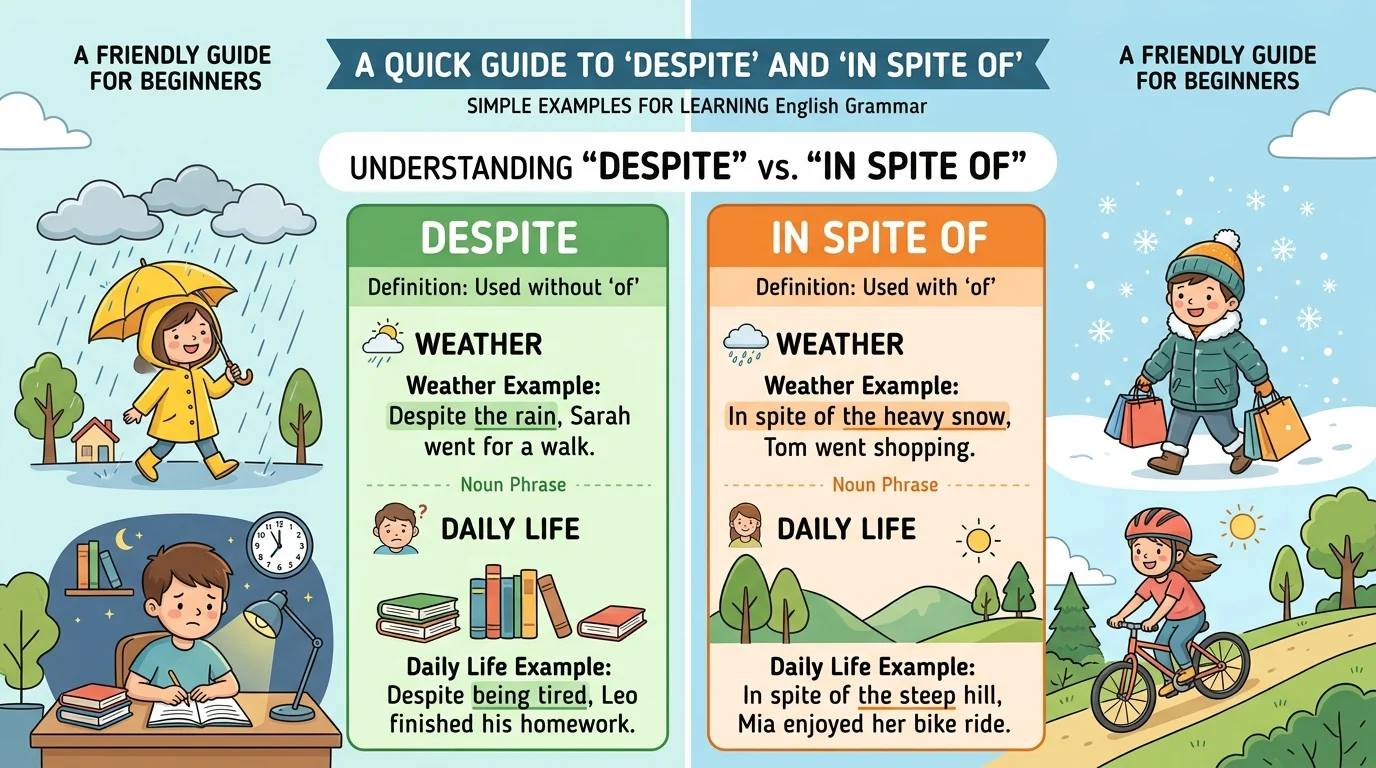
- Despite is one word
- In spite of is a three word phrase
- Both are correct in English
Simple Origin or Background
The word despite comes from old French and has been part of English for many years. It is used to show that something happened even when there was a problem or difficulty.
The phrase in spite of developed in English with the same meaning. Over time, both became common in speaking and writing.
Today, people use both forms naturally in daily English.
Clear Explanation of the Difference
What does “despite” mean
Despite means:
- even though there was a problem
- without being stopped by something
Examples:
- Despite the rain, we went outside
- She smiled despite her pain
What does “in spite of” mean
In spite of has the same meaning as despite.
Examples:
- In spite of the rain, we went outside
- He succeeded in spite of many problems
Main difference
The meaning is almost the same.
The only real difference is style:
- Despite is shorter and more direct
- In spite of sounds slightly more formal or longer
Comparison Table
| Feature | Despite | In Spite Of |
|---|---|---|
| Meaning | Even though | Even though |
| Type | One word | Three word phrase |
| Correct in English | Yes | Yes |
| Common use | Very common | Very common |
| Example | Despite the rain | In spite of the rain |
Which One to Use and When
You can use either form because both are correct.
Use despite when:
- You want a shorter sentence
- You want simple and direct writing
Examples:
- Despite his fear, he spoke well
- Despite the traffic, we arrived early
Use in spite of when:
- You prefer a more natural speaking style
- You want a slightly softer tone
Examples:
- In spite of the cold weather, they played outside
- She stayed calm in spite of the pressure
Common Mistakes People Make
1. Forgetting “of” after “in spite”
Wrong:
- In spite the rain, we played
Correct:
- In spite of the rain, we played
2. Using “despite of”
Wrong:
- Despite of the noise, I slept well
Correct:
- Despite the noise, I slept well
3. Mixing sentence structures
Wrong:
- Despite he was tired, he worked
Correct:
- Despite being tired, he worked
Or:
- Although he was tired, he worked
4. Confusing with “although”
Remember:
- Despite + noun or verb with ing
- Although + full sentence
Example:
- Despite the rain
- Although it was raining
Everyday Real Life Examples
In Emails
- Despite the delay, the meeting was successful
- In spite of the problem, we completed the work
In News
- Despite heavy rain, the match continued
- In spite of economic problems, sales increased
On Social Media
- Despite everything, keep smiling
- In spite of the stress, she stayed positive
In Daily Conversations
- Despite being tired, I finished my homework
- In spite of the traffic, we arrived on time
Short Learning Section for Students and Beginners
1. Remember the simple rule
- Despite + noun
- In spite of + noun
2. Never use “despite of”
Correct:
- Despite the rain
Wrong:
- Despite of the rain
3. Practice both forms
- Despite the noise
- In spite of the noise
4. Keep sentences simple
Short sentences help you learn faster.
FAQ Section
1. Are despite and in spite the same
Yes, they have almost the same meaning.
2. Which one is more correct
Both are correct.
3. Can I say “despite of”
No, that is incorrect.
4. Do I always need “of” after “in spite”
Yes, always use “of.”
5. Is despite formal or informal
It can be used in both formal and informal English.
6. Which one is shorter
Despite is shorter because it is one word.
7. Can I use them in speaking
Yes, both are common in speaking and writing.
8. How can I remember the rule
Remember:
- despite
- in spite of
Conclusion
The difference between despite and in spite of is very small.
Both expressions mean:
- even though there was a difficulty
Remember these simple points:
- Use despite without “of”
- Use in spite of with “of”
Once you practice a few examples, using these expressions becomes very easy.