“Discrete” and “discreet” look almost the same, but they have very different meanings. Just one extra “e” changes everything, and that’s why many learners mix them up.
The good news is that the difference is simple once you see it clearly.
Let’s break it down in an easy way.
Quick Answer
- “Discrete” means separate or distinct
- “Discreet” means careful and private
- They are not interchangeable
- The extra “e” changes the meaning
Simple Background Explanation
Both words come from the same root idea of “separate,” but over time their meanings changed:
- “Discrete” stayed close to the idea of “separate parts”
- “Discreet” developed the meaning of “careful” or “not drawing attention”
That’s why they look similar but mean different things.
Clear Explanation of the Difference
Let’s make it very simple.
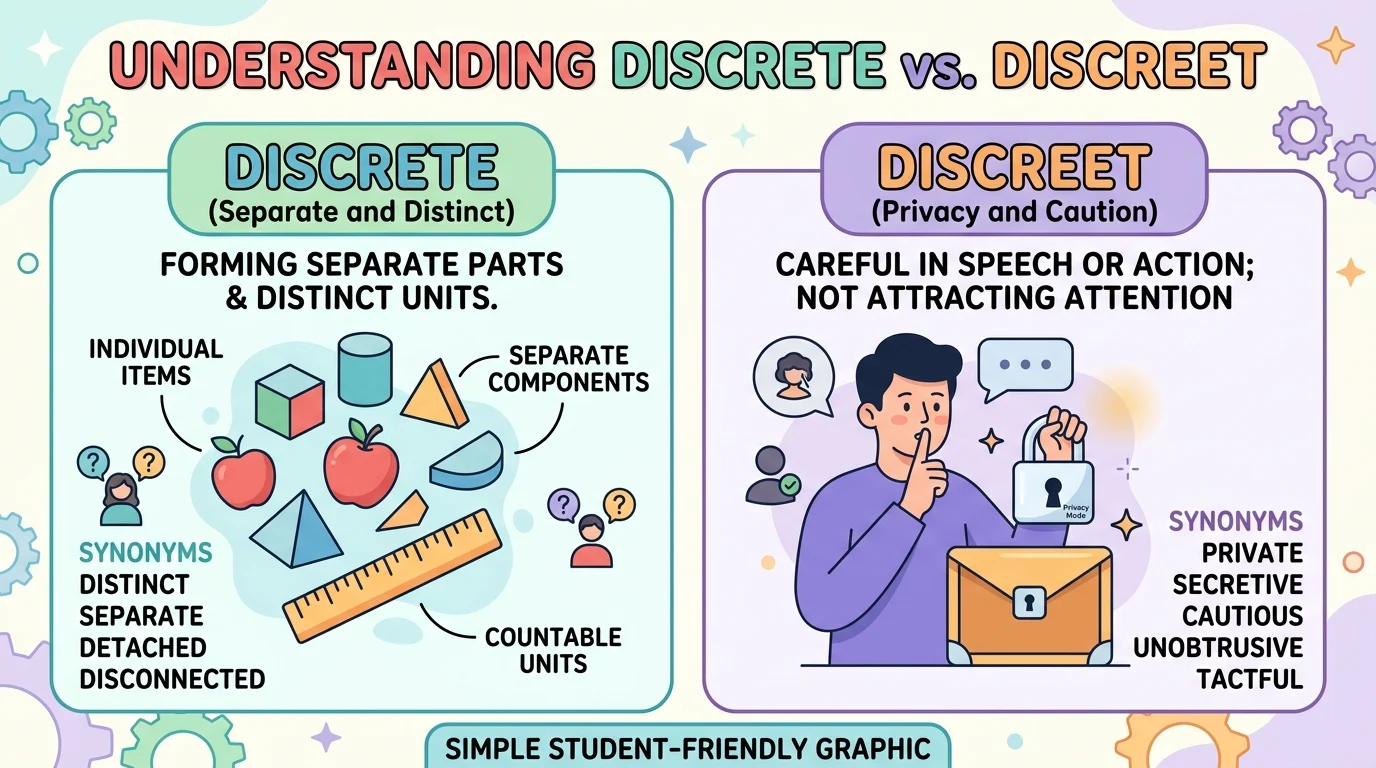
“Discrete”
This word means separate, individual, or distinct.
Examples:
- The system has discrete parts.
- The data is divided into discrete sections.
“Discreet”
This word means careful, quiet, and private.
Examples:
- Please be discreet about this.
- She gave a discreet answer.
So the difference is separate vs careful.
Comparison Table
| Word | Meaning | Type | When to Use |
|---|---|---|---|
| Discrete | Separate or distinct | Adjective | Parts or items |
| Discreet | Careful and private | Adjective | Behavior or communication |
What “Discrete” Means
“Discrete” is used when talking about things that are clearly separate.
Examples:
- The project has discrete stages.
- These are discrete categories.
- The machine has discrete components.
It is often used in technical or structured contexts.
What “Discreet” Means
“Discreet” is used when talking about behavior that is careful or private.
Examples:
- Be discreet with this information.
- He made a discreet comment.
- She handled the situation in a discreet way.
It often relates to secrecy or politeness.
Which One to Use and When
Use “discrete” when:
- Talking about separate things
- Talking about divisions or parts
Examples:
- The data is in discrete groups.
- The process has discrete steps.
Use “discreet” when:
- Talking about being careful
- Talking about privacy
Examples:
- Please be discreet.
- She gave a discreet reply.
Easy Trick to Remember
Here is a simple rule:
Discrete = separate
Discreet = secret
Memory tip:
Discreet has two “e” letters like “keep it secret”
Why People Get Confused
Here are the main reasons:
Similar spelling
Only one letter difference.
Same pronunciation
They sound very similar.
Close appearance
Easy to miss small changes.
Different meanings
But used in similar sentences.
Common Mistakes to Avoid
Here are mistakes to watch for:
Using “discreet” for separate items
- The system has discreet parts ❌
Using “discrete” for behavior
- Please be discrete about this ❌
Correct vs incorrect examples:
- The system has discrete parts ✔️
- The system has discreet parts ❌
- Please be discreet ✔️
- Please be discrete ❌
Everyday Real Life Examples
Here are simple examples from daily life.
In school:
- The project has discrete steps.
- Be discreet about the surprise.
At work:
- The process has discrete stages.
- He gave a discreet response.
In conversation:
- These are discrete parts
- Please be discreet
Easy Learning Section for Beginners
Here is a simple trick:
Ask yourself:
Is it about parts or privacy?
Memory tip:
Parts = discrete
Privacy = discreet
Practice sentences:
- The system has discrete parts
- Please be discreet
- The steps are discrete
Mini exercise:
Fill in the blanks:
- Please be ______ about this
Answer: discreet - The system has ______ parts
Answer: discrete - These are ______ categories
Answer: discrete
Frequently Asked Questions
1. What is the difference between “discrete” and “discreet”
“Discrete” means separate, while “discreet” means careful.
2. Can I use them interchangeably
No, they have different meanings.
3. What does “discrete” mean
It means separate or distinct.
4. What does “discreet” mean
It means careful and private.
5. Why are they confusing
Because they look and sound similar.
6. Is this mistake common
Yes, very common.
7. How can I remember the difference
Think separate vs secret.
8. Will this mistake affect my writing
Yes, it changes meaning.
Conclusion
The difference between “discrete” and “discreet” is simple.
“Discrete” is used for separate things.
“Discreet” is used for careful behavior.
Just remember:
Discrete = separate
Discreet = secret
With this simple rule, you can use both words correctly and confidently.