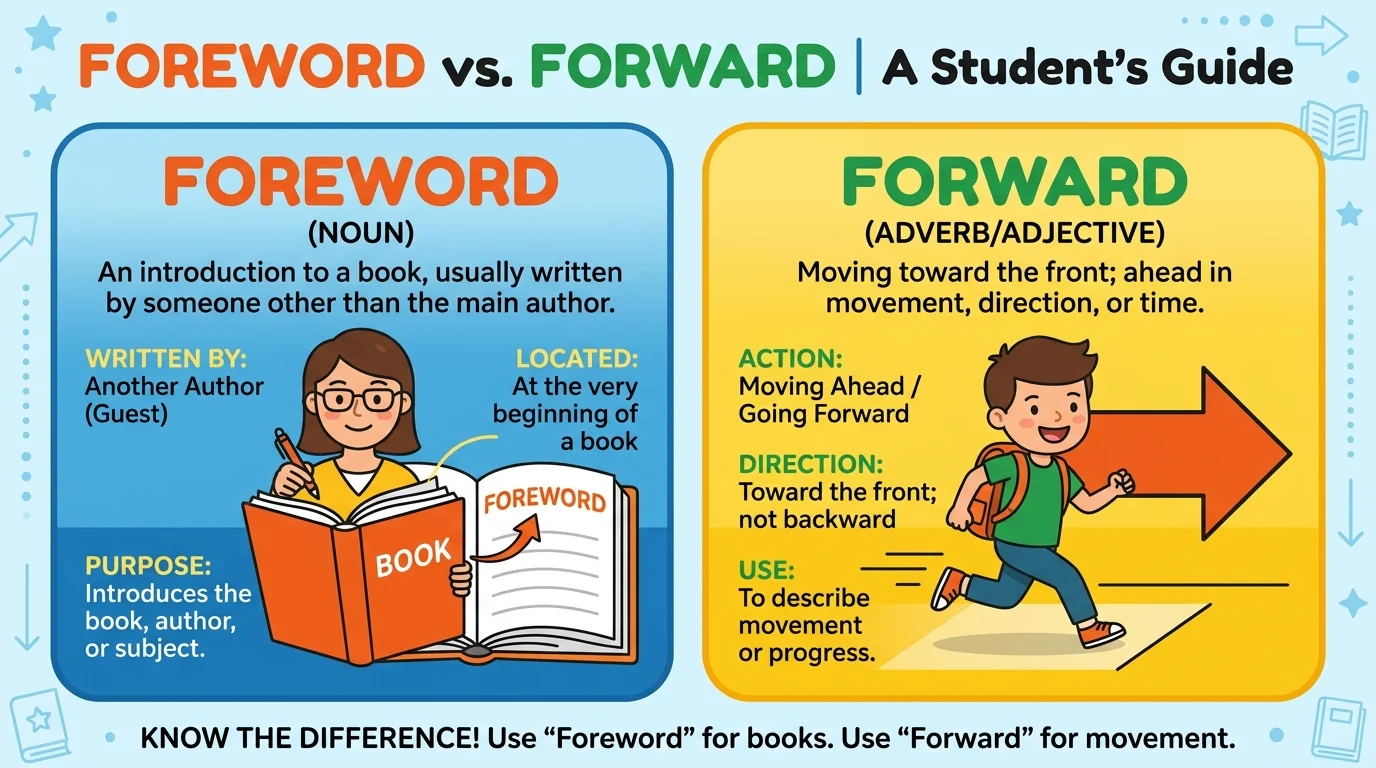
“Foreword” and “forward” sound exactly the same, but they have very different meanings and uses. Many learners confuse them because they hear the same sound and guess the spelling.
The difference is actually very easy once you understand it.
Let’s make it simple and clear.
Quick Answer
- “Foreword” is a noun (a short introduction in a book)
- “Forward” can be an adjective, adverb, verb, or noun (related to direction or movement)
- They are not interchangeable
- Use “foreword” only for books
Simple Background Explanation
Both words come from Old English roots:
- “Foreword” literally means “words before” (an introduction)
- “Forward” relates to moving ahead or direction
Even though they sound the same, their meanings are completely different.
Clear Explanation of the Difference
Let’s make it very simple.
“Foreword”
This is a noun. It is a short introduction at the beginning of a book.
Examples:
- She wrote the foreword to the book.
- The foreword explains the purpose.
“Forward”
This word has many uses, but it generally relates to moving ahead or direction.
Examples:
- Move forward.
- He stepped forward.
- Please forward the email.
So the difference is book introduction vs movement or direction.
Comparison Table
| Word | Type | Meaning | When to Use |
|---|---|---|---|
| Foreword | Noun | Introduction in a book | Books |
| Forward | Verb/Adj/Adv | Movement or direction | General use |
What “Foreword” Means
“Foreword” is used in books.
Meaning:
- A short introduction written before the main content
Examples:
- The author included a foreword.
- The foreword was written by an expert.
- I read the foreword first.
What “Forward” Means
“Forward” has several meanings, but all relate to moving ahead.
Examples:
- She walked forward.
- He moved forward in life.
- Please forward the message.
It can be:
- Verb: to send
- Adverb: ahead
- Adjective: bold or ahead
Which One to Use and When
Use “foreword” when:
- Talking about books
- Referring to an introduction
Examples:
- The foreword is interesting.
- He wrote the foreword.
Use “forward” when:
- Talking about movement
- Talking about sending something
- Talking about progress
Examples:
- Move forward.
- Forward the email.
Easy Trick to Remember
Here is a simple rule:
Foreword = before the book
Forward = ahead
Memory tip:
Foreword has “word” inside it
Why People Get Confused
Here are the main reasons:
Same pronunciation
They sound identical.
Different spelling
But similar appearance.
Multiple meanings
“Forward” has many uses.
Fast writing
People guess spelling.
Common Mistakes to Avoid
Here are mistakes to watch for:
Using “forward” for book introduction
- He wrote the forward ❌
Using “foreword” for movement
- Move foreword ❌
Correct vs incorrect examples:
- He wrote the foreword ✔️
- He wrote the forward ❌
- Move forward ✔️
- Move foreword ❌
Everyday Real Life Examples
Here are simple examples from daily life.
In books:
- The foreword explains the topic.
- She wrote the foreword.
In daily life:
- Move forward.
- Please forward this message.
In conversation:
- Read the foreword
- Move forward
Easy Learning Section for Beginners
Here is a simple trick:
Ask yourself:
Is it about a book or movement?
Memory tip:
Book = foreword
Movement = forward
Practice sentences:
- The foreword is helpful
- Move forward
- Please forward the email
Mini exercise:
Fill in the blanks:
- She wrote the ______ of the book
Answer: foreword - Please ______ the message
Answer: forward - Move ______
Answer: forward
Frequently Asked Questions
1. What is the difference between “foreword” and “forward”
“Foreword” is a book introduction, while “forward” relates to movement.
2. Can I use them interchangeably
No, they have different meanings.
3. What does “foreword” mean
It means an introduction in a book.
4. What does “forward” mean
It means ahead or to send something.
5. Why are they confusing
Because they sound the same.
6. Is this mistake common
Yes, very common.
7. How can I remember the difference
Think book vs movement.
8. Will this mistake affect my writing
Yes, it can make it incorrect.
Conclusion
The difference between “foreword” and “forward” is simple.
“Foreword” is used for book introductions.
“Forward” is used for movement or direction.
Just remember:
Foreword = book
Forward = ahead
With this simple rule, you can use both words correctly and confidently.