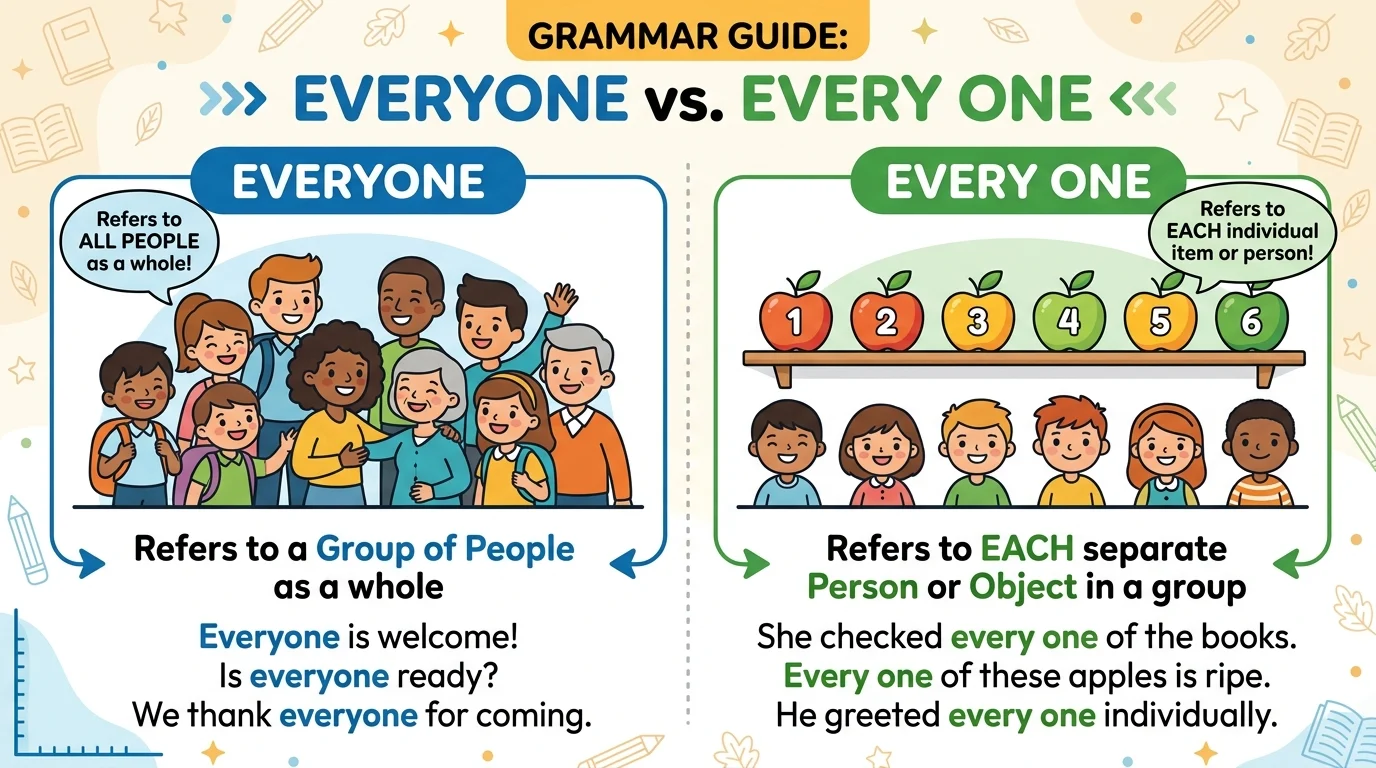
“Everyone” and “every one” look almost the same, but they are used in different ways. Many learners get confused because both talk about people or things in a group.
The key difference is small, but important.
Let’s make it simple and clear so you can use them correctly every time.
Quick Answer
- “Everyone” means all people
- “Every one” means each individual item or person
- “Everyone” is a pronoun
- “Every one” is used with a group you already know
Simple Background Explanation
Both forms come from the idea of “every” (all) and “one” (single unit).
Over time:
- “Everyone” became a single word used for people
- “Every one” stayed as two words to focus on each item or person
That’s why they are similar but not the same.
Clear Explanation of the Difference
Let’s make it very simple.
“Everyone”
This word means all people in a group.
Examples:
- Everyone is here.
- Everyone enjoyed the party.
“Every one”
This phrase means each individual person or thing, often in a known group.
Examples:
- Every one of the students passed.
- I checked every one of the items.
So the difference is all people vs each one separately.
Comparison Table
| Form | Type | Meaning | When to Use |
|---|---|---|---|
| Everyone | Pronoun | All people | General group |
| Every one | Phrase | Each individual | Specific group |
What “Everyone” Means
“Everyone” is used when talking about all people together.
Examples:
- Everyone is happy.
- Everyone knows the answer.
- Everyone was invited.
It is simple and general.
What “Every One” Means
“Every one” is used when focusing on each person or thing separately.
It is often followed by “of.”
Examples:
- Every one of the players tried hard.
- I spoke to every one of them.
- Every one of the books is useful.
Which One to Use and When
Use “everyone” when:
- Talking about people in general
- You do not need to focus on individuals
Examples:
- Everyone is ready.
- Everyone agreed.
Use “every one” when:
- Talking about each person or item
- Referring to a specific group
Examples:
- Every one of the students passed.
- I checked every one of the answers.
Easy Trick to Remember
Here is a simple rule:
Everyone = all people
Every one = each one
Memory tip:
If you can add “of them,” use “every one”
Example:
- Every one of them ✔️
- Everyone of them ❌
Why People Get Confused
Here are the main reasons:
Similar spelling
Only a space changes.
Similar meaning
Both relate to groups.
Fast writing
Easy to miss the space.
Grammar confusion
Pronoun vs phrase.
Common Mistakes to Avoid
Here are mistakes to watch for:
Using “everyone” with “of”
- Everyone of the students ❌
Using “every one” without need
- Every one is happy ❌
Correct vs incorrect examples:
- Everyone is happy ✔️
- Every one is happy ❌
- Every one of the students passed ✔️
- Everyone of the students passed ❌
Everyday Real Life Examples
Here are simple examples from daily life.
In school:
- Everyone passed the test.
- Every one of the answers is correct.
At home:
- Everyone is here.
- I checked every one of the items.
In conversation:
- Everyone is ready
- Every one of them agreed
Easy Learning Section for Beginners
Here is a simple trick:
Ask yourself:
Is it all people or each one?
Memory tip:
All people = everyone
Each one = every one
Practice sentences:
- Everyone is here
- Every one of the students passed
- Everyone enjoyed the event
Mini exercise:
Fill in the blanks:
- ______ is ready
Answer: Everyone - ______ of the students passed
Answer: Every one - I checked ______ of the items
Answer: every one
Frequently Asked Questions
1. What is the difference between “everyone” and “every one”
“Everyone” means all people, while “every one” means each individual.
2. Can I use them interchangeably
No, they have different uses.
3. Can I say “everyone of them”
No, use “every one of them.”
4. Which one is more common
“Everyone” is more common.
5. Why are they confusing
Because they look almost the same.
6. Is this mistake common
Yes, very common.
7. How can I remember the difference
Use “of” with “every one.”
8. Will this mistake affect my writing
Yes, it can make your sentence incorrect.
Conclusion
The difference between “everyone” and “every one” is simple.
“Everyone” is used for all people.
“Every one” is used for each individual.
Just remember:
Everyone = all
Every one = each
With this simple rule, you can use both forms correctly and confidently.