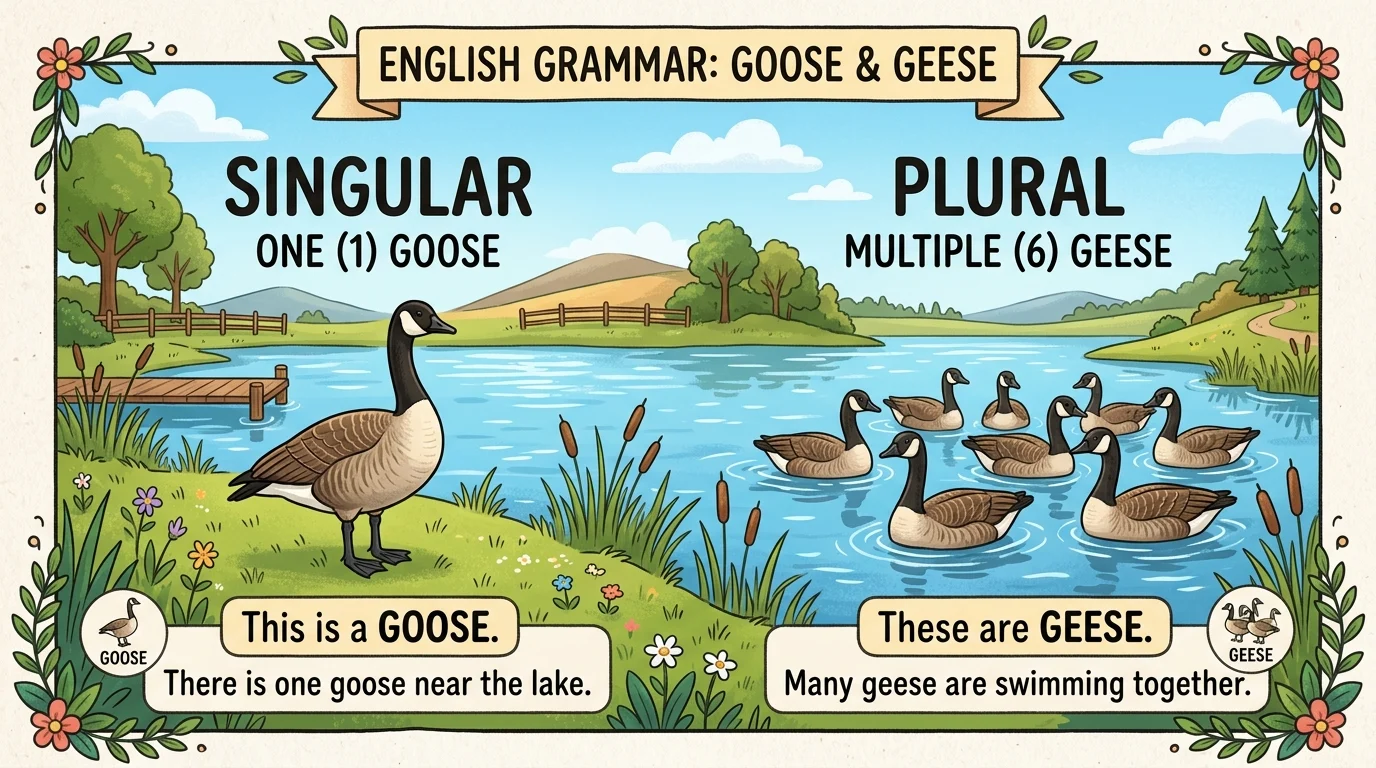
Many English learners get confused between geese and goose because both words refer to the same type of bird. The confusion usually happens because English changes the spelling completely when moving from singular to plural.
Unlike regular nouns that simply add “s” or “es,” this word changes form in an unusual way. That is why learners often wonder which word to use.
The good news is that the rule is simple once you understand singular and plural forms.
This guide explains the difference in very simple English with clear examples and beginner friendly tips.
Quick Answer
- Goose means one bird
- Geese means more than one bird
- Goose is singular
- Geese is plural
Simple Origin or Background
The word goose comes from very old English language roots.
In older English, some words changed vowel sounds when becoming plural instead of adding “s.”
This is why:
- goose becomes geese
just like: - tooth becomes teeth
- foot becomes feet
Because the spelling changes completely, learners often confuse the forms.
Clear Explanation of the Difference
What does “goose” mean
Goose is a singular noun.
It means:
- one goose bird
Examples:
- A goose crossed the road
- The goose swam in the lake
- I saw one white goose
Use this word when talking about only one bird.
What does “geese” mean
Geese is the plural form of goose.
It means:
- more than one goose
Examples:
- The geese flew south for winter
- Several geese stood near the water
- We fed the geese at the park
Use this word when talking about two or more birds.
Comparison Table
| Feature | Goose | Geese |
|---|---|---|
| Meaning | One bird | More than one bird |
| Grammar type | Singular noun | Plural noun |
| Number | One | Two or more |
| Example | A goose is swimming | The geese are swimming |
Which One to Use and When
Use goose when:
- Talking about one bird
Examples:
- The goose is loud
- I photographed a goose
Use geese when:
- Talking about multiple birds
Examples:
- The geese are flying together
- Many geese live near the lake
Common Mistakes People Make
1. Saying “gooses”
Wrong:
- I saw three gooses
Correct:
- I saw three geese
2. Using “geese” for one bird
Wrong:
- One geese is standing there
Correct:
- One goose is standing there
3. Forgetting irregular plural rules
This is an irregular plural noun.
4. Mixing singular and plural verbs
Correct:
- The goose is hungry
- The geese are hungry
Everyday Real Life Examples
In Emails
- A goose entered the garden
- Several geese were seen near the river
In News
- The goose was rescued safely
- Wild geese migrated south this season
On Social Media
- That goose looks funny
- The geese are so beautiful today
In Daily Conversations
- I heard a goose outside
- The geese are making noise again
Short Learning Section for Students and Beginners
1. Learn the simple rule
- goose = one
- geese = many
2. Remember similar word patterns
- tooth → teeth
- foot → feet
- goose → geese
3. Practice simple examples
- One goose
- Two geese
4. Use memory tricks
- goose = single bird
- geese = group of birds
FAQ Section
1. What does “goose” mean
It means one goose bird.
2. What does “geese” mean
It means more than one goose.
3. Is “gooses” correct
No.
Correct plural:
- geese.
4. Which word is singular
Goose.
5. Which word is plural
Geese.
6. Why does the spelling change
Because goose is an irregular noun in English.
7. Are goose and geese pronounced differently
Yes.
8. How can I remember the difference
Remember:
- goose = one
- geese = many
Conclusion
The difference between goose and geese becomes simple once you remember singular and plural forms.
- Goose means one bird
- Geese means more than one bird
A simple memory trick:
- goose = single
- geese = group
With practice and clear examples, you can easily use both words correctly and confidently.