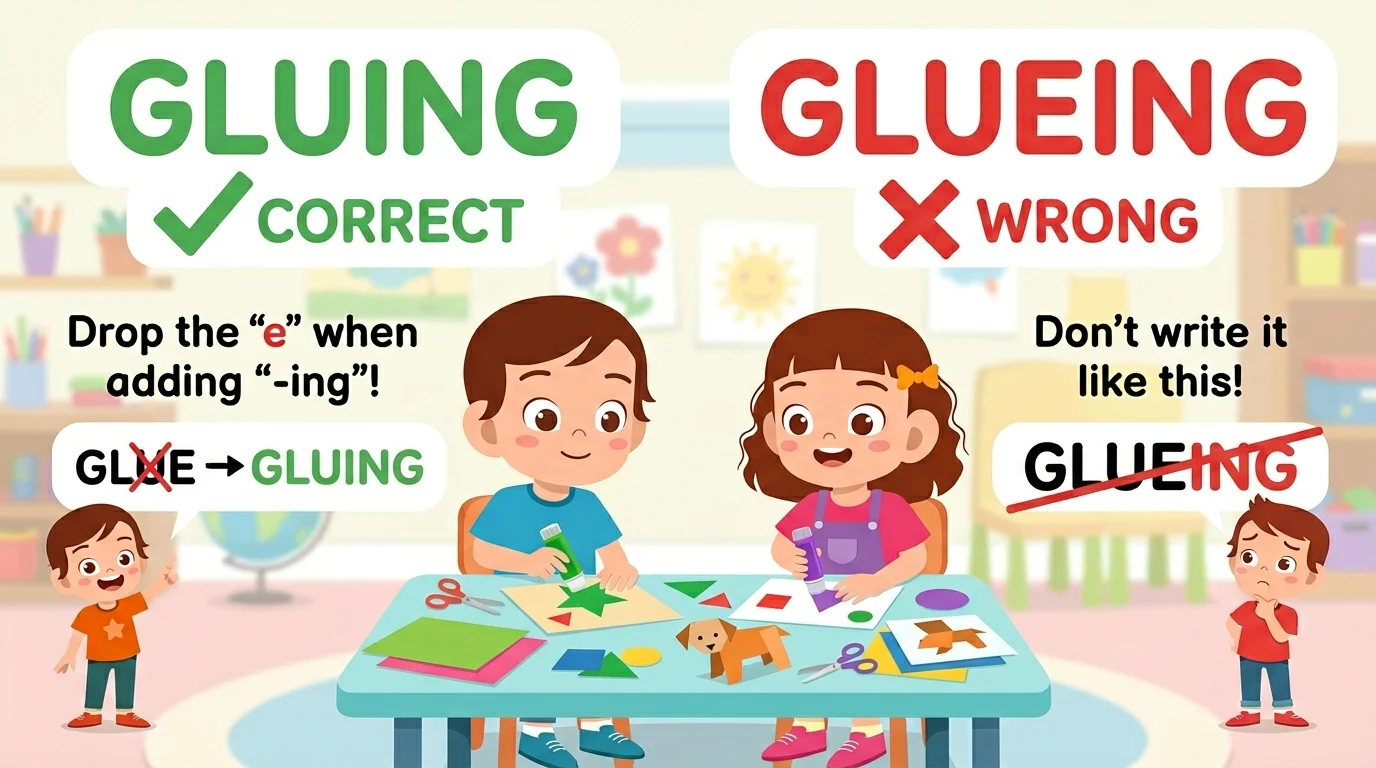
Many English learners confuse glueing and gluing because both spellings seem possible. Since the base word is glue, people often wonder whether the extra “e” should stay when adding “ing.”
The good news is simple:
One spelling is strongly preferred in modern English.
This guide explains the difference in very simple English with clear examples and beginner friendly tips.
Quick Answer
- Gluing is the preferred and standard spelling
- Glueing is much less common
- Both relate to using glue to stick things together
- Gluing is the form most people should use
Simple Origin or Background
The verb glue means:
- to stick things together using glue
When English adds “ing” to many verbs ending in silent “e,” the final “e” is usually removed.
Examples:
- make → making
- write → writing
So:
- glue → gluing
Because the word already contains two vowels together, some people mistakenly keep the “e” and write:
- glueing
Clear Explanation of the Difference
What does “gluing” mean
Gluing is the standard present participle and continuous form of glue.
Examples:
- She is gluing paper to the wall
- We spent the afternoon gluing decorations
- He is gluing the broken toy together
This is the preferred modern spelling.
What about “glueing”
Glueing has the same meaning, but it is much less common.
Examples:
- The children were glueing pictures into books
Although some dictionaries may recognize it, most modern English writing prefers:
- gluing
Comparison Table
| Feature | Glueing | Gluing |
|---|---|---|
| Correct English | Rarely used alternative | Preferred standard spelling |
| Common usage | Less common | More common |
| Meaning | Using glue | Using glue |
| Preferred style | Uncommon spelling | Modern standard English |
Which One to Use and When
Use gluing in almost all situations because it is:
- more common
- more modern
- preferred in dictionaries and writing
Examples:
- I am gluing the pieces together
- They were gluing posters on the wall
Avoid using:
- glueing
unless a specific style guide allows it.
Common Mistakes People Make
1. Keeping the silent “e”
Wrong or uncommon:
- glueing
Preferred:
- gluing
2. Forgetting the “drop the e” rule
Many English verbs remove the silent “e” before adding “ing.”
3. Thinking “glueing” is the main spelling
Modern English strongly prefers:
- gluing
4. Confusing spelling because of vowel sounds
The double vowel combination can make learners unsure.
Everyday Real Life Examples
In Emails
- We are gluing the final parts today
- Students were gluing pictures into notebooks
In News
- Workers spent hours gluing damaged materials
- Children enjoyed gluing craft items together
On Social Media
- I am gluing decorations for the party
- My little brother loves gluing stickers everywhere
In Daily Conversations
- She is gluing the broken cup
- We spent all afternoon gluing paper crafts
Short Learning Section for Students and Beginners
1. Learn the simple rule
- glue → gluing
2. Remember the spelling pattern
Drop the silent “e” before adding:
- ing
3. Practice simple examples
- Gluing paper
- Gluing pictures together
4. Use memory tricks
- gluing follows the same rule as making and writing
FAQ Section
1. Is “gluing” correct
Yes.
2. Is “glueing” correct
It exists, but it is much less common.
3. Which spelling is preferred
Gluing.
4. Why do people write “glueing”
Because they keep the final “e” from glue.
5. What does “gluing” mean
It means sticking things together with glue.
6. Which spelling should students use
Gluing is the best choice.
7. Why is “gluing” more common
Because English usually drops silent “e” before adding “ing.”
8. How can I remember the correct spelling
Remember:
- glue becomes gluing by dropping the final “e.”
Conclusion
The difference between glueing and gluing is mainly about spelling preference.
- Both forms may appear sometimes
- Gluing is the standard and preferred spelling
- Modern English usually drops the silent “e” before adding “ing”
A simple memory trick:
- glue → gluing just like make → making
With practice and clear examples, you can confidently use the correct spelling in everyday English.