Many English learners are confused by inquire and enquire because both words have nearly the same meaning. You’ll see one spelling in American English and another in British English, which makes the choice even more confusing.
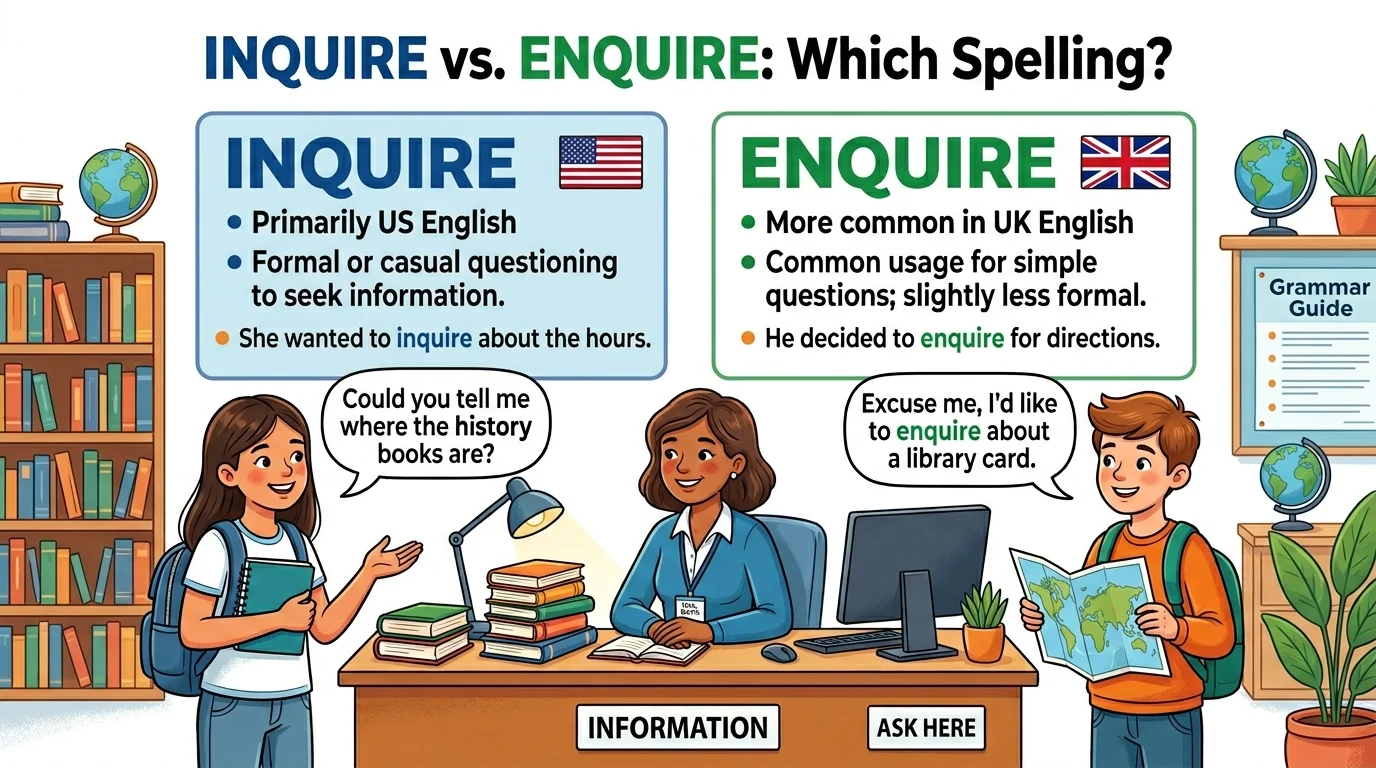
The simple answer is that both inquire and enquire are correct. The difference mainly depends on the type of English you are using and, in some cases, the level of formality.
Quick Answer
- Inquire and enquire both mean “to ask for information.”
- Inquire is the preferred spelling in American English.
- Enquire is more common in British English.
- In modern usage, the meanings are usually the same.
The Basic Difference
| Word | Common Usage |
|---|---|
| Inquire | Preferred in American English |
| Enquire | More common in British English |
Examples
- I would like to inquire about the course.
- She called to enquire about ticket prices.
Both sentences are correct.
What Does “Inquire” Mean?
Inquire is a verb that means:
- to ask a question
- to seek information
- to investigate
Examples:
- I want to inquire about your services.
- She inquired about the job opening.
- The customer inquired about delivery times.
- We inquired whether seats were available.
In American English, inquire is the standard spelling in both formal and informal writing.
What Does “Enquire” Mean?
Enquire has the same basic meaning:
- to ask
- to seek information
- to request details
Examples:
- He enquired about the train schedule.
- They enquired whether rooms were available.
- She enquired about the price.
- I am writing to enquire about your membership plans.
This spelling is more common in British English.
Is There a Meaning Difference?
Traditionally, some British style guides made a distinction:
- Enquire = ask for information.
- Inquire = conduct a formal investigation.
Examples:
- I enquired about the opening hours.
- The committee inquired into the accident.
However, many modern dictionaries and writers treat the words as interchangeable.
Comparison Table
| Feature | Inquire | Enquire |
|---|---|---|
| Correct English | Yes | Yes |
| Meaning | Ask for information | Ask for information |
| American English | Preferred | Rare |
| British English | Common | Common |
| Formal Investigations | Often preferred | Less common |
Which One Should You Use?
Use “Inquire” When
You are writing:
- American English
- business emails
- academic writing
- formal documents
Examples:
- I would like to inquire about your pricing.
- The agency inquired into the complaint.
- She inquired about the application process.
Use “Enquire” When
You are writing:
- British English
- informal requests
- UK-based correspondence
Examples:
- I am writing to enquire about availability.
- He enquired about train times.
- They enquired whether tickets remained.
Common Mistakes People Make
Thinking One Spelling Is Wrong
Both are correct.
Mixing American and British English
If you choose one style, stay consistent.
For example:
- American English → inquire, inquiry
- British English → enquire, enquiry
Assuming They Always Have Different Meanings
In modern English, the difference is often minimal or nonexistent.
Forgetting the Related Nouns
The noun forms are:
- inquiry
- enquiry
Both are correct, though usage varies by region.
Everyday Examples
In Emails
- I would like to inquire about your services.
- I am writing to enquire about availability.
In Business
- Customers may inquire about refunds.
- Visitors can enquire at reception.
In School
- Students often inquire about deadlines.
- Parents may enquire about admissions.
In Conversations
- He inquired about the meeting.
- She enquired about the address.
Easy Memory Trick
Think:
- Inquire = America
- Enquire = Britain
Both mean “ask for information.”
If you’re unsure, inquire is generally understood everywhere and is the more common international spelling.
Practice Sentences
Choose the correct word based on style.
- I would like to _____ about the position.
- She _____ about the ticket price.
- The committee _____ into the incident.
- We called to _____ about hotel rooms.
Answers
- inquire/enquire
- inquired/enquired
- inquired
- inquire/enquire
Frequently Asked Questions
Is inquire correct?
Yes.
It is the preferred spelling in American English.
Is enquire correct?
Yes.
It is commonly used in British English.
Do they mean the same thing?
Usually yes.
Both mean to ask for information.
Which spelling is more common worldwide?
Inquire is generally more common internationally, especially in business and academic writing.
Is enquire old-fashioned?
No.
It remains common in British English.
Should I use inquire or enquire in formal writing?
In American English, use inquire.
In British English, either may be acceptable depending on the style guide.
What about inquiry and enquiry?
Both are correct noun forms, though regional preferences differ.
Conclusion
The difference between inquire and enquire is mostly a matter of regional spelling.
- Inquire is the preferred form in American English.
- Enquire is more common in British English.
- Both mean “to ask for information.”
- In modern usage, they are often interchangeable.
A simple rule to remember is:
If you’re writing American English, use “inquire.” If you’re writing British English, “enquire” is also perfectly acceptable.