Many people wonder whether mama or momma is the correct way to refer to a mother. Since both spellings appear in books, songs, movies, and everyday conversations, it’s easy to be unsure which one to use.
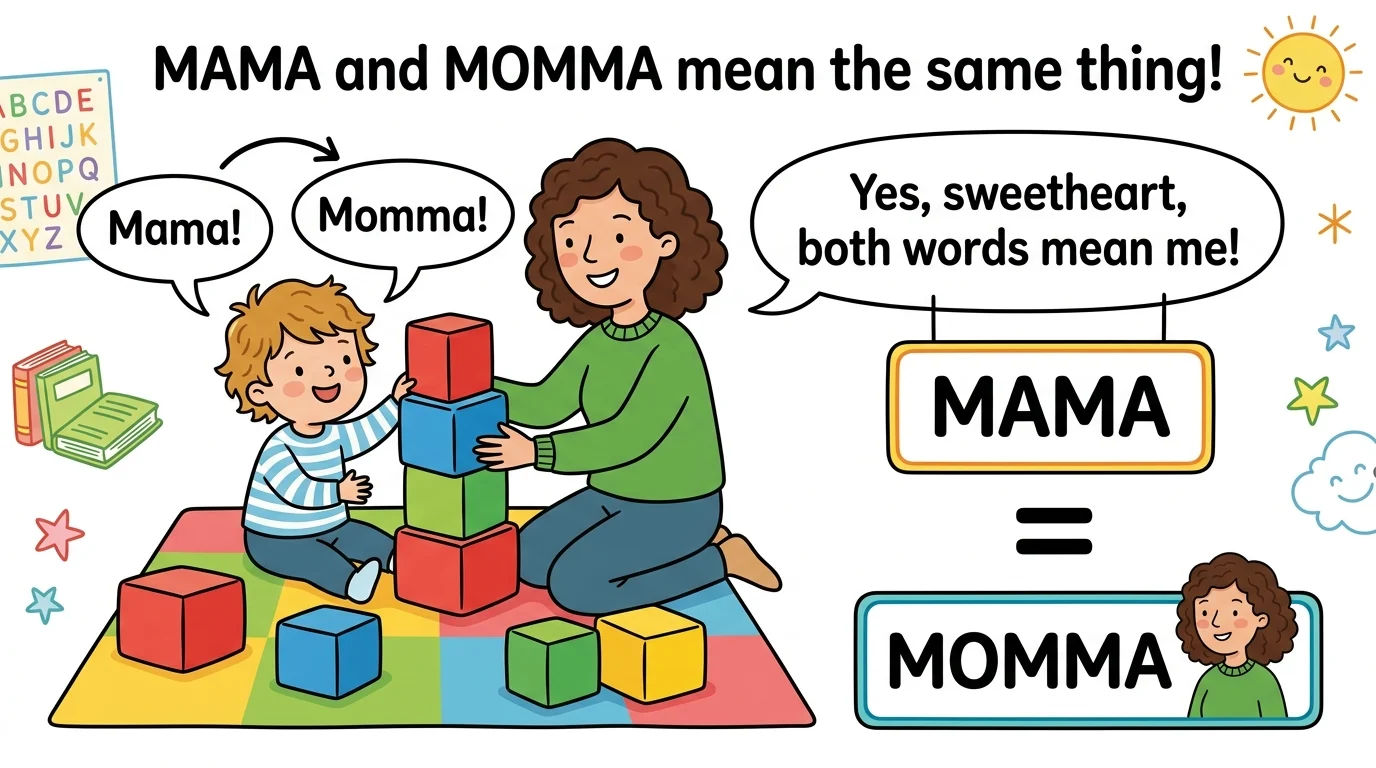
The good news is that both mama and momma are correct. The difference is mainly one of spelling, regional preference, and style rather than meaning.
In most situations, both words refer affectionately to a person’s mother.
Quick Answer
- Mama and momma are both correct.
- Both are affectionate terms for a mother.
- Mama is more widely used and recognized internationally.
- Momma is especially common in parts of the United States, particularly in Southern speech.
The Basic Difference
| Word | Correct? | Usage |
|---|---|---|
| Mama | Yes | Common worldwide |
| Momma | Yes | Common in informal American English |
Examples
- My mama taught me to be kind.
- Momma always made the best cookies.
- I called my mama after work.
- Momma said dinner was ready.
What Does “Mama” Mean?
Mama is an informal and affectionate word for mother.
Children often learn and say this word at a very young age.
Examples
- Mama, can you help me?
- She misses her mama.
- My mama always supported me.
- The baby called out for mama.
The term is common in many English-speaking countries and cultures.
What Does “Momma” Mean?
Momma has the same basic meaning as mama.
It is another affectionate way to refer to a mother.
Examples
- Momma told me to be careful.
- I learned that recipe from my momma.
- His momma was very proud of him.
- Momma always knew what to say.
This spelling is particularly common in informal American English and regional dialects.
Comparison Table
| Feature | Mama | Momma |
|---|---|---|
| Correct English | Yes | Yes |
| Meaning | Mother | Mother |
| Formal Usage | Rare | Rare |
| Worldwide Recognition | High | Moderate |
| Common in Southern U.S. | Yes | Very common |
Which One Should You Use?
Use “Mama” When
You want:
- the more widely recognized spelling
- a simple, universal term
- a spelling commonly used in many countries
Examples:
- I love my mama.
- Mama always encouraged me.
- The child ran to her mama.
Use “Momma” When
You want:
- a regional or Southern American feel
- a more conversational tone
- a family-specific spelling preference
Examples:
- My momma makes amazing pie.
- Momma always said to work hard.
- He called his momma every Sunday.
Common Mistakes People Make
Thinking One Is Wrong
Neither is wrong.
Both spellings are accepted.
Assuming They Have Different Meanings
They usually mean exactly the same thing.
Using Them in Formal Writing
In professional or academic writing, people generally use:
- mother
instead of:
- mama
- momma
Mixing Spellings Unnecessarily
Choose one spelling and stay consistent throughout your writing.
Everyday Examples
In Conversations
- Mama, where are you?
- Momma, can I go outside?
In Songs
- Mama, I’m coming home.
- My momma told me not to worry.
In Books
- She remembered her mama’s advice.
- His momma waited on the porch.
On Social Media
- Happy birthday, Mama!
- Love you, Momma!
Easy Memory Trick
Think:
- Mama = the more universal spelling.
- Momma = a more regional and informal variation.
Since both mean “mother,” you can choose the version that feels most natural to you.
Practice Sentences
Choose the word that fits naturally.
- My _____ taught me to read.
- _____ always knows when I’m upset.
- I called my _____ yesterday.
- Her _____ gave her good advice.
Answers
Both mama and momma can work in all four sentences depending on personal preference and style.
Frequently Asked Questions
Is “mama” correct?
Yes.
It is a common and widely accepted term for a mother.
Is “momma” correct?
Yes.
It is also a correct and widely used informal term.
Which spelling is more common?
Mama is generally more common worldwide.
Do mama and momma mean different things?
Usually no.
Both refer to a mother.
Which spelling is more common in the Southern United States?
Momma is especially popular in Southern American English.
Can I use these words in formal writing?
It’s usually better to use mother in formal contexts.
Which spelling should I choose?
Use whichever spelling matches your family’s preference, regional style, or writing tone.
Conclusion
The difference between mama and momma is mainly one of spelling and style.
- Both words are correct.
- Both are affectionate ways to say mother.
- Mama is the more universal spelling.
- Momma is especially common in informal American English, particularly in the South.
A simple rule to remember is:
If you’re talking affectionately about your mother, both “mama” and “momma” are correct choices.