Many English learners confuse it and its because the words look almost the same. The only difference is the apostrophe that many people expect to see in possessive forms.
This confusion is very common, even among native English speakers. People often write it’s when they actually mean its, or they use it incorrectly in sentences.
The good news is that the rule is simple once you understand how each word works.
This guide explains the difference in very easy English with clear examples and beginner friendly tips.
Quick Answer
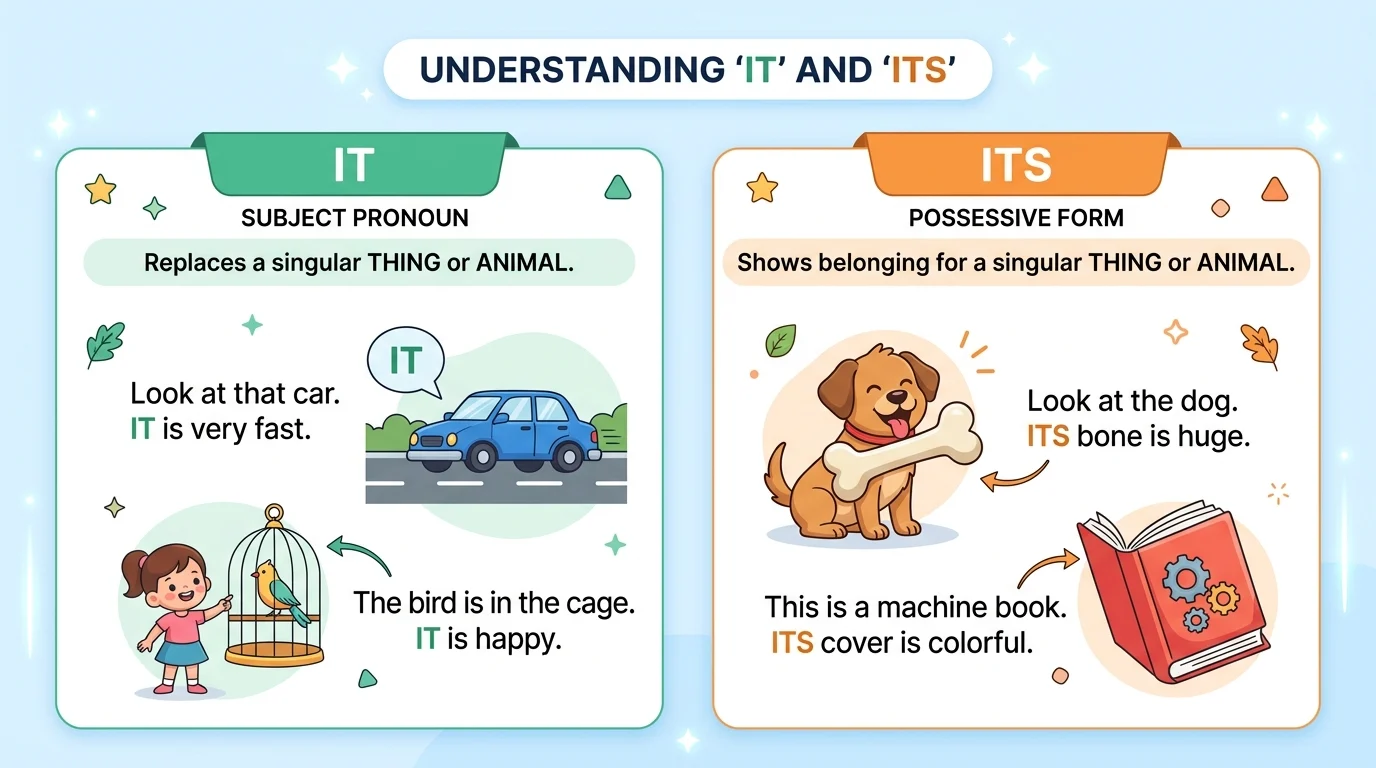
- It is a pronoun
- Its shows possession or ownership
- Its means “belonging to it”
- Do not confuse its with it’s
Simple Origin or Background
The word it has been part of English for hundreds of years and is used for things, animals, ideas, or situations.
The word its developed as the possessive form of it.
Unlike many possessive nouns in English, its does not use an apostrophe.
This is why many learners become confused.
Clear Explanation of the Difference
What does “it” mean
It is a pronoun.
It refers to:
- a thing
- an animal
- an idea
- a situation
Examples:
- It is raining
- I found the book and put it on the table
- The dog wagged its tail because it was happy
This word replaces a noun.
What does “its” mean
Its is a possessive adjective.
It means:
- belonging to it
Examples:
- The company changed its logo
- The cat cleaned its paws
- The tree lost its leaves
This word shows ownership or connection.
Comparison Table
| Feature | It | Its |
|---|---|---|
| Grammar type | Pronoun | Possessive adjective |
| Meaning | Refers to a thing or idea | Belonging to it |
| Shows ownership | No | Yes |
| Example | It is cold | The car lost its tire |
Which One to Use and When
Use it when:
- Referring to something already mentioned
- Replacing a noun
Examples:
- It looks beautiful
- I bought a phone and used it immediately
Use its when:
- Showing possession or ownership
Examples:
- The bird spread its wings
- The school changed its rules
Common Mistakes People Make
1. Using “it” instead of “its”
Wrong:
- The dog hurt it paw
Correct:
- The dog hurt its paw
2. Confusing “its” and “it’s”
Many people confuse:
- its = possession
- it’s = it is or it has
Examples:
- It’s raining today
- The company changed its name
3. Adding apostrophes incorrectly
Possessive pronouns usually do not use apostrophes.
Examples:
- yours
- ours
- theirs
- its
4. Forgetting grammar roles
Remember:
- it = pronoun
- its = possession
Everyday Real Life Examples
In Emails
- The company updated its policy
- It will take two days to finish
In News
- The country changed its laws
- It caused public discussion
On Social Media
- My phone lost its signal
- It happens all the time
In Daily Conversations
- It looks nice
- The cat moved its tail
Short Learning Section for Students and Beginners
1. Learn the simple meanings
- it = refers to something
- its = belonging to it
2. Remember the ownership clue
If something belongs to an object or animal, use:
- its
3. Practice simple examples
- It is sleeping
- The dog wagged its tail
4. Use memory tricks
- it = thing
- its = ownership
FAQ Section
1. What does “it” mean
It is a pronoun used for things, ideas, animals, or situations.
2. What does “its” mean
It means belonging to it.
3. Is “its” possessive
Yes.
4. Does “its” use an apostrophe
No.
5. What is the difference between “its” and “it’s”
Its shows possession.
It’s means “it is” or “it has.”
6. Which word replaces a noun
It.
7. Why do learners confuse these words
Because the spellings are very similar.
8. How can I remember the difference
Remember:
- it = pronoun
- its = possession
Conclusion
The difference between it and its becomes simple once you understand possession.
- It is a pronoun used for things or ideas
- Its shows ownership or connection
A simple memory trick:
- it = refers to something
- its = belongs to something
With practice and clear examples, you can easily avoid this common English mistake.