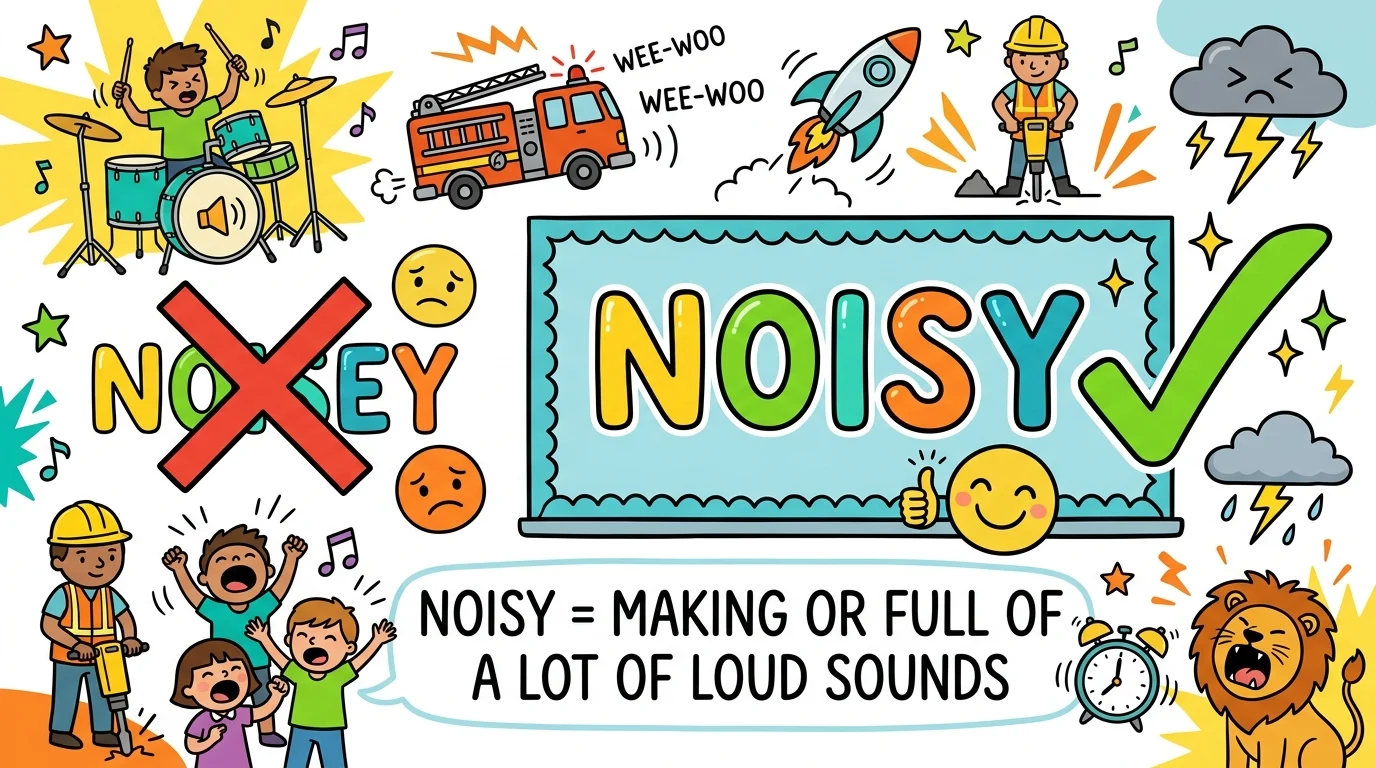
Many English learners are unsure whether they should write noisey or noisy. Since both spellings seem possible, it’s easy to make a mistake.
The simple answer is that noisy is the correct spelling, while noisey is considered a misspelling in standard English.
If you want to describe something that makes a lot of sound, always use noisy.
Quick Answer
- Noisy is the correct spelling.
- Noisey is incorrect in standard English.
- Noisy means loud, full of noise, or making a lot of sound.
- Use noisy in all formal and informal writing.
The Basic Difference
| Word | Correct? | Meaning |
|---|---|---|
| Noisey | ❌ No | Misspelling |
| Noisy | ✅ Yes | Loud or full of noise |
Examples
- The classroom was noisy.
- The street is noisy at night.
- The children became noisy during lunch.
What Does “Noisy” Mean?
Noisy is an adjective.
It describes someone or something that:
- makes a lot of sound
- is loud
- creates disturbance because of noise
Examples
- The neighbors are noisy.
- The market was noisy and crowded.
- The engine became noisy.
- The students were noisy after the bell rang.
Why Is “Noisey” Incorrect?
The correct spelling of the adjective is:
noise + y = noisy
English spelling rules change the ending when certain words take -y.
Because of this, the accepted form is:
- noisy ✅
- noisey ❌
Most dictionaries do not recognize noisey as a standard spelling.
Comparison Table
| Feature | Noisey | Noisy |
|---|---|---|
| Correct English | No | Yes |
| Dictionary Word | No | Yes |
| Common Usage | Misspelling | Standard |
| Meaning | None | Loud; full of noise |
| Recommended Use | Never | Always |
Which One Should You Use?
Use “Noisy” When
You mean:
- loud
- making a lot of sound
- difficult to hear because of noise
Examples:
- The restaurant was noisy.
- The machine is noisy.
- It was a noisy celebration.
- The classroom became noisy.
Never Use “Noisey”
Incorrect:
- The room was noisey.
Correct:
- The room was noisy.
Incorrect:
- My neighbors are noisey.
Correct:
- My neighbors are noisy.
Common Mistakes People Make
Adding an Extra “E”
Many people assume the spelling should match the word noise.
However, when forming the adjective, the spelling becomes:
- noise → noisy
not:
- noise → noisey
Spelling by Sound
Because noisy and noisey may sound similar, learners sometimes write the word incorrectly.
Typing Quickly
The mistake often appears in text messages, social media posts, and emails.
Everyday Examples
In Conversations
- The children are noisy today.
- This street gets noisy at night.
In School
- The classroom became noisy after lunch.
- Students should not be noisy during exams.
In Workplaces
- The office is noisy during meetings.
- The machine is unusually noisy.
On Social Media
- My neighbors are so noisy!
- It was a noisy concert.
Easy Memory Trick
Think about the word:
noise → noisy
Just remove the e and add y.
Examples:
- noise → noisy
- ice → icy
- haze → hazy
This pattern can help you remember the correct spelling.
Practice Sentences
Choose the correct spelling.
- The crowd was _____.
- The classroom became _____.
- The dog is very _____.
- The street was _____ all night.
Answers
- noisy
- noisy
- noisy
- noisy
Frequently Asked Questions
Is “noisey” a real word?
No.
It is generally considered a misspelling of noisy.
Is “noisy” correct?
Yes.
It is the standard English spelling.
What does noisy mean?
It means loud or full of noise.
Why do people write “noisey”?
Because they mistakenly keep the e from the word noise.
Can I use “noisey” in formal writing?
No.
Always use noisy.
How do I remember the correct spelling?
Think:
- noise → noisy
Remove the e before adding y.
Conclusion
The difference between noisey and noisy is simple.
- Noisy is the correct spelling.
- Noisey is a common spelling mistake.
- Use noisy whenever you describe something loud or full of sound.
- Remember that the word comes from noise, but the e is dropped before adding y.
A simple rule to remember is:
If something makes a lot of sound, it’s “noisy,” never “noisey.”