Many English learners confuse crier and cryer because both words seem possible in English spelling. Since many English words use “y” before adding endings, people often wonder which version is correct.
The good news is simple:
Only one spelling is standard in modern English.
This guide explains the difference in very easy English with clear examples and beginner friendly tips.
Quick Answer
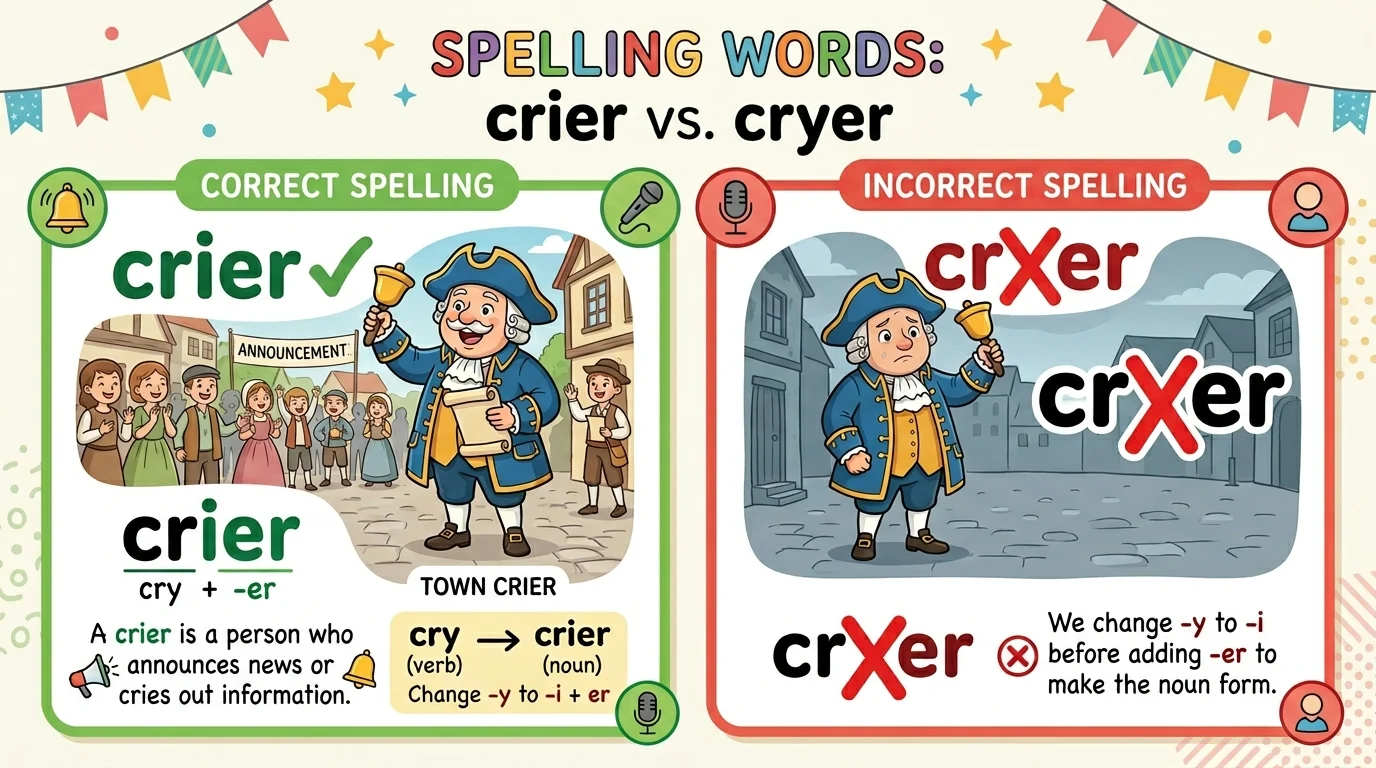
- Crier is the correct spelling
- Cryer is usually incorrect in standard English
- A crier is a person who cries or announces news publicly
- Never use cryer in formal writing unless it is part of a name
Simple Origin or Background
The word crier comes from the verb cry.
When English adds “er” to some verbs ending in “y,” the “y” changes to “i.”
That is why:
- cry → crier
This follows patterns like:
- carry → carrier
Because many learners expect the “y” to stay, they mistakenly write:
- cryer
Clear Explanation of the Difference
What does “crier” mean
Crier is a noun.
It can mean:
- a person who cries often
or - a public announcer
Examples:
- The baby is a loud crier
- The town crier announced the news
- She has always been a quiet crier
This is the correct English spelling.
What about “cryer”
Cryer is usually considered incorrect in standard English spelling.
Examples:
- Wrong: He is a heavy cryer
- Correct: He is a heavy crier
However, Cryer can sometimes appear as:
- a surname or family name
Example:
- Jon Cryer
Comparison Table
| Feature | Crier | Cryer |
|---|---|---|
| Correct spelling | Yes | Usually no |
| Meaning | Person who cries or announces | Usually spelling mistake |
| English usage | Standard English | Rare except names |
| Example | Town crier | Incorrect spelling |
Which One to Use and When
Always use crier in normal English writing.
Use it when talking about:
- someone who cries
- historical public announcers
Examples:
- The child is a frequent crier
- The town crier rang a bell
Do not use:
- cryer
unless it is part of a personal name.
Common Mistakes People Make
1. Keeping the “y”
Wrong:
- cryer
Correct:
- crier
2. Forgetting spelling change rules
Some English words change:
- y → i
before adding endings.
3. Confusing names with standard spelling
“Cryer” may appear as a surname, but not as the standard noun spelling.
4. Typing based on pronunciation
Both spellings sound the same, which causes confusion.
Everyday Real Life Examples
In Emails
- The baby has become a noisy crier
- The event featured a traditional town crier
In News
- The town crier welcomed visitors
- Experts say some babies are naturally frequent criers
On Social Media
- I was such a crier during that movie
- The old town crier costume looked amazing
In Daily Conversations
- My little brother is a loud crier
- The town crier shared announcements publicly
Short Learning Section for Students and Beginners
1. Learn the correct spelling
Correct:
- crier
Incorrect:
- cryer
2. Remember the spelling rule
- cry changes y to i
3. Practice simple examples
- She is a crier
- The town crier arrived early
4. Use memory tricks
- crier = cry with “i” added
FAQ Section
1. Is “cryer” a correct English word
Usually no.
2. What is the correct spelling
Crier.
3. What does “crier” mean
It means a person who cries or publicly announces news.
4. Why do people write “cryer”
Because they keep the “y” from cry.
5. Is “town crier” correct
Yes.
6. Can “Cryer” be a surname
Yes.
7. Why is this spelling confusing
Because both versions sound the same.
8. How can I remember the correct spelling
Remember:
- cry changes y to i in crier.
Conclusion
The difference between crier and cryer is very simple.
- Crier is the correct English spelling
- Cryer is usually a spelling mistake except in names
A simple memory trick:
- cry becomes crier with an “i”
With practice and careful spelling, you can easily avoid this common English mistake.