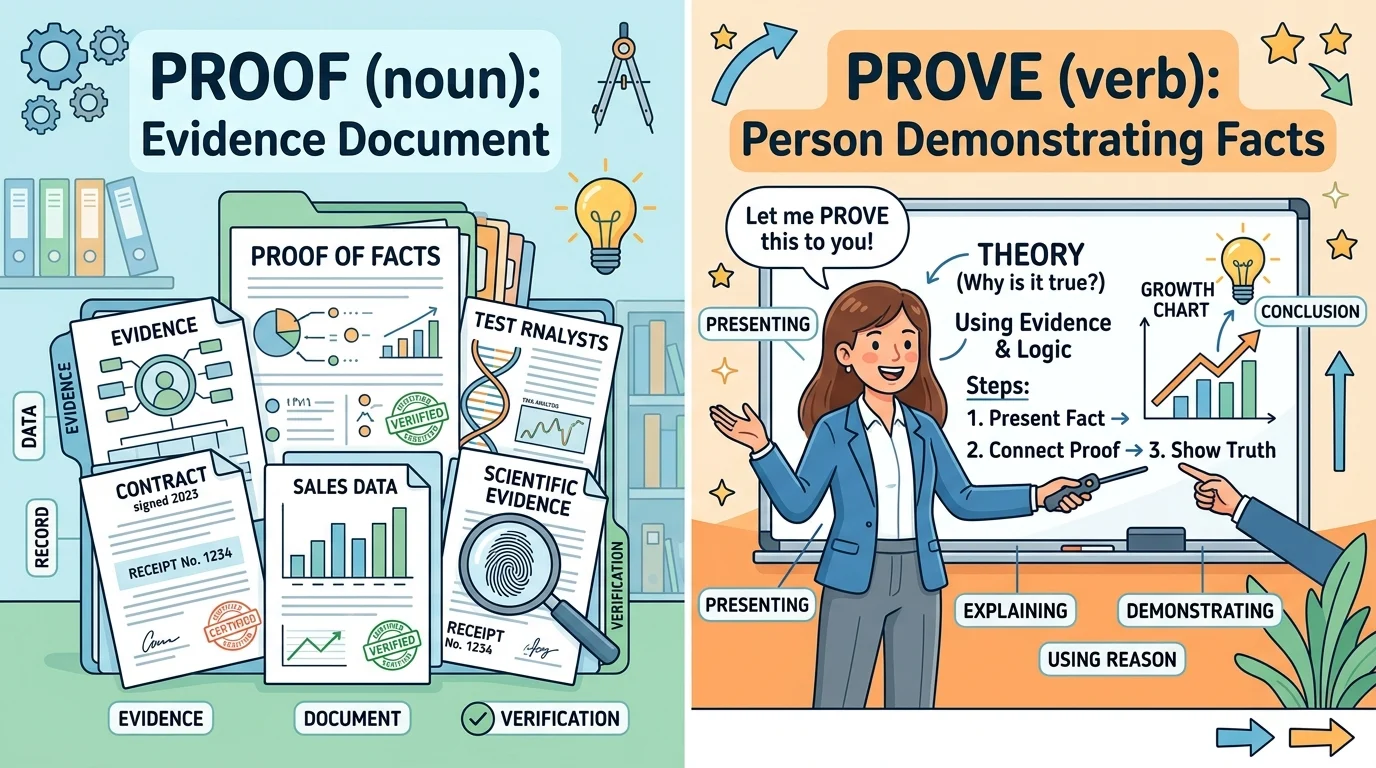
Many English learners confuse proof and prove because the words are closely related in meaning. Both are connected to showing that something is true, correct, or real.
However, these words have different grammar roles. One is usually a noun, while the other is a verb. Because they are connected, learners often accidentally use one in place of the other.
This guide explains the difference in very simple English with clear examples and beginner friendly tips.
Quick Answer
- Proof is usually a noun
- Prove is a verb
- Proof means evidence or confirmation
- Prove means to show something is true
Simple Origin or Background
Both words come from old Latin and French roots related to testing and proving truth.
Over time:
- prove became the action word
- proof became the thing or evidence showing truth
Because they share the same idea, they are easy to confuse.
Clear Explanation of the Difference
What does “proof” mean
Proof is usually a noun.
It means:
- Evidence
- Facts showing something is true
- Confirmation
Examples:
- Do you have proof of payment
- The police found proof of the crime
- Good grades are proof of hard work
This word names the evidence itself.
What does “prove” mean
Prove is a verb.
It means:
- To show something is true
- To demonstrate or confirm something
Examples:
- Can you prove your claim
- She proved her point clearly
- The test will prove the theory
This word describes the action.
Comparison Table
| Feature | Proof | Prove |
|---|---|---|
| Type | Noun | Verb |
| Meaning | Evidence or confirmation | Show something is true |
| Function | Names the evidence | Describes the action |
| Example | I need proof | Please prove it |
Which One to Use and When
Use proof when:
- Talking about evidence
- Referring to confirmation or facts
Examples:
- There is no proof
- Show me the proof
Use prove when:
- Talking about showing or demonstrating truth
Examples:
- He wants to prove himself
- Scientists proved the idea correct
Common Mistakes People Make
1. Using “proof” as a verb
Wrong:
- Can you proof this statement
Correct:
- Can you prove this statement
2. Using “prove” as a noun
Wrong:
- I need some prove
Correct:
- I need some proof
3. Forgetting grammar roles
Remember:
- proof = thing
- prove = action
4. Confusing pronunciation and spelling
The words are related but used differently in sentences.
Everyday Real Life Examples
In Emails
- Please send proof of purchase
- We must prove the information is correct
In News
- Investigators found proof of fraud
- The lawyer tried to prove innocence
On Social Media
- I need proof before believing rumors
- He wants to prove everyone wrong
In Daily Conversations
- Do you have proof
- Can you prove it
Short Learning Section for Students and Beginners
1. Remember noun and verb
- proof = noun
- prove = verb
2. Think about sentence meaning
Ask:
- Is it evidence
or - Is it the action of showing truth
3. Practice simple examples
- The photo is proof
- The photo proves nothing
4. Use memory tricks
- proof = proof exists
- prove = proving action
FAQ Section
1. What does “proof” mean
It means evidence or confirmation.
2. What does “prove” mean
It means to show something is true.
3. Which word is a noun
Proof.
4. Which word is a verb
Prove.
5. Is “I need prove” correct
No.
Correct:
- I need proof.
6. Can “prove” be used in past tense
Yes.
Example:
- She proved the claim.
7. Why do learners confuse these words
Because both are related to truth and evidence.
8. How can I remember the difference
Remember:
- proof = evidence
- prove = action
Conclusion
The difference between proof and prove becomes simple once you understand their grammar roles.
- Proof is evidence or confirmation
- Prove is the action of showing truth
A simple memory trick:
- proof = thing
- prove = action
With practice and clear examples, you can use both words correctly and confidently.