Many English learners mix up quiet and quite because the words look similar and differ by only one letter. However, they have completely different meanings and are used in different situations.
The good news is that once you understand what each word means, choosing the correct one becomes easy.
Quick Answer
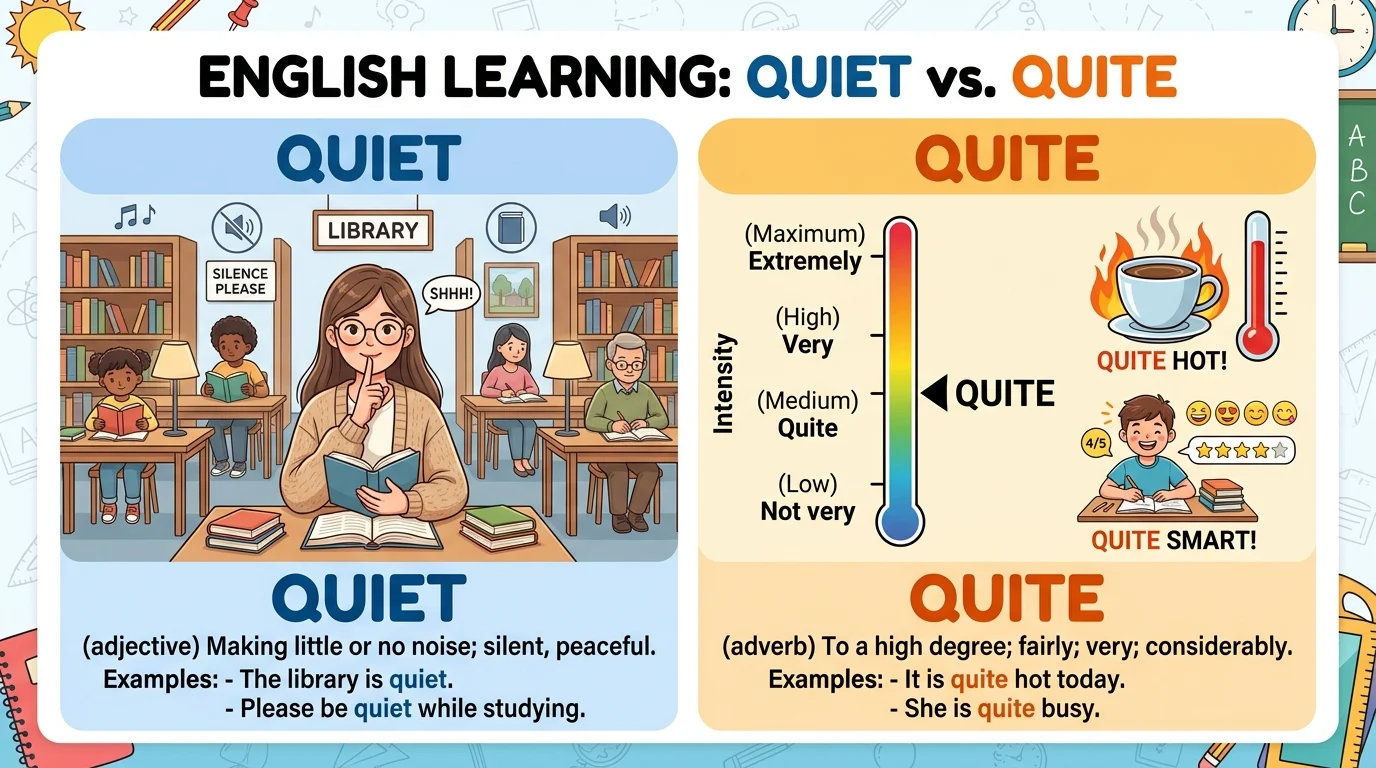
- Quiet means calm, silent, or making little noise.
- Quite means fairly, completely, or very.
- They are different words with different meanings.
- They cannot usually be used interchangeably.
Quiet vs Quite: The Main Difference
| Word | Part of Speech | Meaning |
|---|---|---|
| Quiet | Adjective, noun, verb | Silent, calm, making little noise |
| Quite | Adverb | Fairly, very, completely |
Examples
- The room was quiet. ✅
- The room was quite quiet. ✅
- The room was quite. ❌
In the second sentence, quite modifies quiet and means “fairly” or “very.”
What Does “Quiet” Mean?
Quiet describes a person, place, or thing that makes little or no noise.
Examples
- Please be quiet.
- The library is quiet.
- We live in a quiet neighborhood.
- The baby was surprisingly quiet.
Common Uses of Quiet
- quiet room
- quiet street
- quiet voice
- quiet evening
- keep quiet
What Does “Quite” Mean?
Quite is an adverb that changes the meaning of an adjective, adverb, or verb.
It often means:
- fairly
- rather
- very
- completely
Examples
- The movie was quite interesting.
- She is quite tall.
- I’m quite sure.
- The task was quite easy.
Common Uses of Quite
- quite good
- quite large
- quite difficult
- quite happy
- quite certain
Side by Side Examples
Quiet
- The classroom became quiet.
- He spoke in a quiet voice.
- The town is quiet at night.
Quite
- The classroom was quite noisy.
- He was quite confident.
- The town is quite beautiful.
How to Remember the Difference
A simple trick is to look at the ending of each word.
Quiet = Silence
Think of quiet as containing the word “quiet place” where there is little noise.
Example:
- The room is quiet.
Quite = Degree
Think of quite as meaning very or fairly.
Example:
- The room is quite large.
Comparison Table
| Feature | Quiet | Quite |
|---|---|---|
| Meaning | Silent, calm | Fairly, very, completely |
| Part of Speech | Usually adjective | Adverb |
| Describes Noise? | Yes | No |
| Can Mean “Very”? | No | Yes |
| Example | The room is quiet. | The room is quite large. |
Common Mistakes People Make
Using Quite Instead of Quiet
Incorrect:
- Please be quite.
Correct:
- Please be quiet.
Using Quiet Instead of Quite
Incorrect:
- The test was quiet difficult.
Correct:
- The test was quite difficult.
Assuming They Mean the Same Thing
Although they look similar, their meanings are completely different.
Everyday Examples
At School
- Please stay quiet during the exam.
- The exam was quite difficult.
At Home
- The house is quiet tonight.
- Dinner was quite good.
At Work
- The office is usually quiet in the morning.
- She is quite experienced.
In Conversations
- You’re very quiet today.
- I’m quite happy with the result.
Practice Sentences
Choose the correct word.
- Please be _____ during the presentation.
- The movie was _____ entertaining.
- The street was very _____.
- I’m _____ certain that’s correct.
- The children became _____ after the teacher arrived.
Answers
- quiet
- quite
- quiet
- quite
- quiet
Frequently Asked Questions
Is quiet the same as quite?
No.
They are different words with different meanings.
What does quiet mean?
It means calm, silent, or making little noise.
What does quite mean?
It means fairly, rather, very, or completely.
Can quite mean very?
Yes.
In many situations, quite can mean something close to very.
Which word relates to noise?
Quiet.
Which word is an adverb?
Quite.
Common Phrases
Quiet
- keep quiet
- quiet place
- quiet night
- quiet voice
- peace and quiet
Quite
- quite good
- quite sure
- quite easy
- quite difficult
- quite happy
Final Verdict
The difference between quiet and quite is simple once you know their meanings.
- Quiet means silent, calm, or making little noise.
- Quite means fairly, rather, very, or completely.
- They are not interchangeable.
- Always check whether you’re talking about noise (quiet) or degree/intensity (quite).
A simple rule to remember is:
If you’re talking about silence, use “quiet.” If you’re talking about “very” or “fairly,” use “quite.”