Many English learners wonder whether the plural of roof is rooves or roofs. The confusion comes from the fact that some English words ending in f change to ves in the plural, such as leaf → leaves and knife → knives.
So, should roof become rooves or roofs?
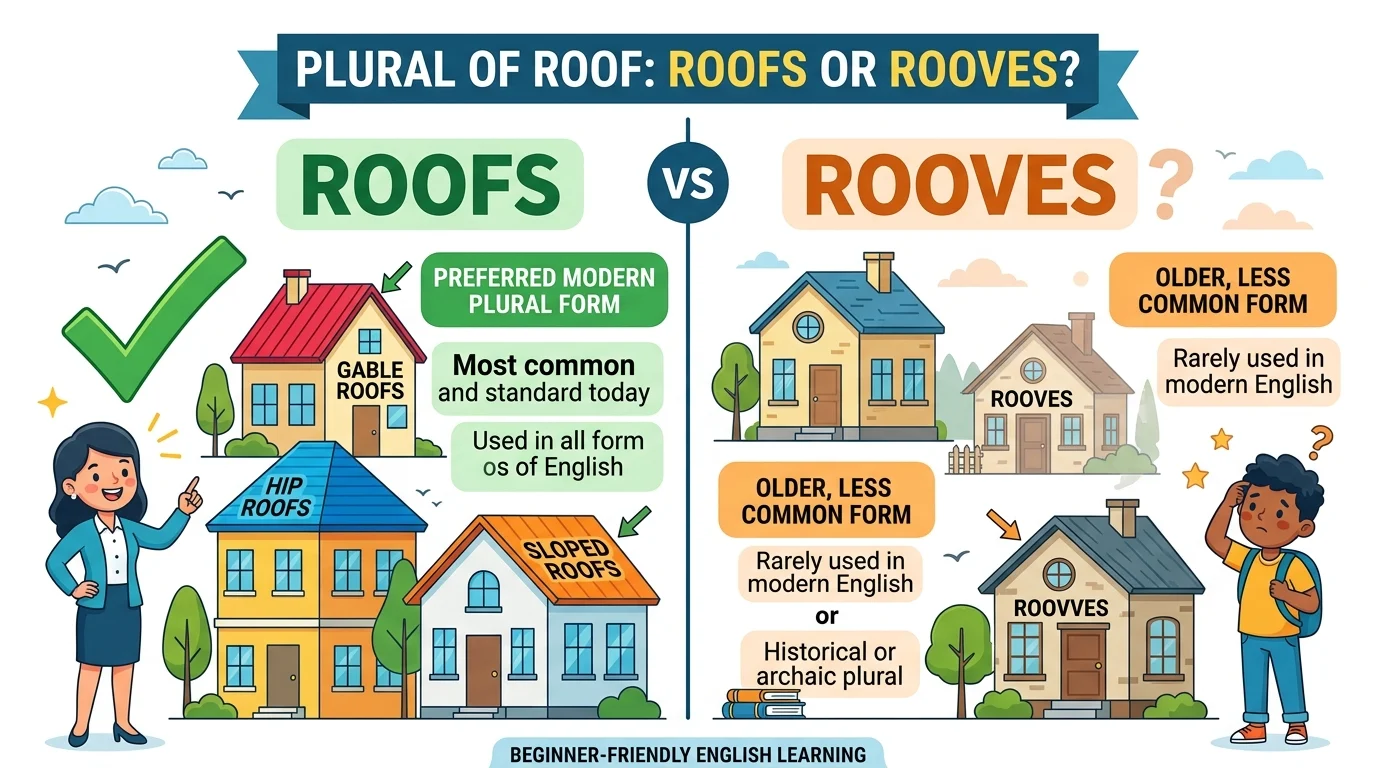
The simple answer is that roofs is the standard and most widely accepted plural form today. Rooves exists, but it is rare and considered old-fashioned in modern English.
Quick Answer
- Roofs is the standard plural of roof.
- Rooves is a rare alternative form.
- In modern English, use roofs.
- Most dictionaries list roofs as the preferred plural.
Simple Origin or Background
English has several nouns ending in f or fe that change to ves in the plural.
Examples:
- leaf → leaves
- knife → knives
- wife → wives
However, not every word follows this pattern.
Some words simply add s:
- roof → roofs
- chief → chiefs
- belief → beliefs
Because of older pronunciation patterns, rooves appeared in the past, but roofs became the standard form.
Clear Explanation of the Difference
What Does “Roofs” Mean?
Roofs is the plural of roof.
A roof is the top covering of a building.
Examples:
- The roofs were covered with snow.
- Workers repaired several roofs.
- The city has many red-tiled roofs.
This is the form used in modern English.
What Does “Rooves” Mean?
Rooves is an older and less common plural form of roof.
Examples:
- Some older texts use the word rooves.
Today, most native speakers rarely use it.
Comparison Table
| Feature | Rooves | Roofs |
|---|---|---|
| Correct English | Yes, but rare | Yes |
| Modern Usage | Uncommon | Standard |
| Recommended Choice | Usually no | Yes |
| Found in Older Texts | Often | Yes |
| Found in Modern Writing | Rarely | Frequently |
Which One to Use and When
Use “Roofs” When
You are writing:
- school assignments
- business documents
- emails
- articles
- everyday English
Examples:
- The roofs need repairs.
- Snow covered the roofs.
- New roofs were installed last year.
Use “Rooves” Only When
You are:
- discussing historical usage
- quoting older texts
- studying language history
Examples:
- Some older dictionaries listed rooves as a plural form.
For modern writing, roofs is the safer and preferred choice.
Common Mistakes People Make
Assuming All “F” Words Change to “Ves”
Not every word follows that rule.
Examples:
- belief → beliefs
- chief → chiefs
- roof → roofs
Using “Rooves” in Formal Modern Writing
Most style guides and dictionaries recommend roofs.
Confusing Roof With Words Like Leaf
The plural patterns are different.
Thinking “Rooves” Is the Only Correct Form
It is not.
In modern English, roofs is far more common.
Everyday Real Life Examples
In Emails
- The company inspected the roofs.
- Several roofs were damaged during the storm.
In News
- Strong winds damaged roofs across the area.
- Workers repaired hundreds of roofs.
On Social Media
- Snow looks beautiful on the roofs today.
- The new roofs look amazing.
In Daily Conversations
- The roofs need painting.
- Birds were sitting on the roofs.
Short Learning Section for Students and Beginners
Easy Rule
For the plural of roof, use:
- roofs
Avoid:
- rooves
unless discussing historical or rare usage.
Practice Sentences
- The roofs were repaired.
- Snow covered the roofs.
- The roofs are blue.
- Workers inspected the roofs.
Memory Trick
Remember:
- belief → beliefs
- chief → chiefs
- roof → roofs
These words keep the f and simply add s.
FAQ Section
Is “roofs” correct?
Yes. It is the standard plural form.
Is “rooves” correct?
Yes, but it is rare and old-fashioned.
Which form is more common?
Roofs.
What is the plural of roof?
Roofs.
Why do people think it should be “rooves”?
Because some words ending in f change to ves.
Do dictionaries prefer roofs?
Yes, most modern dictionaries do.
Should students use roofs or rooves?
Roofs.
How can I remember the correct form?
Think:
- chief → chiefs
- belief → beliefs
- roof → roofs
Conclusion
The difference between rooves and roofs is mainly one of modern usage.
- Roofs is the standard and preferred plural form today.
- Rooves is a rare alternative that appears mostly in older English.
- For school, work, and everyday writing, use roofs.
A simple memory trick is to remember that roof behaves like chief and belief, adding s instead of changing to ves.