“Laid off” and “layed off” sound the same, so many learners get confused when writing them. Since English spelling is not always phonetic, people often guess and choose the wrong form.
In this case, only one version is correct in standard English.
Let’s make this clear and easy so you never make this mistake again.
Quick Answer
- “Laid off” is the correct form
- “Layed off” is incorrect
- “Laid” is the past form of “lay”
- Always use “laid off” in writing
Simple Background Explanation
The verb “lay” means to put something down.
Its past form is “laid,” not “layed.”
So when we use the phrase “laid off,” we are using the correct past form of “lay.”
“Layed” is a common spelling mistake and not accepted in standard English.
Clear Explanation of the Difference
Let’s make it very simple.
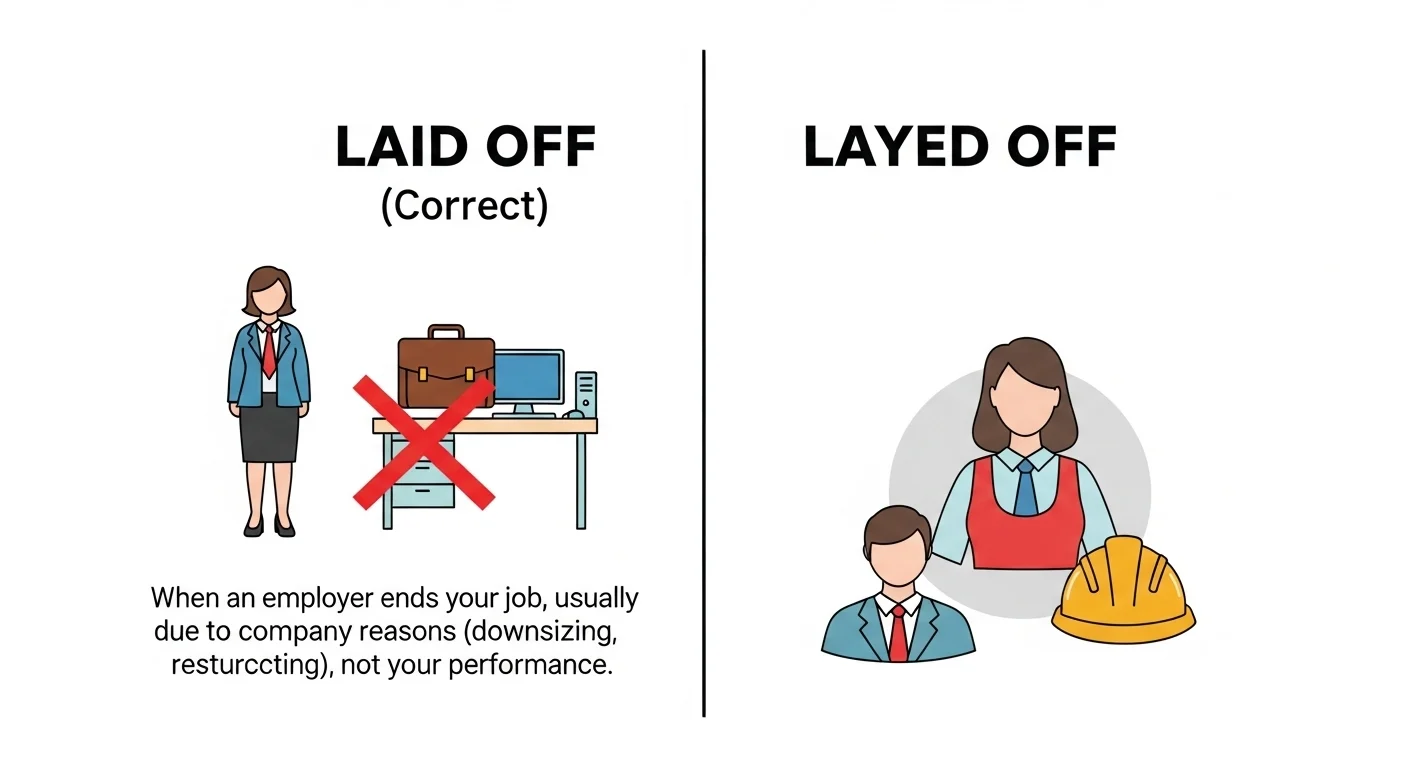
“Laid off”
This is correct. It means someone lost their job, usually because the company reduced staff.
Examples:
- He was laid off last month.
- Many workers were laid off.
“Layed off”
This is incorrect and should not be used.
Example:
- He was layed off ❌ wrong
So the difference is about correct vs incorrect spelling.
Comparison Table
| Phrase | Correct or Not | Meaning | Should You Use It |
|---|---|---|---|
| Laid off | Correct | Lost a job or removed from work | Yes |
| Layed off | Incorrect | No meaning | No |
What “Laid Off” Means
“Laid off” is used when:
- A person loses their job
- The company reduces workers
- The job loss is not the worker’s fault
Examples:
- She was laid off due to budget cuts.
- Many employees were laid off last year.
- He got laid off unexpectedly.
When to Use “Laid Off”
Use “laid off” when talking about:
- Job loss
- Company decisions
- Employment changes
Examples:
- The company laid off several workers.
- He was laid off during the crisis.
- They were laid off without notice.
There is never a correct situation to use “layed off.”
Why People Make This Mistake
Here are the main reasons:
Sound confusion
“Laid” and “layed” sound the same.
Irregular verb
“Lay” does not follow simple “-ed” rules.
Spelling guess
People assume adding “-ed” is correct.
Lack of practice
Irregular verbs can be tricky.
Simple tip:
Lay → laid (not layed)
Common Mistakes to Avoid
Here are mistakes to watch for:
Using “layed”
- He was layed off ❌
Forgetting irregular form
Always use “laid.”
Not proofreading
Check your spelling.
Correct vs incorrect examples:
- He was laid off ✔️
- He was layed off ❌
- They were laid off ✔️
- They were layed off ❌
Everyday Real Life Examples
Here are simple examples from daily life.
In news:
- Workers were laid off due to economic issues.
- Hundreds were laid off this year.
At work:
- He got laid off last week.
- Several employees were laid off.
In conversation:
- I was laid off recently.
- She was laid off from her job.
Easy Learning Section for Beginners
Here is a simple trick:
Lay → laid
Memory tip:
No “y” in “laid”
Practice sentences:
- He was laid off
- She got laid off
- They were laid off
Mini exercise:
Fill in the blanks:
- He was ______ off
Answer: laid - They were ______ off
Answer: laid - She got ______ off
Answer: laid
Never use “layed”
Frequently Asked Questions
1. Is “layed off” correct
No, it is incorrect.
2. What is the correct form
The correct form is “laid off.”
3. What does “laid off” mean
It means losing a job due to company reasons.
4. Why do people write “layed”
Because they think all verbs take “-ed.”
5. Is “laid” the past of “lay”
Yes, it is.
6. Is this mistake common
Yes, very common.
7. How can I remember the correct form
Remember “lay” becomes “laid.”
8. Will this mistake affect my writing
Yes, it makes your writing incorrect.
Conclusion
The difference between “laid off” and “layed off” is simple.
“Laid off” is the correct form and should always be used.
“Layed off” is incorrect and should be avoided.
Just remember:
Lay → laid
With this simple rule, you can use the correct phrase confidently every time.