Many English learners get confused between ment and meant because they sound similar when spoken quickly. In casual messages, social media posts, and online chats, people sometimes write ment when they actually mean meant.
The good news is simple: meant is the correct English word in most situations, while ment is usually a spelling mistake or an abbreviation in very informal writing.
This guide explains the difference in simple English so you can use the correct word with confidence.
Quick Answer
- Meant is a correct English word.
- Ment is usually a spelling mistake of meant.
- Meant is the past tense and past participle of mean.
- In standard English writing, use meant.
Simple Origin or Background
The word meant comes from the verb mean, which can mean:
- to intend
- to signify
- to express an idea
Examples:
- I mean what I say.
- What does this word mean?
When talking about the past, English changes mean to meant.
Because the pronunciation is unusual, many learners mistakenly write ment instead.
Clear Explanation of the Difference
What Does “Meant” Mean?
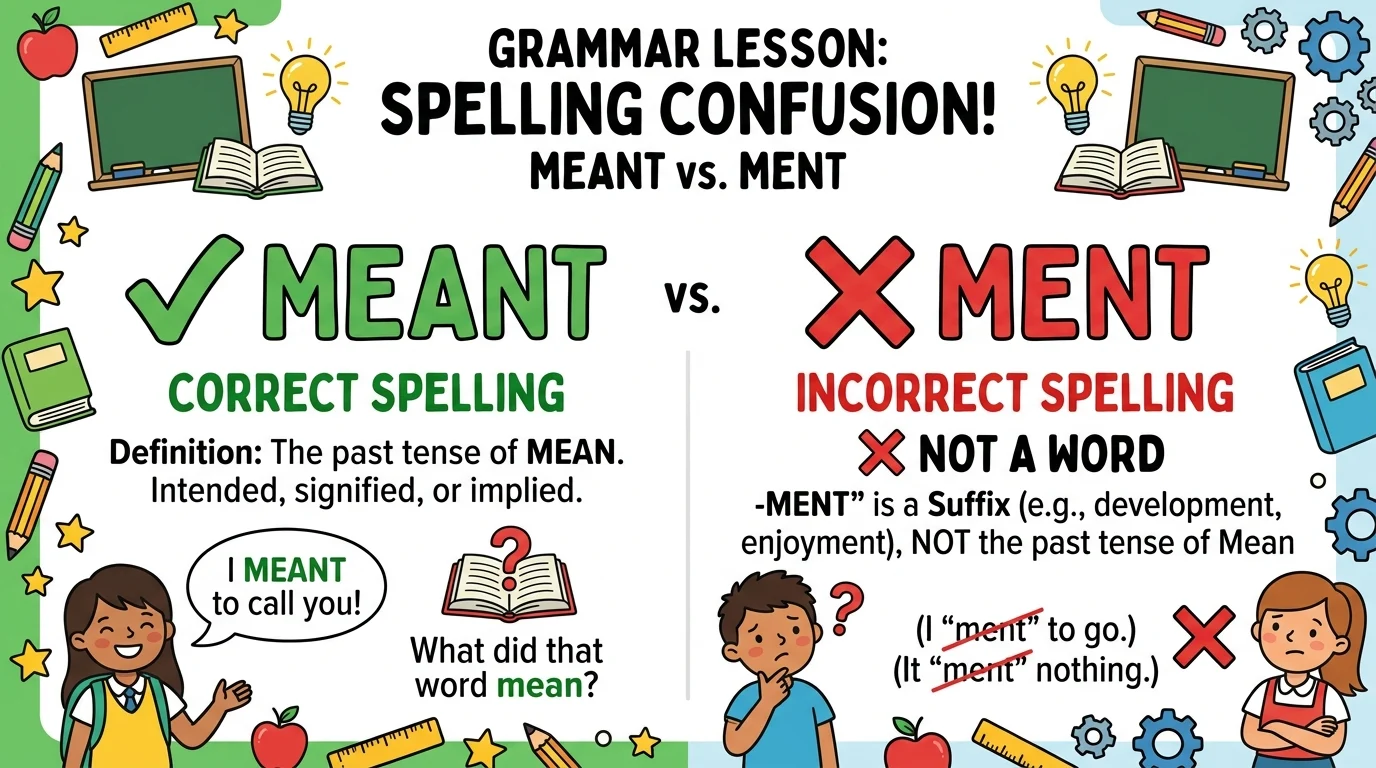
Meant is the past tense and past participle of mean.
It can mean:
- intended
- wanted to say
- signified
Examples:
- I meant to call you yesterday.
- What she said meant a lot to me.
- He meant no harm.
This is the correct spelling in standard English.
What About “Ment”?
Ment is usually not considered a standard English word in this context.
Examples:
- Incorrect: I ment to help you.
- Correct: I meant to help you.
Sometimes people use ment in text messages or online chats as a shortened spelling, but it is not correct in formal writing.
Comparison Table
| Feature | Ment | Meant |
|---|---|---|
| Correct Standard English | No | Yes |
| Meaning | Usually none in this context | Past tense of mean |
| Common in Formal Writing | No | Yes |
| Example | I ment to call | I meant to call |
Which One to Use and When
Use “Meant” When
You are talking about:
- intentions
- meanings
- something in the past
Examples:
- I meant every word.
- She meant well.
- The gift meant a lot to him.
- We meant to arrive earlier.
Avoid “Ment”
Examples:
- Incorrect: I ment no offense.
- Correct: I meant no offense.
In school assignments, emails, reports, and professional writing, always use meant.
Common Mistakes People Make
Spelling “Meant” as “Ment”
Wrong:
- I ment to send the email.
Correct:
- I meant to send the email.
Writing Based on Pronunciation
The pronunciation can make people think the spelling should be ment, but English spelling does not follow that pattern.
Using Informal Texting Spellings
Text messages sometimes contain shortened spellings that are not correct in standard English.
Forgetting the Past Tense Form
Remember:
- mean → meant
Everyday Real Life Examples
In Emails
- I meant to reply earlier.
- We meant to discuss this yesterday.
In News
- The statement meant a great deal to many people.
- Officials said they meant no criticism.
On Social Media
- I meant what I posted.
- Sorry, I meant to tag you.
In Daily Conversations
- I meant to call you.
- That’s not what I meant.
Short Learning Section for Students and Beginners
Easy Rule
If you want the past form of mean, use:
- meant
Never use:
- ment
Practice Sentences
- I meant to help.
- She meant well.
- What did you mean?
- What you said meant a lot.
Memory Trick
Remember:
- mean → meant
Just like:
- deal → dealt
- dream → dreamt in British English
The letters ea stay in the word.
FAQ Section
Is “ment” a correct word?
Not when you mean the past tense of mean.
Is “meant” correct?
Yes.
What does “meant” mean?
It is the past tense of mean.
Why do people write “ment”?
Because it sounds similar to meant when spoken.
Which spelling should I use in school writing?
Meant.
Is “I meant to call you” correct?
Yes.
Is “I ment to call you” correct?
No.
How can I remember the correct spelling?
Remember:
- mean → meant
The word keeps the letters ea.
Conclusion
The difference between ment and meant is very simple.
- Meant is the correct English word.
- Ment is usually a spelling mistake.
- Meant is the past tense of mean.
- Use meant in all standard English writing.
A simple memory trick is to remember that mean changes to meant, keeping the ea in the spelling.
Once you learn this pattern, you will avoid one of the most common English spelling mistakes.