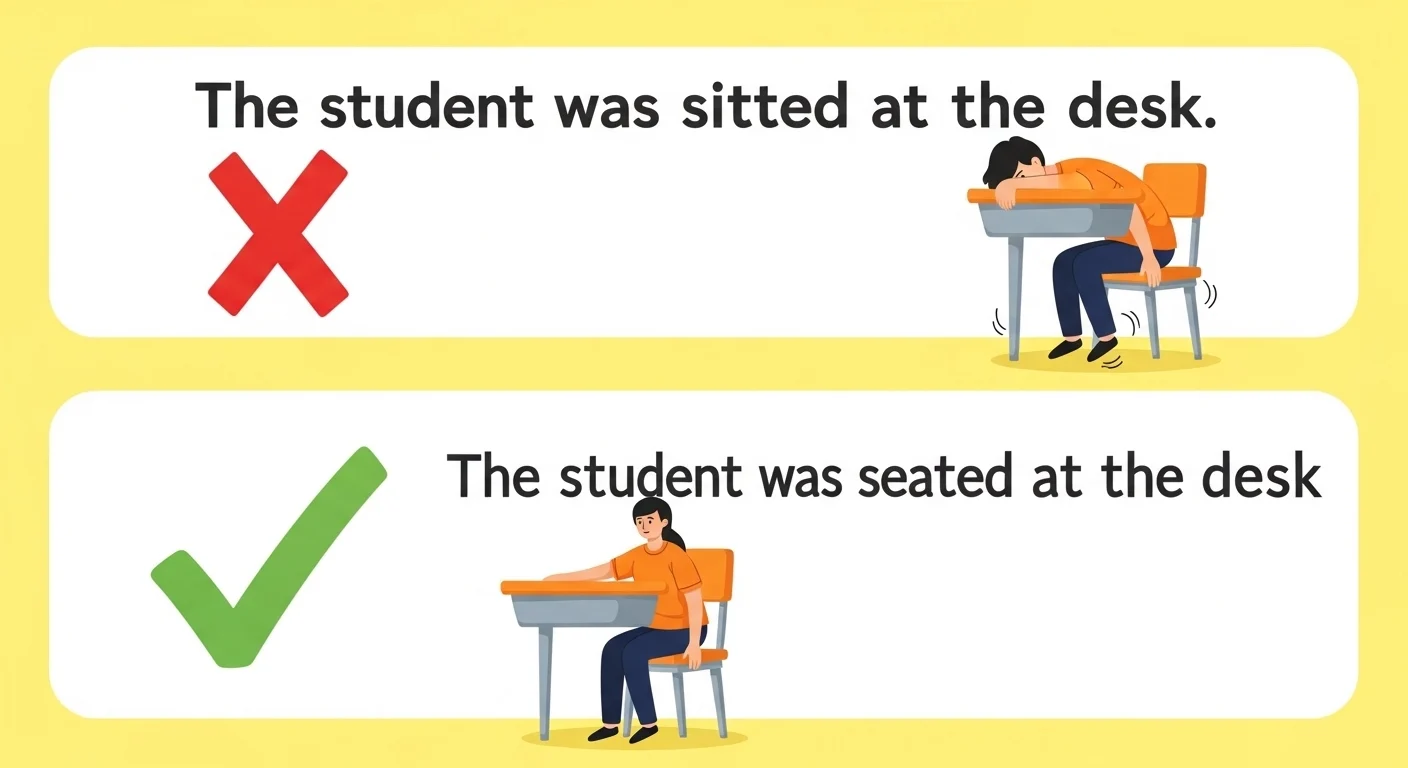
Many English learners feel confused when they see the words “sitted” and “seated.” Both seem to come from the verb “sit,” so it is easy to think they mean the same thing. But in real English, one of these words is correct and commonly used, while the other is not.
This article will help you understand the difference in a very simple and clear way. By the end, you will know exactly which word to use and when.
Quick Answer
- “Seated” is correct and commonly used
- “Sitted” is incorrect in modern English
- The correct past form of “sit” is “sat,” not “sitted”
- “Seated” is often used when someone helps another person sit or when describing a position
Simple Origin or Background
The verb “sit” is an irregular verb in English. This means it does not follow the normal rule of adding “-ed” to make the past tense.
For example:
- Sit → Sat → Sat
Because of this, “sitted” is not a correct form.
On the other hand, “seat” is a regular verb. It follows the normal pattern:
- Seat → Seated → Seated
So, “seated” comes from “seat,” not directly from “sit.”
This is the main reason why people get confused. They think “sitted” should exist, but it does not.
Clear Explanation of the Difference
Let’s break it down in a very simple way.
What does “sitted” mean
“Sitted” is not a correct word in modern English. You should not use it in writing, speaking, or exams.
Some learners create it by mistake because they think every verb needs “-ed” in the past.
Wrong example:
- I sitted on the chair.
Correct version:
- I sat on the chair.
What does “seated” mean
“Seated” is correct and useful. It comes from the verb “seat.”
It has two main uses:
- When someone helps another person sit
- The teacher seated the students.
- When describing someone already sitting in a place
- She was seated near the window.
“Seated” sounds a bit more formal than “sat,” but both are correct depending on the situation.
Comparison Table
| Word | Correct or Not | Base Verb | Meaning | Example |
| Sitted | Incorrect | Sit | Not used in modern English | ❌ I sitted there |
| Seated | Correct | Seat | Placed in a sitting position or already sitting | ✅ She was seated in front |
Which One to Use and When
Here is a simple guide to help you choose the right word.
Use “sat” (not sitted)
Use “sat” when talking about the past of “sit.”
Examples:
- I sat on the sofa.
- He sat next to me.
- They sat quietly in the room.
Use “seated”
Use “seated” in these situations:
- When someone places another person in a seat
- The host seated the guests.
- When describing a position in a more formal way
- The audience was seated before the show started.
- In written or polite English
- Please remain seated.
Simple Tip
- Everyday speech → use “sat”
- Formal or descriptive situations → use “seated”
- Never use “sitted”
Common Mistakes People Make
Here are some common errors learners make and how to fix them.
Mistake 1: Using “sitted” as past tense
Wrong:
- I sitted on the bench.
Correct:
- I sat on the bench.
Mistake 2: Mixing “sat” and “seated”
Wrong:
- I was sated near the door.
Correct:
- I was seated near the door.
Or:
- I sat near the door.
Mistake 3: Overusing “seated” in casual speech
Not wrong, but less natural:
- I was seated on the couch watching TV.
More natural:
- I sat on the couch watching TV.
Mistake 4: Thinking “seated” and “sat” are the same
They are similar but not always the same.
- “Sat” is simple past
- “Seated” is more formal or descriptive
Everyday Real-Life Examples
Here are simple examples from daily life to help you understand better.
In Emails
- Please remain seated until your number is called.
- All guests will be seated at 7 PM.
In News
- The audience was seated before the event began.
- The judge remained seated during the hearing.
On Social Media
- I sat in the park and enjoyed the sunset.
- We were seated at a beautiful table by the beach.
In Daily Conversations
- I sat next to my friend in class.
- The waiter seated us quickly.
- She was seated in the front row.
Short Learning Section for Students and Beginners
Here is a quick learning guide you can remember easily.
Rule 1
Do not create “sitted.” It is incorrect.
Rule 2
Use “sat” as the past of “sit.”
Example:
- Today I sit here.
- Yesterday I sat here.
Rule 3
Use “seated” when talking about position or formal situations.
Example:
- The guests were seated in the hall.
Practice Sentences
Fill in the blanks:
- I ______ on the chair.
- The teacher ______ the students.
- We were ______ in the front row.
Answers:
- sat
- seated
- seated
FAQ Section
1. Is “sitted” a real word
No, “sitted” is not correct in modern English. You should not use it.
2. What is the past tense of “sit”
The past tense of “sit” is “sat.”
Example:
- I sat on the floor.
3. What does “seated” mean
“Seated” means placed in a sitting position or already sitting somewhere.
4. Can I use “seated” instead of “sat”
Sometimes yes, but not always. “Seated” is more formal.
Example:
- I sat on the chair.
- I was seated near the window.
5. Which is more common in daily speech
“Sat” is more common in everyday conversation.
6. Is “seated” formal
Yes, “seated” is often used in formal or polite situations.
7. Why do learners say “sitted”
Because they think all past verbs use “ ed.” But “sit” is an irregular verb.
8. What is the difference between “sit” and “seat”
- “Sit” means to take a position
- “Seat” means to place someone in a position
Example:
- I sit down.
- She seats the guests.
Conclusion
The difference between “sitted” and “seated” is simple once you understand it clearly.
“Sitted” is not a correct word and should never be used. The correct past form of “sit” is “sat.”
“Seated” is correct and comes from the verb “seat.” It is often used in formal situations or when describing someone’s position.
If you remember one thing, remember this:
Use “sat” for the past of “sit,” use “seated” for formal or descriptive situations, and avoid “sitted” completely.
With a little practice, this confusion will disappear, and you will use the right word naturally.