“Whos” and “whose” confuse many learners because they sound the same. When you hear them, they are identical, so it is easy to guess the wrong spelling.
But in correct English, only one of these forms is actually a real word.
Let’s make this clear and easy so you never make this mistake again.
Quick Answer
- “Whose” is the correct word
- “Whos” is incorrect
- “Whose” shows possession (ownership)
- Always use “whose” in writing
Simple Background Explanation
The word “whose” comes from “who” and is used to show ownership, just like:
- his
- her
- their
“Whos” is not a real word in standard English. It usually appears when people forget to write “who’s” (which means “who is”).
Clear Explanation of the Difference
Let’s make it very simple.
“Whose”
This is correct. It shows that something belongs to someone.
Examples:
- Whose book is this?
- Whose phone is ringing?
“Whos”
This is incorrect and should not be used.
Example:
- Whos book is this ❌ wrong
So the difference is correct vs incorrect spelling.
Comparison Table
| Word | Correct or Not | Meaning | Should You Use It |
|---|---|---|---|
| Whose | Correct | Shows possession | Yes |
| Whos | Incorrect | No meaning | No |
What “Whose” Means
“Whose” is used to ask or show ownership.
It answers the question: “Who does this belong to?”
Examples:
- Whose bag is this?
- Whose idea was that?
- Do you know whose car this is?
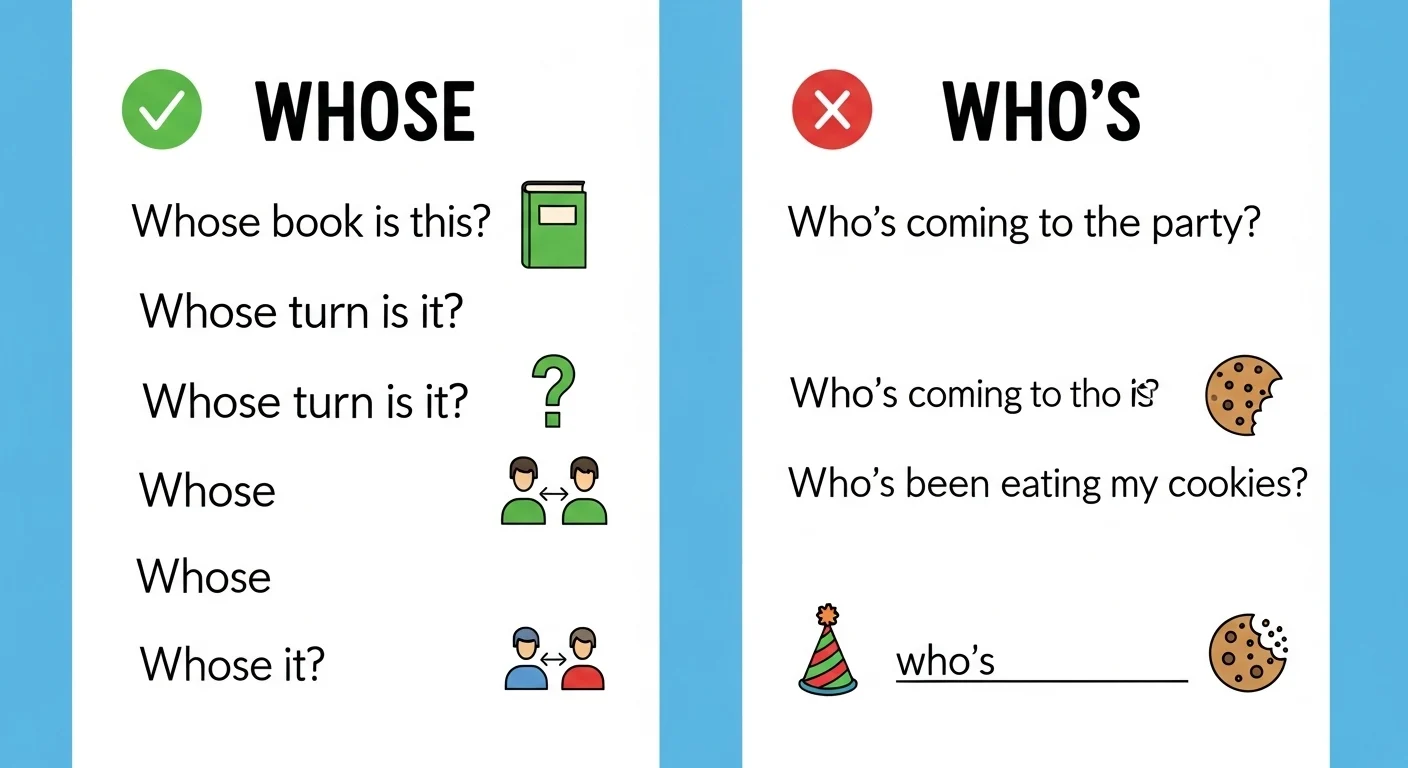
Important Note: “Who’s” vs “Whose”
Many learners confuse “whose” with “who’s.”
- “Who’s” = who is or who has
- “Whose” = belonging to someone
Examples:
- Who’s coming today? (who is)
- Whose book is this? (ownership)
Which One to Use and When
Use “whose” when:
- Asking about ownership
- Showing possession
Examples:
- Whose keys are these?
- Whose turn is it?
Never use “whos.”
Easy Trick to Remember
Here is a simple rule:
Whose = possession
Memory tip:
If you can replace it with “his” or “her,” use “whose.”
Example:
- Whose book → his book ✔️
Why People Get Confused
Here are the main reasons:
Same pronunciation
They sound identical.
Spelling mistakes
People forget the apostrophe.
Mixing with “who’s”
Very common confusion.
Fast typing
Mistakes happen quickly.
Common Mistakes to Avoid
Here are mistakes to watch for:
Using “whos”
- Whos phone is this ❌
Mixing “whose” and “who’s”
- Whose coming today ❌
Correct vs incorrect examples:
- Whose book is this ✔️
- Whos book is this ❌
- Who’s coming ✔️
- Whose coming ❌
Everyday Real Life Examples
Here are simple examples from daily life.
In conversation:
- Whose phone is this?
- Whose bag is on the table?
At school:
- Whose notebook is this?
- Do you know whose pen this is?
At home:
- Whose shoes are these?
- Whose turn is it?
Easy Learning Section for Beginners
Here is a simple trick:
Ask yourself:
Is it about ownership?
Memory tip:
Ownership = whose
Practice sentences:
- Whose book is this
- Whose phone is ringing
- Whose idea was that
Mini exercise:
Fill in the blanks:
- ______ bag is this
Answer: Whose - Do you know ______ car this is
Answer: whose - ______ keys are these
Answer: Whose
Frequently Asked Questions
1. Is “whos” correct
No, it is incorrect.
2. What is the correct word
The correct word is “whose.”
3. What does “whose” mean
It shows ownership.
4. What is “who’s”
It means “who is” or “who has.”
5. Why do people write “whos”
Because they forget the correct spelling.
6. Is this mistake common
Yes, very common.
7. How can I remember the correct form
Think of possession.
8. Will this mistake affect my writing
Yes, it makes your writing incorrect.
Conclusion
The difference between “whos” and “whose” is simple.
“Whose” is the correct word used to show ownership.
“Whos” is incorrect and should be avoided.
Just remember:
Whose = ownership
With this simple rule, you can use the correct word confidently every time.