Many English learners get confused between wont and won’t because the two words look almost identical. The only visible difference is the apostrophe, but that small mark changes the meaning completely.
In modern English, won’t is extremely common, while wont is much less frequently used. Because of this, many people assume they are simply different spellings of the same word. However, they have different meanings and uses.
This guide explains the difference between wont and won’t in simple English with clear examples and easy-to-follow rules.
Quick Answer
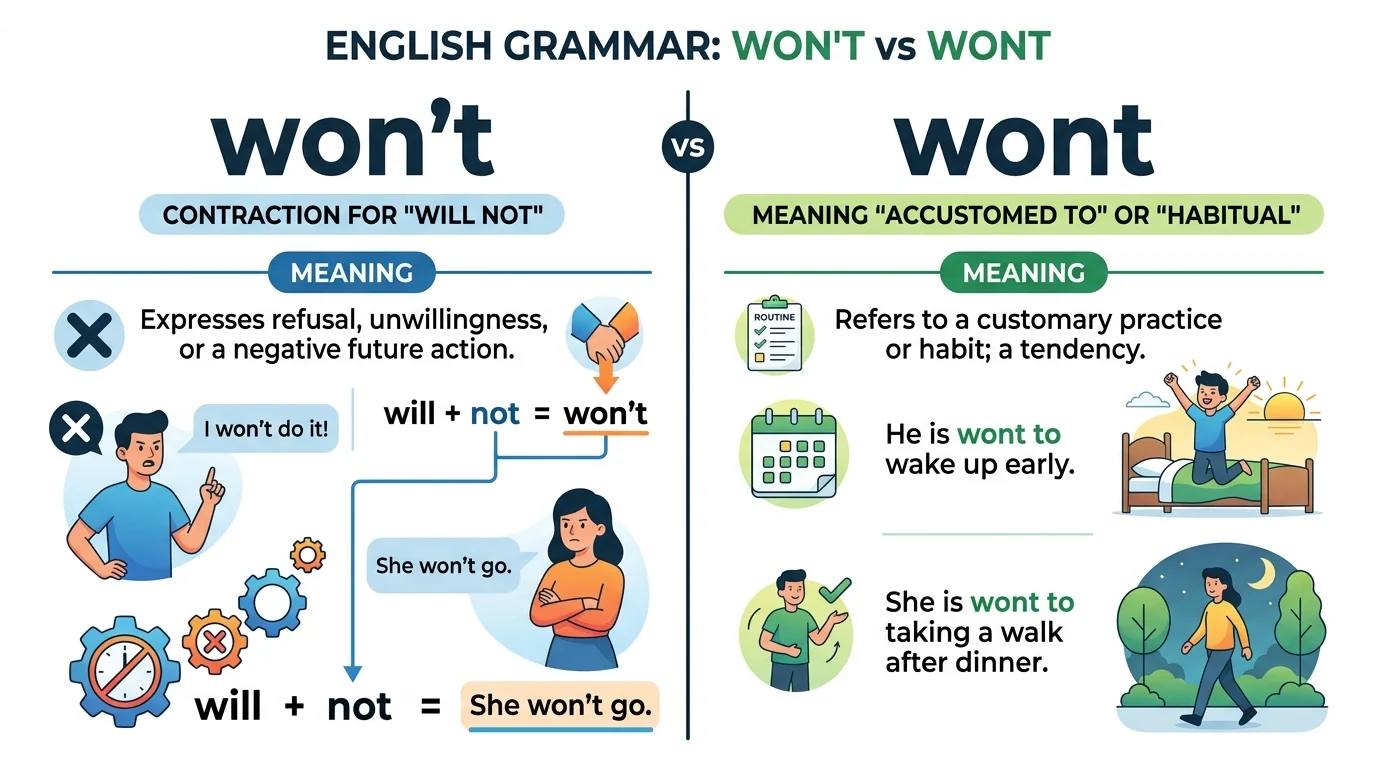
- Won’t is a contraction of will not.
- Wont is an adjective meaning accustomed or used to something.
- Won’t is very common in everyday English.
- Wont is relatively rare and often appears in formal or literary writing.
The Basic Difference
| Word | Meaning | Part of Speech |
|---|---|---|
| Won’t | Will not | Contraction |
| Wont | Accustomed to, used to | Adjective |
Examples
- I won’t be late.
- She won’t agree to that plan.
- He was wont to take a walk every evening.
- They were wont to arrive early.
What Does “Won’t” Mean?
Won’t is the contracted form of will not.
It is used to talk about something that will not happen in the future or something someone refuses to do.
Examples
- I won’t forget your birthday.
- She won’t attend the meeting.
- They won’t be here tomorrow.
- We won’t give up.
In Questions
- Won’t you join us?
- Won’t they arrive soon?
Because won’t is a contraction, the apostrophe is important.
What Does “Wont” Mean?
Wont is an adjective that means:
- accustomed to
- in the habit of
- regularly doing something
It is mostly found in formal, historical, or literary English.
Examples
- He was wont to rise before dawn.
- She was wont to spend her evenings reading.
- The professor was wont to begin lectures exactly on time.
In modern everyday conversation, people usually say:
- He was used to rising before dawn.
instead of:
- He was wont to rise before dawn.
Why Is “Won’t” Spelled So Differently?
Many learners wonder why will not becomes won’t instead of willn’t.
This spelling developed from older forms of English. Over time, will not evolved into won’t, and the unusual spelling became the standard form.
Today, won’t is the accepted contraction of will not.
Comparison Table
| Feature | Wont | Won’t |
|---|---|---|
| Correct English | Yes | Yes |
| Common Usage | Rare | Very common |
| Meaning | Accustomed to | Will not |
| Part of Speech | Adjective | Contraction |
| Example | He was wont to read. | He won’t read. |
Which One Should You Use?
Use “Won’t” When
You mean:
- will not
- refuse to
- something that will not happen
Examples:
- I won’t be there.
- She won’t answer.
- We won’t forget.
Use “Wont” When
You mean:
- accustomed to
- in the habit of
Examples:
- He was wont to travel frequently.
- They were wont to meet every Sunday.
For most modern writing, won’t is the word you will use much more often.
Common Mistakes People Make
Forgetting the Apostrophe
Incorrect:
- I wont go.
Correct:
- I won’t go.
Without the apostrophe, the meaning changes completely.
Using “Wont” Instead of “Won’t”
Incorrect:
- She wont come tomorrow.
Correct:
- She won’t come tomorrow.
Assuming They Mean the Same Thing
They do not.
Compare:
- She won’t come tomorrow. (She will not come.)
- She was wont to come early. (She usually came early.)
Everyday Examples
In Emails
- I won’t be available this afternoon.
- He was wont to reply within a day.
In Conversations
- I won’t forget.
- They won’t believe it.
In Books
- The king was wont to ride through the countryside.
- The scholar was wont to write late into the night.
On Social Media
- I won’t miss this event!
- We won’t stop cheering.
Easy Memory Trick
Remember:
- Won’t = will not
- Wont = used to
A simple way to remember the difference is:
If you can replace the word with “will not,” use “won’t” with an apostrophe.
Practice Sentences
Choose the correct word:
- I _____ attend the meeting tomorrow.
- She was _____ to read before bed.
- They _____ arrive on time.
- He was _____ to take long walks.
Answers
- won’t
- wont
- won’t
- wont
Frequently Asked Questions
Is “wont” a real word?
Yes. It means accustomed to or in the habit of doing something.
Is “won’t” correct?
Yes. It is the standard contraction of will not.
Which word is more common?
Won’t is much more common.
Can I use “wont” instead of “won’t”?
No. They have different meanings.
Why do people confuse these words?
Because they look almost identical except for the apostrophe.
Is “I wont go” correct?
No.
Correct:
- I won’t go.
Is “He was wont to complain” correct?
Yes.
It means he was accustomed to complaining.
How can I remember the difference?
Think:
- won’t = will not
- wont = used to
Conclusion
The difference between wont and won’t is small in spelling but large in meaning.
- Won’t is the contraction of will not and is used every day in spoken and written English.
- Wont means accustomed to or habitually doing something and is mostly found in formal or literary writing.
- The apostrophe in won’t is essential because it changes the word completely.
A simple rule to remember is:
If you mean “will not,” always use “won’t.” If you mean “accustomed to,” use “wont.”