Many English learners confuse borders and boarders because the words sound almost exactly the same. These words are homophones, which means they have the same pronunciation but different meanings and spellings.
Even native speakers sometimes mix them up while writing quickly. However, the meanings are completely different.
One word relates to edges, boundaries, or countries. The other refers to people who receive meals and lodging somewhere.
This guide explains the difference in very simple English with clear examples and beginner friendly tips.
Quick Answer
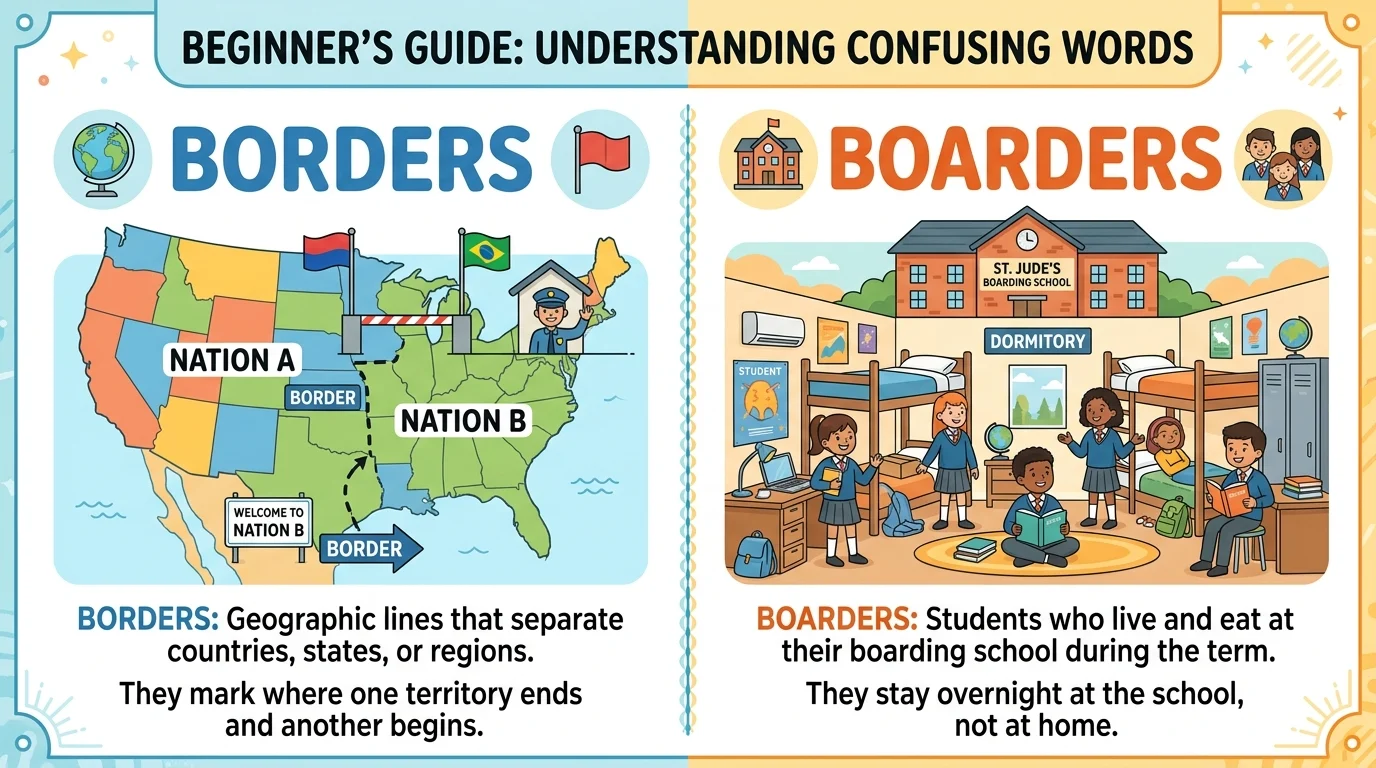
- Borders refers to edges, boundaries, or lines between places
- Boarders refers to people who stay somewhere and receive meals or lodging
- The words sound the same but have different meanings
- Both are correct English words
Simple Origin or Background
The word border comes from old words related to edges and boundaries.
The word boarder comes from the word board, which was once connected to meals and lodging in homes or schools.
Over time:
- border became linked to limits and edges
- boarder became linked to people staying somewhere
Because they sound alike, learners often confuse them.
Clear Explanation of the Difference
What does “borders” mean
Borders is the plural form of border.
It means:
- Edges of something
- Boundaries between countries, regions, or areas
- Decorative edges around objects
Examples:
- The two countries share borders
- She painted flower borders on the wall
- Strong borders protect a nation
This word is connected to limits or edges.
What does “boarders” mean
Boarders is the plural form of boarder.
It means:
- People who live somewhere temporarily and receive meals
- Students staying at boarding schools
- Renters who pay for room and food
Examples:
- The school has many boarders
- The house owner welcomed new boarders
- Boarders ate dinner together
This word refers to people.
Comparison Table
| Feature | Borders | Boarders |
|---|---|---|
| Meaning | Edges or boundaries | People staying somewhere |
| Related to | Countries, lines, decorations | Housing or schools |
| Type | Noun | Noun |
| Example | National borders | Boarding school boarders |
Which One to Use and When
Use borders when:
- Talking about country lines
- Referring to edges or limits
- Describing decorations around something
Examples:
- The map shows borders clearly
- The garden has colorful borders
Use boarders when:
- Talking about people staying somewhere
- Referring to boarding schools or rented lodging
Examples:
- The hostel accepts boarders
- Several boarders arrived today
Common Mistakes People Make
1. Using “boarders” for countries
Wrong:
- The country strengthened its boarders
Correct:
- The country strengthened its borders
2. Using “borders” for students living at school
Wrong:
- The school has many borders
Correct:
- The school has many boarders
3. Forgetting the spelling clue
Remember:
- boarders has “board” inside it
- boarding schools and boarding houses use “board”
4. Mixing meanings because of pronunciation
These words sound the same but mean different things.
Everyday Real Life Examples
In Emails
- The company operates across international borders
- New boarders must register today
In News
- Leaders discussed national borders
- Boarding schools welcomed new boarders
On Social Media
- I love decorative borders in notebooks
- The dormitory has friendly boarders
In Daily Conversations
- Borders can change over time
- The house has three boarders
Short Learning Section for Students and Beginners
1. Remember the simple meanings
- borders = edges or boundaries
- boarders = people staying somewhere
2. Use spelling clues
- boarders contains “board”
- think of boarding school
3. Practice simple examples
- The countries share borders
- The school has many boarders
4. Focus on context
Ask:
- Is it about boundaries
or - Is it about people staying somewhere
FAQ Section
1. What does “borders” mean
It means edges, boundaries, or country lines.
2. What does “boarders” mean
It means people staying somewhere with lodging or meals.
3. Do these words sound the same
Yes, they are homophones.
4. Which word relates to countries
Borders.
5. Which word relates to boarding schools
Boarders.
6. Is “boarders” used for boundaries
No.
7. Why do learners confuse these words
Because they sound exactly alike.
8. How can I remember the difference
Remember:
- borders = boundaries
- boarders = boarding people
Conclusion
The difference between borders and boarders becomes simple once you focus on meaning and spelling.
- Borders refers to edges, limits, or country boundaries
- Boarders refers to people staying somewhere with lodging or meals
A simple memory trick:
- borders = boundaries
- boarders = boarding people
With practice and clear examples, you can easily avoid this common English mistake.