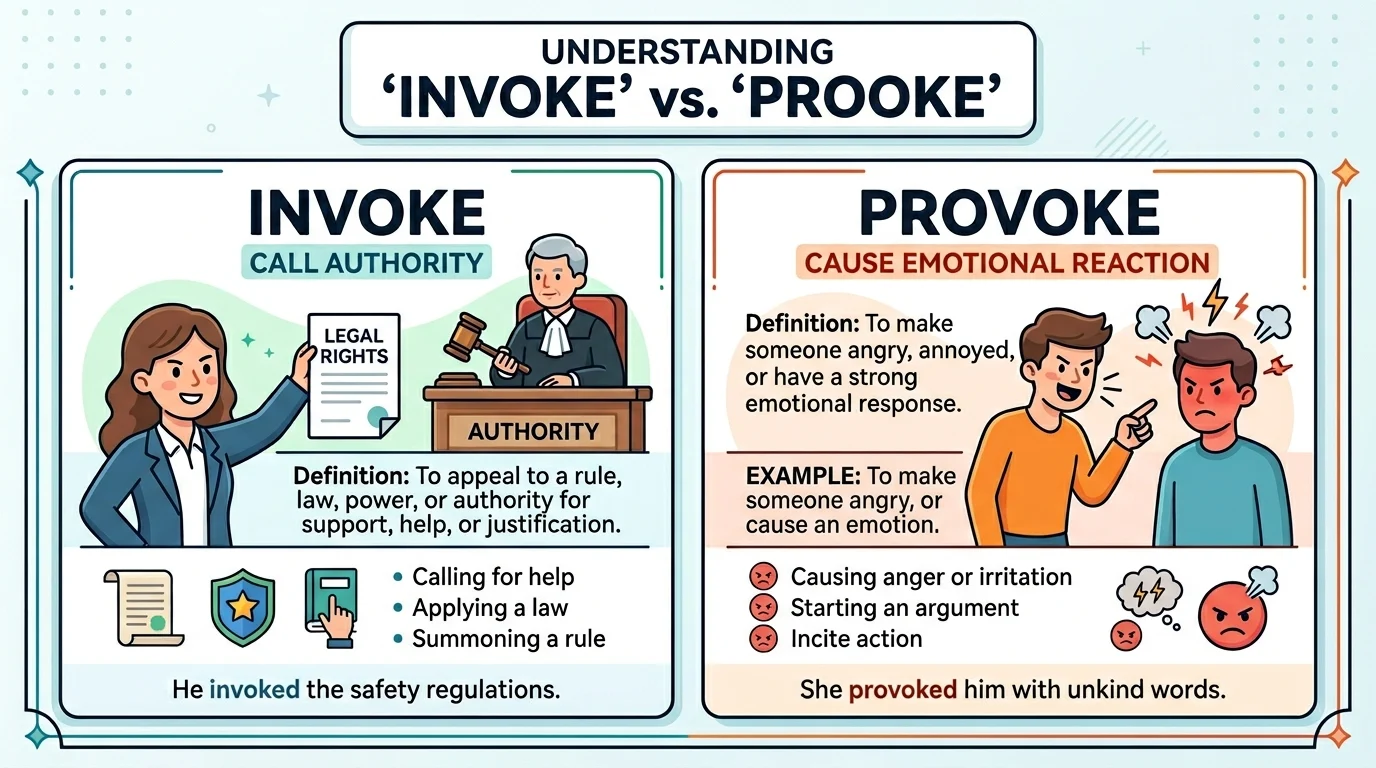
Many English learners confuse invoke and provoke because the words look and sound similar. Both are formal English verbs, and both are connected to causing or bringing something forward in some way.
However, their meanings are very different. One usually means calling upon something for help or support, while the other means causing a reaction, especially anger or emotion.
This guide explains the difference in very simple English with clear examples and beginner friendly tips.
Quick Answer
- Invoke means to call upon or request help, support, or authority
- Provoke means to cause a reaction, especially anger or emotion
- Both are verbs
- Their meanings are completely different
Simple Origin or Background
Both words come from Latin roots.
The word invoke developed from words meaning:
- call upon
- appeal to
The word provoke developed from roots meaning:
- stir up
- trigger
Because the spellings are close, learners sometimes accidentally use the wrong one.
Clear Explanation of the Difference
What does “invoke” mean
Invoke is a verb.
It means:
- To call upon something
- To request help or support
- To use authority, rules, or laws
Examples:
- The lawyer invoked the law
- She invoked her right to remain silent
- The speaker invoked peace and unity
This word is often used in formal situations.
What does “provoke” mean
Provoke is also a verb.
It means:
- To cause a reaction
- To make someone angry, emotional, or upset
- To trigger something
Examples:
- His rude comments provoked anger
- The decision provoked debate
- Do not provoke the dog
This word usually involves reactions or emotions.
Comparison Table
| Feature | Invoke | Provoke |
|---|---|---|
| Meaning | Call upon or request | Cause a reaction |
| Related to | Support, authority, law | Anger, emotion, response |
| Tone | Formal or respectful | Emotional or reactive |
| Example | Invoke a law | Provoke anger |
Which One to Use and When
Use invoke when:
- Referring to laws, rights, or authority
- Asking for support or inspiration
- Speaking formally
Examples:
- He invoked his legal rights
- The speech invoked hope
Use provoke when:
- Talking about reactions or emotions
- Describing anger or conflict
- Explaining what caused a response
Examples:
- The joke provoked laughter
- His actions provoked criticism
Common Mistakes People Make
1. Using “invoke” for anger
Wrong:
- His behavior invoked anger
Better:
- His behavior provoked anger
2. Using “provoke” for legal rights
Wrong:
- She provoked her right to privacy
Correct:
- She invoked her right to privacy
3. Confusing similar spelling
Both words look alike but have different meanings.
4. Forgetting emotional context
Remember:
- provoke often involves reactions or feelings
Everyday Real Life Examples
In Emails
- The company invoked company policy
- His message provoked complaints
In News
- Leaders invoked national unity
- The decision provoked public anger
On Social Media
- That post provoked strong reactions
- The speaker invoked hope and change
In Daily Conversations
- Do not provoke your brother
- She invoked an old family tradition
Short Learning Section for Students and Beginners
1. Learn the simple meanings
- invoke = call upon
- provoke = cause reaction
2. Remember emotional clues
- provoke often involves feelings or anger
3. Practice easy examples
- The lawyer invoked the law
- The comment provoked laughter
4. Use memory tricks
- invoke = invite help or authority
- provoke = produce reaction
FAQ Section
1. What does “invoke” mean
It means to call upon or request support, authority, or help.
2. What does “provoke” mean
It means to cause a reaction or emotion.
3. Which word relates to anger
Provoke.
4. Which word relates to laws or rights
Invoke.
5. Are both words verbs
Yes.
6. Can provoke mean causing laughter
Yes.
Example:
- The joke provoked laughter.
7. Why do learners confuse these words
Because they look and sound similar.
8. How can I remember the difference
Remember:
- invoke = call upon
- provoke = trigger reaction
Conclusion
The difference between invoke and provoke becomes simple once you understand their meanings.
- Invoke means calling upon support, authority, or ideas
- Provoke means causing reactions, emotions, or responses
A simple memory trick:
- invoke = invite support
- provoke = produce reaction
With practice and clear examples, you can use both words correctly and confidently.