Many English learners confuse continuous and continuing because both words come from the verb continue and both describe something that keeps going.
However, these words are not used in exactly the same way. One usually describes something without stopping, while the other often describes something that still goes on over time, even if there are pauses.
This guide explains the difference in very simple English with clear examples and beginner friendly tips.
Quick Answer
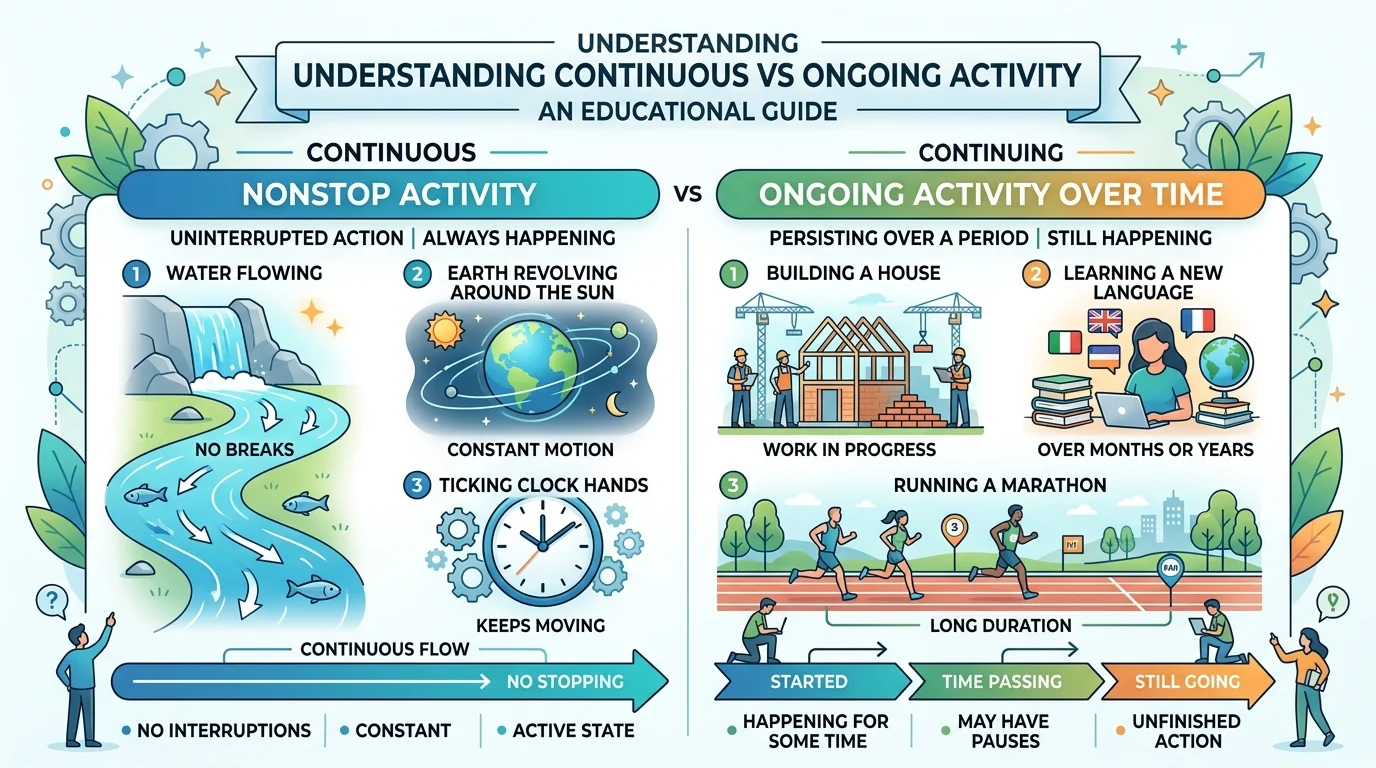
- Continuous means happening without stopping
- Continuing means still happening or carrying on over time
- Continuous often suggests no interruption
- Continuing can include pauses or repeated activity
Simple Origin or Background
Both words come from the verb continue, which means to keep going.
Over time:
- continuous became linked to something constant and uninterrupted
- continuing became linked to ongoing action or repeated continuation
Because both involve ongoing activity, learners often mix them up.
Clear Explanation of the Difference
What does “continuous” mean
Continuous is an adjective.
It means:
- Happening without stopping
- Uninterrupted
- Constant
Examples:
- The machine made a continuous noise
- We had continuous rain all day
- Continuous talking can become tiring
This word strongly suggests no break or pause.
What does “continuing” mean
Continuing is usually an adjective or part of a verb phrase.
It means:
- Still happening
- Ongoing over time
- Carrying on into the future
Examples:
- The company faces continuing problems
- She showed continuing support
- Continuing education is important
This word allows the idea of pauses or repeated action.
Comparison Table
| Feature | Continuous | Continuing |
|---|---|---|
| Meaning | Without stopping | Still happening over time |
| Breaks allowed | Usually no | Sometimes yes |
| Focus | Constant activity | Ongoing activity |
| Example | Continuous rain | Continuing discussion |
Which One to Use and When
Use continuous when:
- Something never stops
- Activity is constant or uninterrupted
Examples:
- Continuous music played all night
- The baby’s continuous crying worried everyone
Use continuing when:
- Something keeps happening over time
- Activity continues into the future
Examples:
- Continuing support helped the project
- The school offers continuing education programs
Common Mistakes People Make
1. Using “continuous” for repeated events
Wrong:
- We had continuous meetings every week
Better:
- We had continuing meetings every week
Weekly meetings have breaks between them.
2. Using “continuing” for nonstop action
Wrong:
- The alarm made a continuing sound for hours
Better:
- The alarm made a continuous sound for hours
3. Forgetting interruption differences
Remember:
- continuous = no stopping
- continuing = ongoing over time
4. Thinking both always mean the same thing
They are similar but not identical.
Everyday Real Life Examples
In Emails
- We appreciate your continuing support
- Continuous system errors caused delays
In News
- The region suffered continuous rainfall
- Officials discussed continuing economic concerns
On Social Media
- My phone has continuous notifications today
- Thank you for your continuing kindness
In Daily Conversations
- The noise was continuous
- They had continuing arguments for months
Short Learning Section for Students and Beginners
1. Learn the simple meanings
- continuous = nonstop
- continuing = ongoing
2. Think about pauses
Ask:
- Does it stop at all
or - Does it continue over time
3. Practice simple examples
- Continuous music
- Continuing lessons
4. Use memory tricks
- continuous = constant
- continuing = still going
FAQ Section
1. What does “continuous” mean
It means happening without stopping.
2. What does “continuing” mean
It means still happening over time.
3. Which word suggests no interruption
Continuous.
4. Can “continuing” include pauses
Yes.
5. Is continuous rain nonstop rain
Usually yes.
6. What is continuing education
Education programs that continue over time.
7. Why do learners confuse these words
Because both come from the word “continue.”
8. How can I remember the difference
Remember:
- continuous = nonstop
- continuing = ongoing
Conclusion
The difference between continuous and continuing becomes simple once you focus on interruptions and time.
- Continuous means something happens without stopping
- Continuing means something still goes on over time
A simple memory trick:
- continuous = constant
- continuing = still happening
With practice and clear examples, you can use both words correctly and naturally.