Many English learners get confused between indecisive and undecisive because both words seem to have the same meaning. Since English often uses prefixes like “in” and “un,” people naturally think both forms should be correct.
However, only one word is commonly accepted in standard English. The other is considered incorrect or very uncommon.
This guide explains the difference in very simple English so students and beginners can understand it easily.
Quick Answer
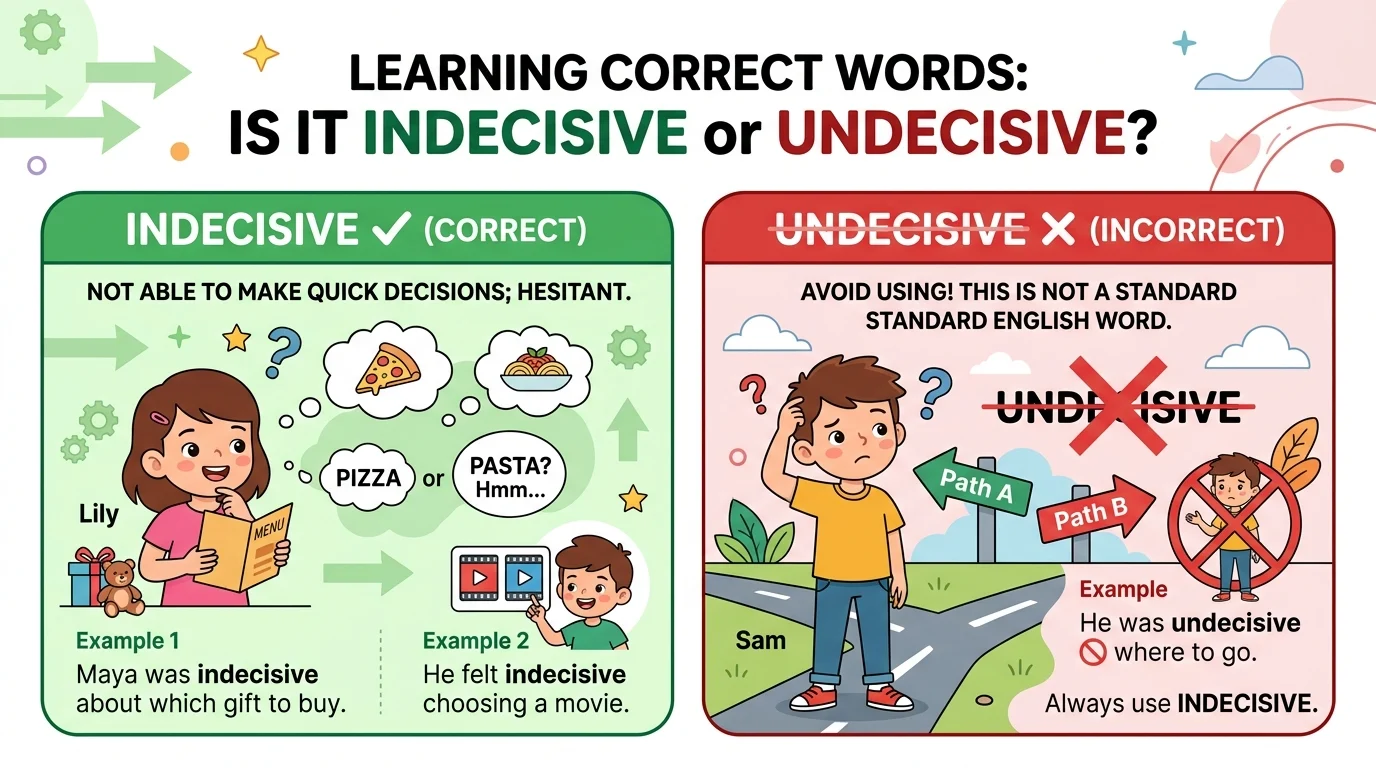
- Indecisive is the correct and common English word
- Undecisive is generally considered incorrect or nonstandard
- Use indecisive to describe someone who cannot make decisions easily
- Avoid using undecisive in formal or everyday writing
Simple Origin or Background
The word indecisive comes from Latin roots connected to decision making. It has been part of English for a long time and is widely accepted in speaking and writing.
The form undecisive appeared later because people thought it should follow the same pattern as words like:
- unhappy
- unclear
- unfair
Even though it sounds logical, English does not commonly accept undecisive as the standard form.
Clear Explanation of the Difference
What does “indecisive” mean
Indecisive is an adjective.
It means:
- Unable to make decisions easily
- Unsure about choices
- Changing opinions often
Examples:
- She is very indecisive about buying clothes
- He felt indecisive before choosing a career
- Indecisive leaders can create confusion
This is the correct and widely used word.
What does “undecisive” mean
Undecisive is generally considered incorrect or nonstandard in modern English.
Some people use it by mistake because:
- They think “un” works with every adjective
- It sounds similar to correct English patterns
However, most dictionaries and grammar guides recommend using indecisive instead.
Comparison Table
| Feature | Indecisive | Undecisive |
|---|---|---|
| Is it standard English | Yes | Usually no |
| Meaning | Unable to decide easily | Same intended meaning |
| Common usage | Very common | Rare or incorrect |
| Recommended | Yes | No |
| Example | She is indecisive | Nonstandard usage |
Which One to Use and When
Use indecisive when:
- Talking about difficulty making decisions
- Describing uncertain behavior
Examples:
- I am indecisive about dinner plans
- He seems indecisive today
- Her indecisive nature caused delays
Avoid undecisive in:
- School writing
- Emails
- Professional communication
- Daily formal English
Common Mistakes People Make
1. Thinking both words are equally correct
Wrong idea:
- undecisive and indecisive are the same in standard English
Correct:
- indecisive is the accepted form
2. Using “un” automatically
English does not always follow one rule for every adjective.
Examples:
- incorrect
- impossible
- indecisive
3. Copying incorrect online writing
Some websites or social posts use “undecisive,” which confuses learners.
4. Guessing spelling from sound
The words sound believable, so learners may not notice the mistake.
Everyday Real Life Examples
In Emails
- The client seemed indecisive about the proposal
- She is indecisive when choosing colors
In News
- Analysts described the leader as indecisive
- Indecisive actions affected the project
On Social Media
- I am so indecisive about what to watch tonight
- Being indecisive makes shopping difficult
In Daily Conversations
- He is very indecisive
- Stop being indecisive and choose something
Short Learning Section for Students and Beginners
1. Remember the correct form
Always use:
- indecisive
2. Think of “decision”
The word comes from:
- decision
- decisive
- indecisive
3. Avoid guessing prefixes
Not every adjective uses “un.”
4. Practice simple examples
- She is indecisive
- I feel indecisive today
FAQ Section
1. Is “undecisive” a real word
It exists in some usage, but it is generally considered nonstandard or incorrect.
2. Which word should I use
Use indecisive.
3. What does “indecisive” mean
It means unable to make decisions easily.
4. Why do people say “undecisive”
Because it sounds logical with the prefix “un.”
5. Is “undecisive” acceptable in formal writing
No, it is best avoided.
6. Can “indecisive” describe people
Yes.
Example:
- He is indecisive about plans.
7. Is “indecisive” common in English
Yes, it is widely used.
8. How can I remember the correct word
Remember:
- decisive
- indecisive
Conclusion
The difference between indecisive and undecisive is simple.
- Indecisive is the correct and accepted English word
- Undecisive is usually considered incorrect or nonstandard
Whenever you talk about someone struggling to make decisions, always choose indecisive.
With practice and careful spelling, this confusion becomes very easy to avoid.